






Definition & Meaning
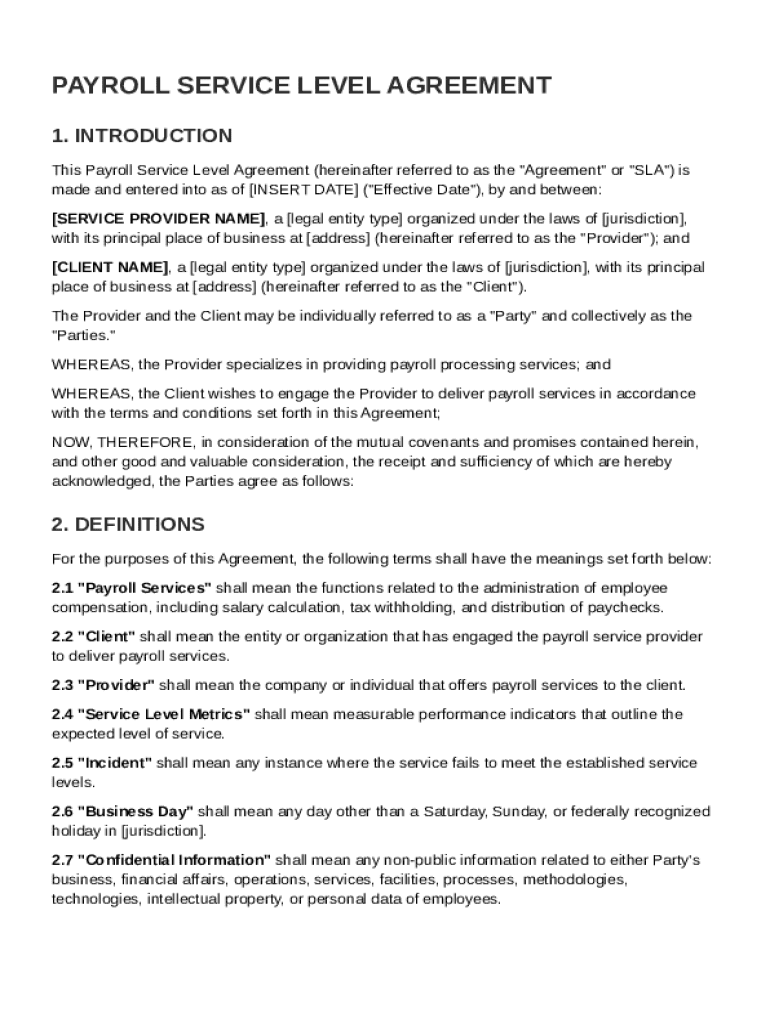
The Payroll Service Level Agreement (SLA) Template outlines the formal agreement between a payroll service provider and a client. This document is crucial for defining the terms under which payroll processing services are delivered, and it establishes responsibilities, performance metrics, and expectations. By clearly specifying these elements, the SLA serves as a guide to ensure that both parties understand their obligations and the standards for service. This agreement ensures that payroll tasks such as salary processing, deductions, and tax filings are managed efficiently and accurately.
Standard Components
- Scope of Services: Details the specific payroll tasks the provider will handle.
- Performance Metrics: Includes benchmarks for service delivery time and error rates.
- Responsibilities: Outlines duties of both the client and provider.
Key Elements of the Payroll Service Level Agreement Template
The template is structured to cover all essential components needed for a comprehensive agreement. It begins by establishing the scope of services, which includes all payroll functions the service provider agrees to perform. Performance metrics are defined to measure the quality and timeliness of services, ensuring accountability. The template also specifies the responsibilities of both parties, including data provision by the client and service execution by the provider.
Important Sections
- Incident Management Procedures: Establishes protocols for addressing and resolving service issues.
- Compliance with Legal Requirements: Ensures adherence to relevant laws and regulations.
- Confidentiality Clauses: Protects sensitive employee and company data from unauthorized access.
How to Use the Payroll Service Level Agreement Template
This template provides a structured format that can be tailored to fit specific organizational needs. Begin by downloading the template and reviewing each section to ensure all necessary details are included. Customization is possible without altering the template's fundamental structure, which allows for specific terms to be set according to the client's and provider's needs. It is advisable for both parties to review the completed document together to guarantee mutual understanding and agreement.
Customization Tips
- Adjust Scope of Services: Modify to reflect additional services or exclude irrelevant ones.
- Set Realistic Performance Metrics: Ensure benchmarks are achievable and measurable.
- Define Clear Responsibilities: Clearly outline tasks each party is responsible for.
Steps to Complete the Payroll Service Level Agreement Template
Completing the template requires attention to detail to ensure accuracy and legal compliance. Begin by filling in the basic information, such as company names and contact details. Next, specify the scope of services to clearly define all tasks included in the agreement. Set performance metrics to establish measurable standards for service delivery. Conclude by including terms for data protection and understanding legal implications.
Step-by-Step Guide
- Input Company Details: Fill in the legal names and addresses of both parties.
- Detail Services Provided: Clearly list all payroll services covered under the agreement.
- Set Performance Benchmarks: Define metrics for evaluating service quality and timeliness.
- Incorporate Legal and Compliance Terms: Ensure adherence to relevant laws is explicitly covered.
Legal Use of the Payroll Service Level Agreement Template
The template should be used in accordance with legal standards to ensure that it constitutes a binding agreement. It contains necessary legal provisions such as compliance with state and federal regulations, which are critical to maintaining the integrity of the payroll processes. Before finalizing the agreement, it is crucial to have it reviewed by a legal professional or a team familiar with employment law to ensure full compliance and protection against potential disputes.
Legal Considerations
- Adherence to Labor Laws: Ensure that terms comply with local employment regulations.
- Confidentiality Requirements: Secure agreements from both parties to protect sensitive data.
- Dispute Resolution: Include terms for resolving disagreements or breaches of contract.
Examples of Using the Payroll Service Level Agreement Template
This agreement is commonly used by businesses of varying sizes that outsource their payroll services to third-party providers. For instance, a small business may use this SLA to set clear terms with their provider regarding the processing of employee salaries and tax filings. Large corporations might rely on such agreements for managing complex payroll structures across different states, ensuring each branch complies with local regulations.
Practical Scenarios
- Small Business: Uses SLA for regular payroll and tax filing services for a handful of employees.
- Corporation: Requires an SLA to manage payroll across multiple departments and jurisdictions.
- Non-Profit Organization: Ensures payroll donations and stipends are handled correctly and timely.
Who Typically Uses the Payroll Service Level Agreement Template
The template is primarily used by businesses and payroll service providers looking to formalize their working relationship. While any business that outsources payroll can benefit, it is especially useful for firms undergoing rapid growth or those entering unfamiliar markets. Similarly, companies with limited internal HR capabilities often use these agreements to secure consistent and reliable payroll management, allowing them to focus on their primary business operations.


Common Users
- Small to Medium Enterprises (SMEs): Benefit from formalizing payroll processes amidst growth.
- Large Corporations: Use SLAs to ensure standardized payroll operations across various branches.
- Start-ups: Rely on these agreements to secure dependable payroll services as they scale.

Important Terms Related to Payroll Service Level Agreement Template
Several key terms are intrinsic to understanding and executing a payroll SLA efficiently. Terms such as ‘service scope,’ ‘performance metrics,’ and ‘incident management’ are typically defined within the agreement to provide a clear framework. Understanding these terms ensures both parties are aligned in expectations and can act quickly and efficiently by the guidelines set forth.
Essential Definitions
- Service Scope: The range of payroll services to be delivered.
- Performance Metrics: Standards set for assessing service quality and speed.
- Incident Management: Procedures for handling errors or service disruptions efficiently.