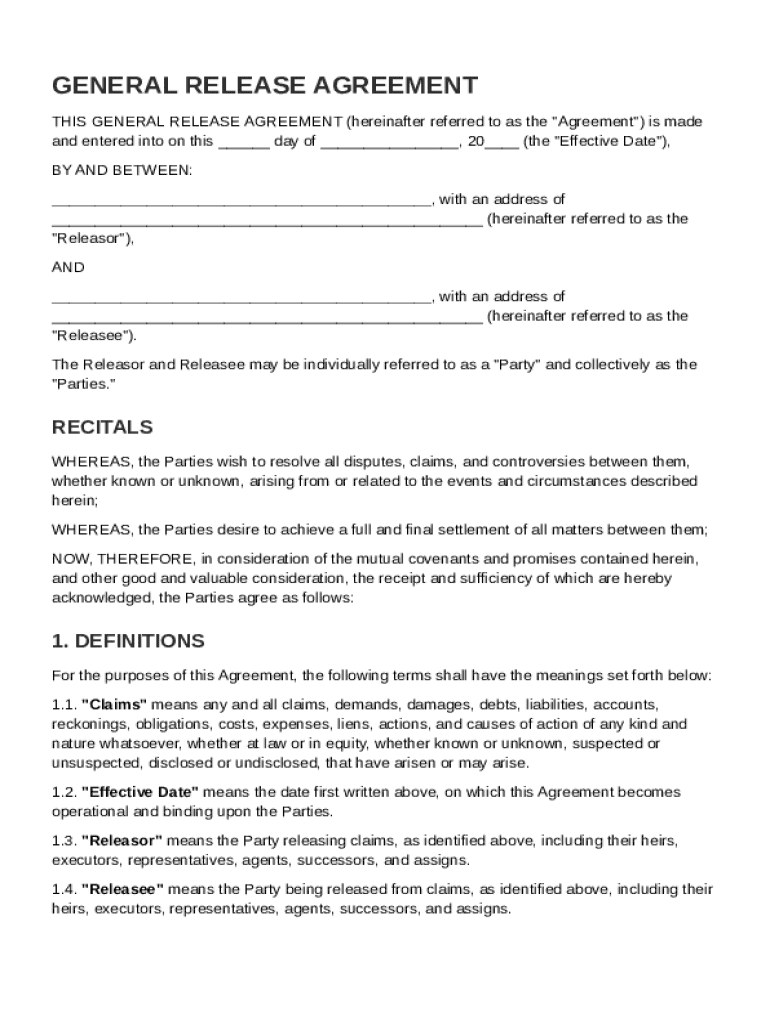







Definition and Meaning
A General Release Agreement is a legally binding document that resolves disputes between two parties, often referred to as the Releasor and the Releasee. This agreement includes the release of all known and unknown claims, providing both parties with peace of mind and closure. By definition, the Releasor agrees not to pursue any further legal action against the Releasee concerning past grievances or damages. This document is essential in various contexts, including business, employment, and personal situations, where conflicts need a formal resolution.
How to Use the General Release Agreement Template
To effectively use the General Release Agreement Template, begin by identifying all relevant parties, ensuring that the names of the Releasor and Releasee are correctly entered. It's crucial to specify the claims and disputes that are being released clearly. The template will guide you through sections outlining representations and warranties from both parties, which confirm their authority to enter into the agreement and that no claims are pending. This structured approach allows users to ensure completeness and accuracy, ultimately avoiding potential future disputes.
Steps to Complete the General Release Agreement Template
-
Download the Template: Access the template from a trusted source and save it to your device.
-
Fill Out Party Information: Enter the names and contact details of both the Releasor and Releasee.
-
Outline Claims and Disputes: Clearly describe the disputes and claims being released.
-
Review Representations and Warranties: Confirm that all parties have the authority to execute the agreement and verify no active claims exist.
-
Include Indemnification Clauses: Address indemnification provisions to protect against any losses arising from the claims.
-
Specify Governing Law: Detail the jurisdiction under which potential disputes related to the document will be resolved.
-
Finalize with Signatures: Both parties must sign the document to make it legally binding.
Key Elements of the General Release Agreement Template
- Parties Involved: Identifies the Releasor and Releasee.
- Scope of Release: Clarifies the types of claims being waived.
- Representations and Warranties: Ensures both parties have the authority and legal capacity to enter the agreement.
- Indemnification Clause: Protects parties from liabilities related to released claims.
- Governing Law: Specifies which state's laws will govern the agreement.
- Severability: Ensures that if one part of the agreement is invalid, the remainder still holds.
Important Terms Related to General Release Agreement Template
Understanding the terms within the General Release Agreement is critical. Common terms include:
- Releasor: The party waiving their right to future claims.
- Releasee: The party being protected from future claims.
- Claims: Legal demands or causes of action that one party may have against another.
- Indemnification: Protection against future claims or damages.
- Severability: If any provision is deemed unenforceable, the rest of the document remains intact.
Legal Use of the General Release Agreement Template
This template serves to prevent future litigation by clearly outlining waived claims. It is often utilized in employment terminations, settlement negotiations, and business dissolutions. The agreement must comply with applicable laws, such as ensuring it is executed voluntarily and with full understanding. Failure to comply with these legal standards can render the agreement void.
State-Specific Rules for the General Release Agreement Template
State laws might affect how these agreements are enforced, with differences in statutes regarding the scope of claims and time frames for addressing disputes. It's vital to consult legal counsel familiar with the state-specific nuances to customize the template accordingly. For instance, some states require additional disclosures or specific language to preserve the enforceability of releases concerning employment claims.
Who Typically Uses the General Release Agreement Template
The template is widely used by:
- Businesses: To settle disputes with former employees or partners.
- Individuals: In personal injury settlements to ensure no further claims.
- Legal Professionals: To create agreements that resolve client disputes efficiently.
- Corporations: During mergers or acquisitions to manage potential liabilities.
Being familiar with these diverse applications allows users to adapt the template to meet specific needs effectively, ensuring a comprehensive resolution of conflicts.