






Definition & Meaning
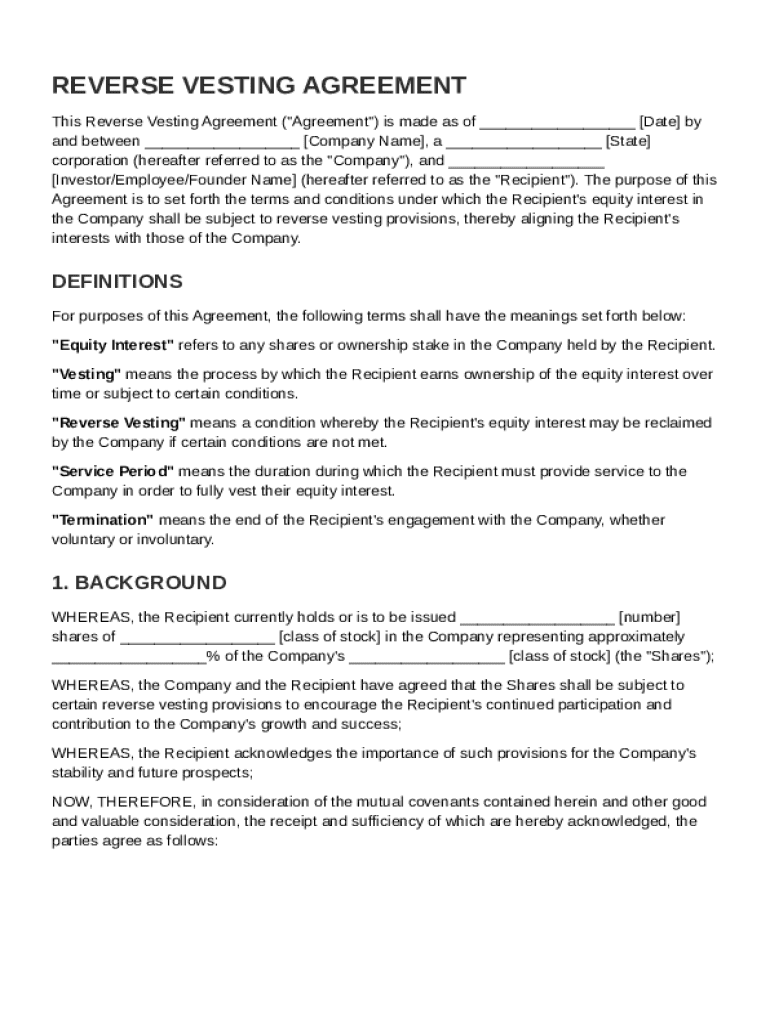
A Reverse Vesting Agreement Template is a legal document commonly used in startup companies to manage equity allocation among founders and key employees. It defines the conditions under which shares that have been issued to the Recipient are subjected to vesting restrictions. The core of this agreement focuses on ensuring that the equity or shares are earned over a period, often contingent upon the Recipient's continued involvement with the company. This is particularly valuable to prevent scenarios where a shareholder leaves the company prematurely but retains significant stock without contributing to the company's growth.
Reverse vesting essentially obliges the Recipient to gradually earn their shares over time, meaning unvested shares can be reclaimed by the company if specific conditions are not met. It is a safeguard for businesses, ensuring the Recipient remains committed to the company's success, aligning their interests with those of other stakeholders. The mechanism is vital in preserving the company’s equity structure and motivating employee retention.
How to Use the Reverse Vesting Agreement Template
Using a Reverse Vesting Agreement Template involves several structured steps to ensure the arrangement meets both the company's and the Recipient's needs. Begin by reviewing the template to understand its provisions thoroughly. It's crucial to customize the document, ensuring the vesting schedule is explicitly outlined and tailored to your company's specific timeline and milestones.
-
Customize Vesting Schedule:
- Define the timeline over which shares will vest, typically ranging from one to four years.
- Decide on a cliff period, a span during which no shares are vested, often set at one year.
- Specify the percentage of shares to vest at each interval post-cliff period.
-
Include Key Definitions:
- Clearly define terms such as 'Equity Interest', 'Vesting', and 'Reverse Vesting'.
- Establish the vesting triggers and conditions explicitly.
-
Outline Termination Scenarios:
- Detail the conditions under which Repurchase Rights are activated upon termination.
- Specify the differentiation between voluntary resignation and termination for cause.
By tailoring these elements to suit your business, you can ensure that the agreement effectively serves its intended purpose while providing clarity to all parties involved.
Key Elements of the Reverse Vesting Agreement Template
A comprehensive Reverse Vesting Agreement Template includes several critical components to ensure its enforceability and utility:
- Vesting Schedule: Arguably the most critical element, stipulating the phased approach to share acquisition by the Recipient.
- Repurchase Rights: Clauses allowing the company to buy back unvested shares upon certain conditions such as termination of employment.
- Restrictions on Transfers: Limitations on the Recipient’s ability to transfer or sell unvested shares.
- Termination Events: Specifies what happens to unvested shares in various termination scenarios.
- Defining Relationship: Articulates the relationship between the company and the Recipient and the expectation of continued engagement.
These components ensure the agreement clearly communicates expectations and legal obligations, thus preventing potential disputes.
Steps to Complete the Reverse Vesting Agreement Template
Completing this template effectively requires several systematic steps:
-
Initial Review and Customization:
- Assess the pre-defined terms and adjust them according to the company’s specific needs.
- Adapt the vesting schedule to reflect company policy or industry standards.
-
Legal Consultation:
- Engage with legal experts to review the drafted document, mitigating potential legal challenges.
- Incorporate any legal recommendations to fortify the agreement.
-
Recipient Discussion:
- Have an open discussion with the Recipient about the agreement’s terms.
- Ensure mutual understanding and acceptance prior to final signing.
-
Finalization and Execution:
- Finalize the document by having authorized representatives of the company and the Recipient sign.
- Retain copies for both parties and compliant record-keeping.
This structured approach helps in safeguarding each stakeholder's interests while adhering to legal requisites.
Important Terms Related to the Reverse Vesting Agreement Template
Understanding the terminology is crucial for interpreting and enforcing the agreement:
- Vesting: The process by which the Recipient earns shares over time.
- Cliff Period: An initial period during which no shares vest, often to ensure initial commitment from the Recipient.
- Equity Interest: The stake or share in the company that is subject to the vesting schedule.
- Repurchase Right: The company's right to reclaim unvested shares under specified conditions.
- Termination for Cause: Conditions under which the Recipient's association with the company is ended due to specific actions or failures.
These terms anchor the agreement and provide a clear framework for both enforcement and understanding among involved parties.
Legal Use of the Reverse Vesting Agreement Template
The legal enforceability of a Reverse Vesting Agreement Template hinges on compliance with state and federal laws concerning equity distribution and employment agreements. It is essential for the template to be crafted within the purview of the law, ensuring:
- Clarity and Fairness: Terms must be expressed in clear language, understood by all parties.
- Compliance with Securities Regulations: Meeting requirements spelled out by the Securities and Exchange Commission.
- Review for Legal Precedents: Incorporation of past legal precedents to bolster enforceability.
- Governing Laws: Specification of the laws under which the agreement is governed, typically abiding by the state where the company is headquartered.
These legal considerations fortify the agreement’s binding nature, reducing potential litigation risk.
Who Typically Uses the Reverse Vesting Agreement Template
This template is extensively utilized in startup environments where equitable ownership plays a significant role in attracting and retaining talent. Typical users include:
- Founders: To ensure retention and proper equity distribution.
- Key Early Employees: To align interests with company growth objectives.
- Investors: Often require agreements to protect their interests by ensuring equity is deserved rather than granted.
Using this agreement, companies can incentivize contributions while safeguarding against premature equity dispersion.


State-Specific Rules for the Reverse Vesting Agreement Template
While the underlying principles of a Reverse Vesting Agreement are widely accepted, state-specific rules can influence its application:
- Variations in Contract Law: Each state may have nuances in contract enforceability and definitions.
- Employment and Labor Laws: Compliance with state-specific labor laws, especially regarding termination and repurchase conditions.
- Equity Distribution Regulations: Some states may have additional securities regulations impacting how shares can be vested.
Understanding these state-specific elements is crucial for drafting a legally sound agreement, ensuring that all operations comply with local statutes.