




01. Edit your form online
Type text, add images, blackout confidential details, add comments, highlights and more.

Type text, add images, blackout confidential details, add comments, highlights and more.

Draw your signature, type it, upload its image, or use your mobile device as a signature pad.

Send it via email, link, or fax. You can also download it, export it or print it out.
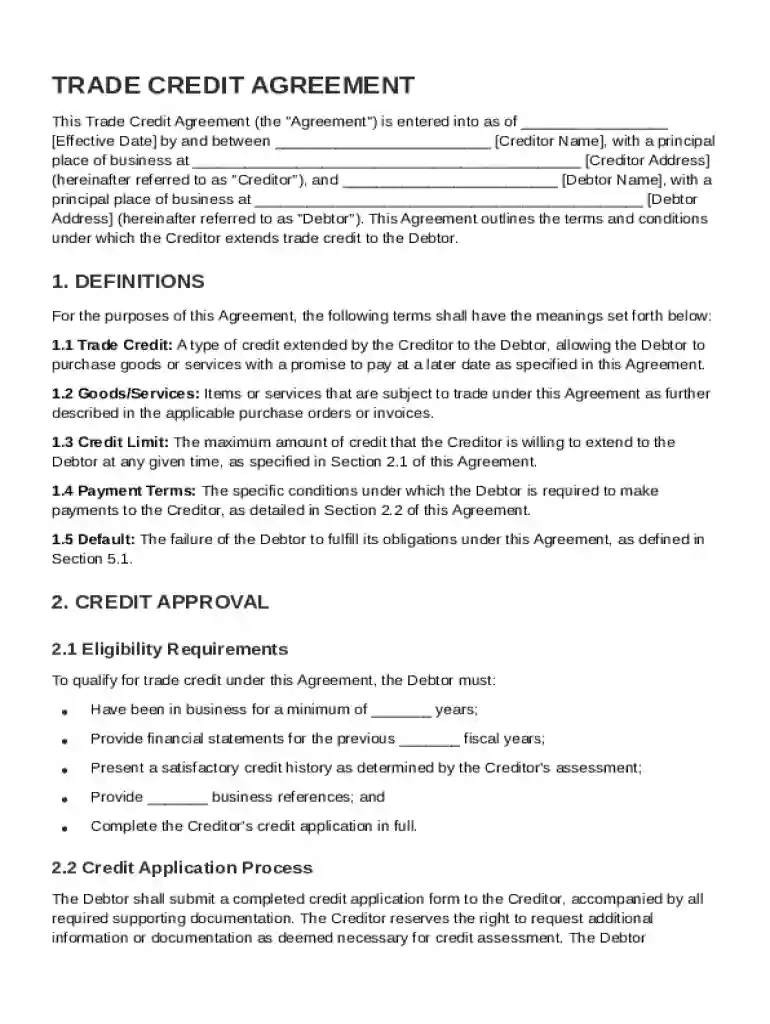
A Trade Credit Agreement is a legally binding document that outlines the terms and conditions under which a creditor extends trade credit to a debtor. This arrangement allows the debtor to purchase goods or services with deferred payment, meaning they are not required to pay the full amount at the time of purchase. The agreement serves as a crucial part of business transactions, particularly for companies that need to manage cash flow effectively while maintaining a steady supply of inventory or services. Key components of the agreement include definitions of important terms, eligibility for credit, and conditions for repayment.
Understanding specific terms within a Trade Credit Agreement is crucial for both parties to ensure clarity and compliance with the agreement. Some of these terms define the scope and execution of the agreement, outlining both rights and obligations.
A clear understanding of these terms helps prevent misunderstandings and disputes, ensuring that both parties are aligned regarding expectations and responsibilities.
The Trade Credit Agreement Template is structured to cover every necessary detail for secure and efficient transactions. This template serves as a comprehensive guide to building a legally compliant agreement.
These elements ensure that the agreement is complete and enforceable, reducing the risk of legal challenges and facilitating smoother transactions.
Completing a Trade Credit Agreement Template involves a series of systematic steps to ensure accuracy and compliance. Each step demands careful attention to detail to cover all necessary legal and financial aspects.
During the process, challenges may include aligning terms with legal standards and ensuring that both parties fully understand the clauses.
The legal framework of a Trade Credit Agreement Template is designed to comply with United States law, making it a reliable document for business transactions. Ensuring legal compliance is critical in preventing disputes and fostering trust between parties.
Legal compliance not only protects both parties but also streamlines the transaction process, reducing potential legal costs and disruptions.
Various business entities utilize Trade Credit Agreement Templates to facilitate smoother credit transactions. Understanding the typical users of these agreements can illuminate the form’s utility.



Using a trade credit agreement allows these entities to improve cash flow, build credit histories, and establish stronger supplier relationships.
While the core structure of a Trade Credit Agreement may remain consistent, state-specific regulations can influence particular sections. Understanding these differences is crucial for compliance.
Businesses must verify state-specific rules when drafting their agreements to avoid potential legal pitfalls, ensuring that terms comply with both state and federal guidelines.
There are several advantages to using a Trade Credit Agreement Template, particularly when it comes to standardizing business processes efficiently. These templates are designed to provide convenience while ensuring comprehensive coverage of contractual terms.
Adopting such templates helps businesses to execute transactions more swiftly and with greater confidence, enhancing overall operational efficiency.
At DocHub, your data security is our priority. We follow HIPAA, SOC2, GDPR, and other standards, so you can work on your documents with confidence.





by E BREZA TRADE CREDIT AND ORGANIZATIONAL FORM: We study how restrictions to the set of feasible contracts affect buyer-supplier relationships
Nov 1, 2023 These terms supplement and form part of your Agreement with Adyen for payment processing and related services.


