
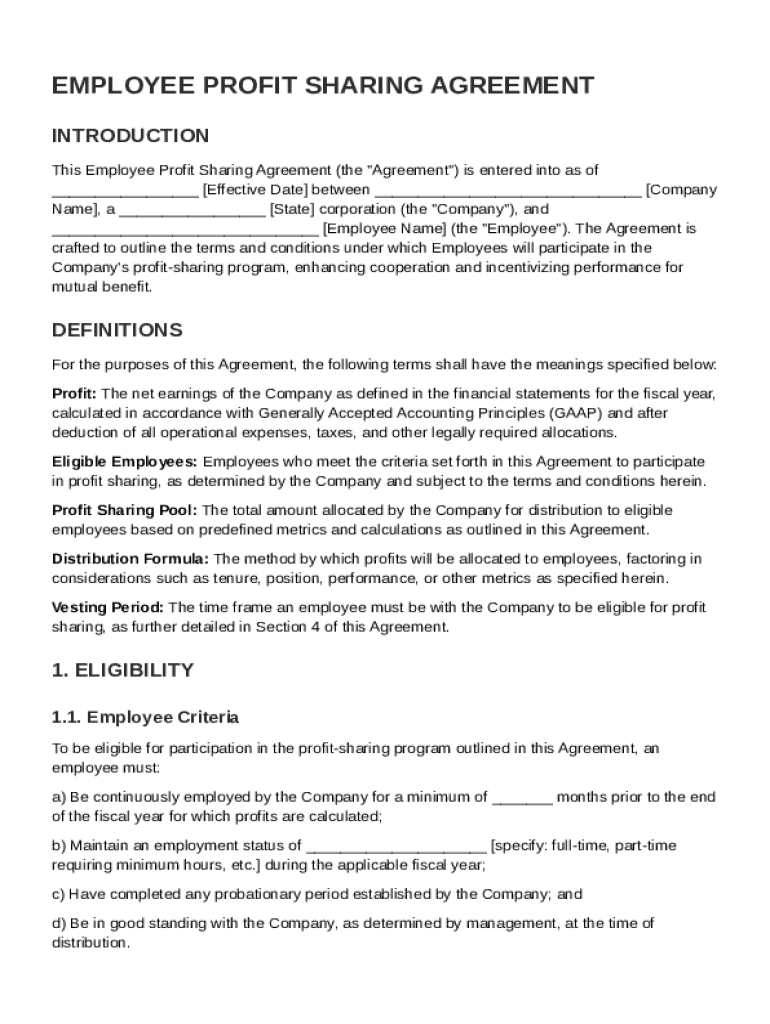







Definition & Meaning
The Employee Profit Sharing Agreement Template is a formal document designed to outline the terms and conditions regarding an employee’s participation in a company's profit-sharing program. This template serves as a framework to define important concepts like 'Profit', 'Eligible Employees', and 'Profit Sharing Pool'. It not only specifies how profits are to be shared among employees but also aims to incentivize performance by aligning employees' interests with the financial goals of the company. By employing this template, companies ensure clarity and standardization in communicating the responsibilities and benefits associated with profit-sharing schemes.
Key Elements of the Employee Profit Sharing Agreement Template
A comprehensive Employee Profit Sharing Agreement Template consists of several vital components:
- Eligibility Criteria: Outlines who qualifies to participate in the profit-sharing program, often based on tenure, performance, or role within the company.
- Profit Calculation Method: Describes the formula or method used to calculate the profit-sharing pool.
- Distribution Formula: Details how profits will be distributed among eligible employees, such as based on salary, position, or other performance metrics.
- Vesting Schedules: Explains the timeline over which employees earn the right to their shares, which may involve a gradual increase over several years.
- Tax Implications: Provides an overview of how profit shares are treated for tax purposes, both for the company and the employees.
- Dispute Resolution Processes: Specifies the procedures for resolving disagreements related to the profit-sharing agreement.
Steps to Complete the Employee Profit Sharing Agreement Template
To efficiently fill out the Employee Profit Sharing Agreement Template, follow these steps:
- Identify Eligible Employees: Determine which employees meet the criteria for inclusion in the profit-sharing program.
- Define Profit Calculation Method: Clearly articulate how profits are calculated and ensure this is accurately reflected in the template.
- Specify Distribution Details: Enter the distribution formula that will govern the sharing of profits among participating employees.
- Outline Vesting Requirements: Detail how and when employees will gain access to their profit shares through vesting schedules.
- Include Tax Information: Incorporate necessary information regarding tax responsibilities associated with profit sharing.
- Finalize and Review: Ensure all relevant sections of the template are filled out, and conduct a thorough review to maintain accuracy.
Legal Use of the Employee Profit Sharing Agreement Template
The legal validity of an Employee Profit Sharing Agreement lies in its adherence to applicable employment laws and regulations within the United States. Companies must ensure compliance with the Employee Retirement Income Security Act (ERISA) where applicable and should consult with legal professionals to confirm that the agreement aligns with federal and state laws. This includes maintaining transparency, fairness, and legality in its terms to protect both the organization and its employees.
State-Specific Rules for the Employee Profit Sharing Agreement Template
Profit-sharing agreements might be subject to nuances depending on state legislation. While the federal framework provides a general guideline, states may have specific regulations influencing employment contracts, taxation, or profit distribution. For instance, California's labor laws might impose additional stipulations on what constitutes an eligible employee, while New York might have unique reporting requirements. Engaging legal experts familiar with state-specific laws ensures that the agreement remains compliant and enforceable across all jurisdictions where the company operates.
Important Terms Related to Employee Profit Sharing Agreement Template
Understanding key terms within the Employee Profit Sharing Agreement Template is crucial:
- Profit Sharing Pool: The sum of money allocated for distribution among eligible employees, derived from company profits.
- Eligible Employees: Employees who meet predefined criteria set by the employer for participation in the profit-sharing plan.
- Vesting: The process by which employees earn the rights to receive their profit shares over a period of time.
- Allocation Formula: The method used to determine each employee’s share of the profit-sharing pool.
- Tax Treatment: Tax considerations and obligations for profit distribution, which can affect both legal compliance and employee outcomes.
Eligibility Criteria
Eligibility criteria define who can participate in the profit-sharing program and often include factors such as:
- Length of Service: Employees may need to work a specified number of years or months to qualify.
- Job Position or Grade Level: Certain positions may be eligible based on their impact or contribution to the company.
- Performance Metrics: Employees must meet or exceed specific performance targets to be considered eligible.
By setting clear eligibility criteria, the agreement helps in managing expectations and ensuring fairness in the implementation of the profit-sharing plan.


Application Process & Approval Time
Implementing a profit-sharing plan requires a structured application and approval process:
- Proposal Development: The initial step involves creating a proposal detailing the plan's scope, eligibility, and distribution strategies.
- Board Approval: Obtain necessary approvals from the company’s board or decision-making body.
- Employee Notification: Communicate the plan to employees, outlining their roles within the program.
- Enrollment: Eligible employees may have to formally enroll or agree to participate.
- Implementation: Once approved, the plan is put into action following the outlined steps and procedures.
Approval times can vary based on the complexity of the plan and organizational protocols.
IRS Guidelines
The Internal Revenue Service (IRS) provides specific guidelines regarding profit-sharing plans:
- Tax Deductibility: Contributions to profit-sharing plans are generally tax-deductible for the company, reducing its taxable income.
- Contribution Limits: The IRS imposes limits on the amount that can be contributed to a profit-sharing plan, which must be adhered to.
- Reporting Requirements: Employers must file the appropriate forms with the IRS to report plan contributions and allocations.
Adhering to these guidelines is critical to maintain the legitimacy and benefits of the profit-sharing plan.




