




01. Edit your form online
Type text, add images, blackout confidential details, add comments, highlights and more.

Type text, add images, blackout confidential details, add comments, highlights and more.

Draw your signature, type it, upload its image, or use your mobile device as a signature pad.

Send it via email, link, or fax. You can also download it, export it or print it out.
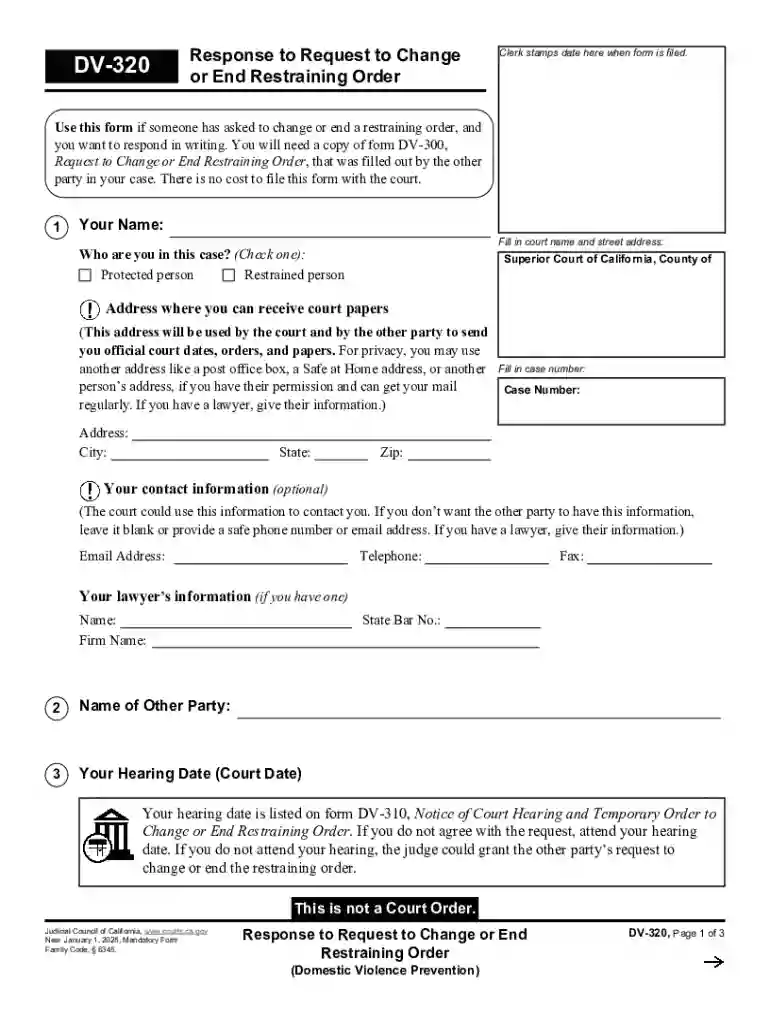
The DV-320 form is a critical document used in California for individuals who need to respond to a request to change or end a restraining order within the context of domestic violence prevention. This form serves as a formal response mechanism where the respondent can affirm, contest, or provide a nuanced perspective on the request made by the opposing party. It allows respondents to communicate their position clearly, submit relevant reasons, and prepare for any legal proceedings that may follow.
Identifying Information: Start by filling out your personal information, including your full name, contact details, and case number. This section ensures the form is appropriately matched to your case.
Response to Request: Indicate whether you agree or disagree with the request to change or end the restraining order. Provide detailed explanations or objections that support your stance.
Supporting Evidence: Attach any relevant documents or evidence that strengthen your position. This could include text messages, emails, or testimonies that validate your response.
Filing Instructions: Follow the included guidelines for submitting the form to the appropriate family court, ensuring all parts are accurately completed to avoid delays.
The DV-320 form holds significant legal importance as it directly influences the court's decision regarding modifications to a restraining order. Its use is dictated by state laws, particularly in domestic violence prevention cases. The form acts as a partial determinant in maintaining or altering existing judicial protection measures, highlighting the importance of accuracy and clarity in its completion.
The DV-320 is generally completed by respondents in a domestic violence restraining order case in California who have been notified of a request to change or end the order. This includes individuals who wish to maintain the protection provided by the original restraining order or need to contest proposed changes that they believe may compromise their safety or rights.
The DV-320 form is available through several channels:
Online Access: It can be downloaded from the California Courts’ official website or obtained via legal aid services offering document access.
Court Clerks: Local family court clerks often provide copies upon request for those who may prefer obtaining the form in person.
Legal Aid Organizations: Many non-profit legal services provide the form as part of their assistance to individuals facing domestic violence issues.
While the DV-320 form is specific to California, it reflects local legal protocols regarding domestic violence cases. California courts require strict adherence to filing deadlines and precise procedural compliance to ensure that responses are considered. Respondents should be aware of these state-specific rules to avoid procedural dismissals or delays.
Response Timeline: Typically, there is a 20-day period to file a response after receiving notice of the restraining order modification request.
Court Dates: The form indicates deadlines for subsequent hearings, crucial for planning and case preparation.
A common scenario is when a restraining order originally set for one year is challenged by the person it protects. The DV-320 allows the respondent to file objections, illustrating why the order should continue unchanged, citing incidents that support their rationale. Alternatively, the form can be used if the respondent agrees to the proposed amendments, perhaps due to changed circumstances or reconciliation efforts.
Paper vs. Digital: DV-320 is available in both formats, with digital versions simplifying submission through online court portals.
Adaptations: Certain adaptations may be required if case specifics differ from the regular context, such as adjustments for technology-assisted restraining orders.
We've got more versions of the DV-320 Response to Request to Change or End Restraining Order (Domestic Violence Prevention) Judicia form. Select the right DV-320 Response to Request to Change or End Restraining Order (Domestic Violence Prevention) Judicia version from the list and start editing it straight away!
| Versions | Form popularity | Fillable & printable |
|---|---|---|
| 2025 | 4.7 Satisfied (32 Votes) |
At DocHub, your data security is our priority. We follow HIPAA, SOC2, GDPR, and other standards, so you can work on your documents with confidence.

by I Ayres Cited by 2 Temporary Restraining Orders (TROs) provide victims of domestic violence temporary ex parte court-ordered protection against further abuse.Read more
Response to Request to Change or End Restraining Order (Domestic Violence Prevention) (DV-320) Effective: January 1, 2025 Go to How-to instructions for


