
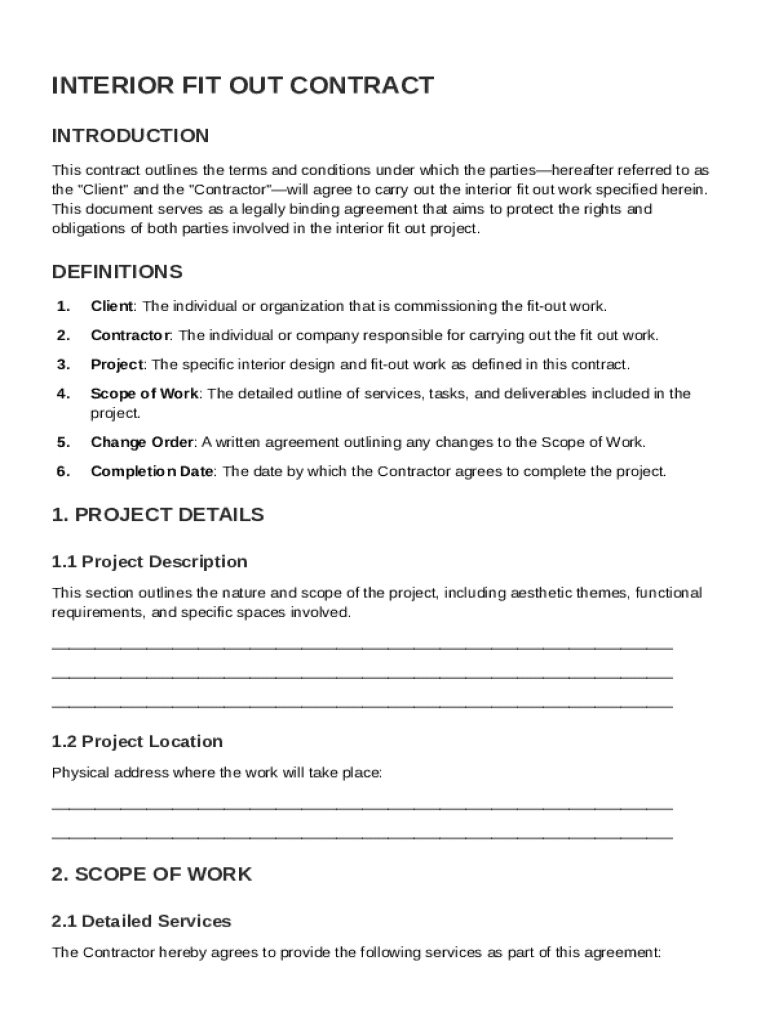







Definition and Purpose of the Interior Fit Out Contract Template
The Interior Fit Out Contract Template serves as a comprehensive agreement between a client and a contractor. Its primary purpose is to establish the terms and conditions under which interior fit out work will be executed. This contract aims to protect the rights and responsibilities of both parties, ensuring that the project is executed according to the agreed-upon standards.
- Definitions: The template includes precise definitions of terminologies related to the project, such as "fit out," "contractor," and "client," to avoid ambiguity in interpretation.
- Project Overview: It outlines the specifics of the project, providing a detailed description of the work to be performed, including any unique features or requirements.
How to Use the Interior Fit Out Contract Template
To maximize the utility of the Interior Fit Out Contract Template, you should approach it systematically, ensuring all relevant information is entered accurately.
- Customizing the Template: Begin by personalizing the template with specific project details, including dates, names, and project scope.
- Reviewing Terms: Thoroughly review all standard clauses, such as compensation structure and liability, to ensure they align with project expectations.
- Legal Consultation: Consider having the final draft reviewed by a legal professional to guarantee compliance with local laws and regulations.
Steps to Complete the Interior Fit Out Contract Template
Completing the template requires attention to detail and a clear understanding of the project requirements.
- Entering Client and Contractor Information: Accurately fill in the names, addresses, and contact details of both parties.
- Defining Scope of Work: Clearly articulate the specific tasks, timelines, and deliverables associated with the project.
- Setting Compensation Terms: Outline the agreed-upon payment terms, including payment schedule and amounts.
- Detailing Responsibilities: Specify the responsibilities of each party to prevent misunderstandings during the project implementation.
- Finalizing the Agreement: Ensure both parties review all sections thoroughly before signing the document to finalize the contract.
Key Elements of the Interior Fit Out Contract Template
Several key elements must be included in the contract to ensure its effectiveness.
- Scope of Work: This section should meticulously describe the tasks to be completed, the materials to be used, and the standards to be met.
- Timeline: Establish a clear timeline, including start and completion dates, along with milestones for monitoring progress.
- Compensation Structure: Define how and when payments will be made, detailing necessary financial arrangements and contingencies.
- Warranty and Maintenance: Specify any warranties on the workmanship and materials used, along with the maintenance responsibilities post-completion.
Who Typically Uses the Interior Fit Out Contract Template
The template is widely used by various stakeholders involved in interior fit out projects.
- Clients: Individuals or businesses commissioning a fit out project utilize the contract to ensure their specifications are met.
- Contractors: Professionals and companies responsible for executing the fit out work employ the template to formalize the business agreement.

Legal Use of the Interior Fit Out Contract Template
Legal considerations are integral to the use of this contract template.
- Compliance: The template must be compliant with relevant federal, state, and local laws.
- Binding Agreement: Once signed, the contract becomes a legally binding document that can be enforced in a court of law, protecting both parties' interests.
Important Terms Related to the Interior Fit Out Contract Template
Understanding specific terms within the contract is crucial for its effective application.
- Change Orders: Procedures for requesting and approving changes or modifications to the project's scope or details.
- Liability and Insurance: Requirements for insurance coverage by the contractor to protect against potential losses or damages.
Examples of Using the Interior Fit Out Contract Template
Real-world scenarios demonstrate the application of this template.
- Residential Projects: An interior designer uses the template to outline renovation work in a private home, ensuring all design elements are agreed upon.
- Commercial Spaces: A retail chain employs the contract to standardize the fit out process across various locations, maintaining consistency in brand presentation.
Digital vs. Paper Version
The Interior Fit Out Contract Template is available in both digital and paper formats, each with distinct advantages.
- Digital: Offers easy editing and sharing capabilities, facilitating remote collaboration and electronic signing.
- Paper: Suitable for traditional settings where digital access is limited, ensuring compliance with paper-based regulatory requirements.
Software Compatibility
The template's compatibility with document management software enhances its functionality.
- DocHub: The contract can be seamlessly edited, signed, and shared using platforms like DocHub, ensuring efficient document workflow and security with encryption and authentication measures.
- Other Tools: Integration with other software tools like Google Workspace enhances accessibility and streamlines processes for users who rely on those platforms.




