






Definition and Meaning
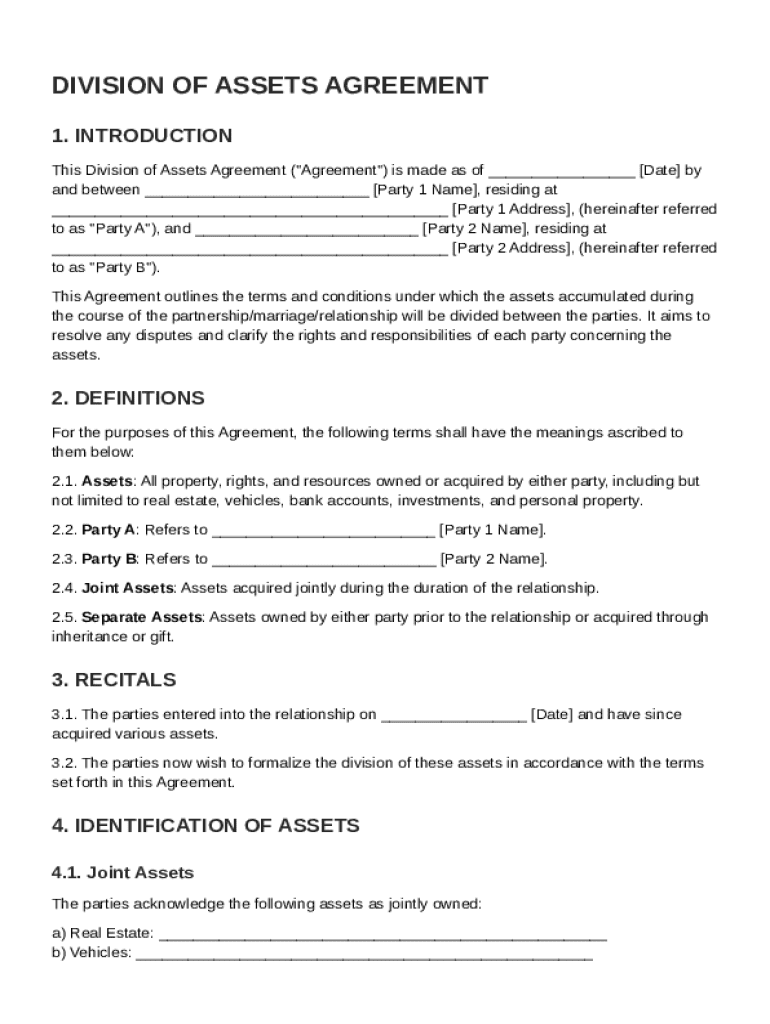
The Division of Assets Agreement Template serves as a comprehensive legal document that outlines the allocation of assets between two parties, commonly in the context of relationships such as marriages, partnerships, or long-term collaborations. This template aids in defining joint and individual assets, detailing how these will be valued and subsequently divided. It enumerates procedures for resolving disputes, ensuring clarity regarding the rights and responsibilities of each party towards shared and personal properties. By establishing these elements in a structured manner, the agreement mitigates potential conflicts and provides legal security.
Key Elements of the Division of Assets Agreement Template
To effectively draft a Division of Assets Agreement, it's crucial to include specific elements that uphold its legal efficacy and clarity:
- Identification of Parties: Clearly naming the individuals or entities involved, typically referred to as Party A and Party B.
- Asset Inventory: A comprehensive list of all joint and separate assets, including but not limited to real estate, bank accounts, stocks, and personal property.
- Valuation Methods: Explicitly stating the agreed methods for asset valuation, which may include appraisal or market value assessments.
- Division Terms: Outlining the specific terms under which assets and liabilities will be distributed between the parties.
- Dispute Resolution: Specifying the processes for resolving disagreements, possibly through mediation or arbitration.
- Signatures and Witnessing: Ensuring both parties sign the agreement in the presence of witnesses or a notary for validation.
Steps to Complete the Division of Assets Agreement Template
Completing the Division of Assets Agreement Template involves several methodical steps:
- Initial Consultation: Both parties should seek individual legal counsel to understand their rights and options.
- Gather Documentation: Collect all relevant financial documents, statements, and appraisals essential for a thorough asset inventory.
- Drafting the Agreement: Utilize the template to input relevant information, ensuring adherence to legal standards.
- Review and Adjust: Revise the draft to incorporate feedback from both parties and their respective legal advisors.
- Finalize and Execute: Once both parties agree to the terms, the document should be signed in front of witnesses or a notary public.
Who Typically Uses the Division of Assets Agreement Template
This template caters to a diverse range of users, including:
- Married Couples: Heading towards divorce or separation, where asset division is necessary.
- Business Partners: Dissolving a business partnership and needing to allocate business assets.
- Co-habitants: Individuals in non-marital relationships who wish to formally define asset ownership.


Legal Use of the Division of Assets Agreement Template
The Division of Assets Agreement Template is designed to uphold legal standards and can be used in various contexts within the United States. When executed correctly, it provides a legally binding framework recognized by courts. To ensure legal validity:
- Consult Legal Experts: Involving lawyers specializing in family or business law can help tailor the agreement to jurisdictional requirements.
- Compliance with State Laws: Each state may have specific statutes affecting the division of assets, mandating compliance with these laws.
State-Specific Rules for the Division of Assets Agreement Template
Laws governing the division of assets vary across states, which may affect how the template is utilized:
- Community Property States: States like California and Texas require assets acquired during marriage to be divided equally.
- Equitable Distribution States: Other states follow equitable distribution, wherein assets are divided fairly, though not always equally.
Understanding these distinctions is essential in tailoring the agreement to reflect state-specific regulations.
Examples of Using the Division of Assets Agreement Template
Various scenarios highlight the utility and flexibility of the agreement:
- Divorces: Facilitates smoother transitions by predefining asset division, minimizing courtroom conflicts.
- Dissolution of Business Ventures: When business partners decide to part ways, this agreement efficiently records asset allocation.
- Estate Planning: In the event of managing family estates or trusts, the template assists in clarifying individual ownership amongst heirs.
Important Terms Related to the Division of Assets Agreement Template
Familiarity with key legal and financial terms enhances understanding and execution of the agreement:
- Joint Assets: Items owned collectively by both parties.
- Separate Assets: Property owned individually by either party before the partnership or marriage.
- Debts and Liabilities: Financial obligations incurred during the relationship and how they are assigned to each party.
Understanding these terms provides clarity, reducing potential disputes over asset classification and division.
Software Compatibility and Integration
Utilizing document workflow solutions like DocHub, individuals can efficiently manage the Division of Assets Agreement Template digitally. DocHub supports file formats such as PDF, DOC, and more, facilitating the seamless editing and signing of this template. This integration allows for:
- Ease of Editing: Quickly insert, remove, or modify text using DocHub’s comprehensive editing tools.
- Secure Signing: Ensure legally binding electronic signatures with features that comply with the ESIGN Act.
- Cloud Storage Access: Import and export documents directly from cloud services, streamlining coordination and communication between involved parties.