






Definition and Purpose of the Contractor Payment Agreement Template
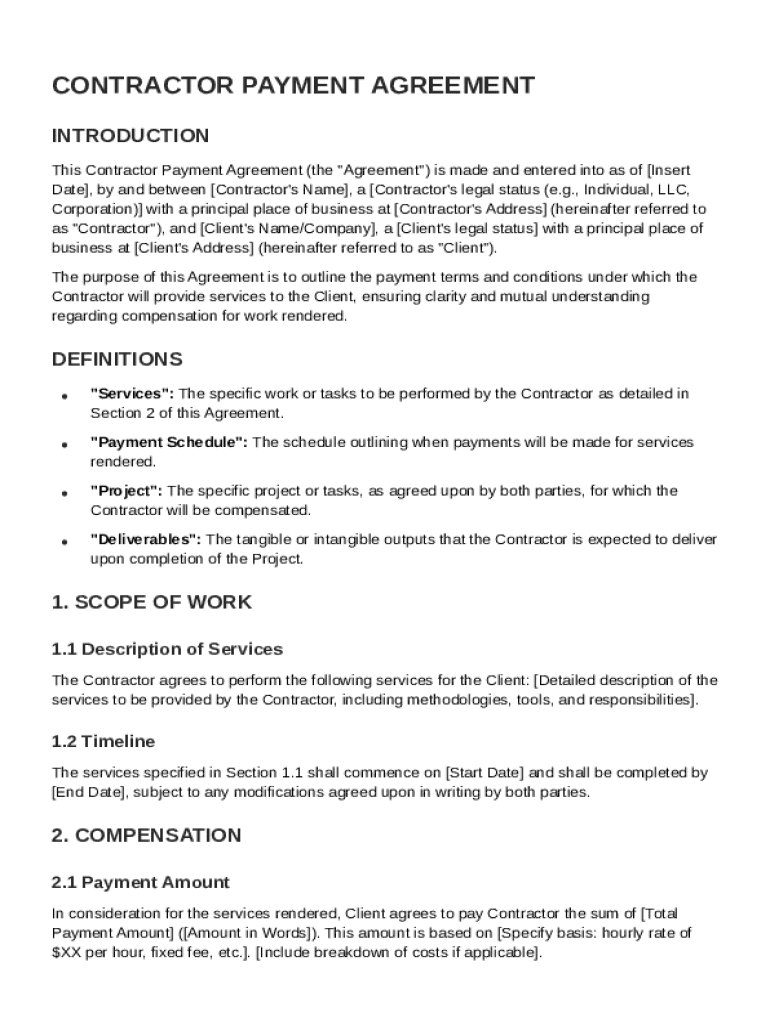
The Contractor Payment Agreement Template is a legally binding document that outlines the terms and conditions under which a contractor and a client agree on payment for services rendered. Its primary purpose is to provide clarity and prevent disputes by detailing the scope of work, compensation structure, payment methods, and responsibilities of each party. This template includes various sections that define key terms, establish methods for dispute resolution, and specify conditions for contract termination. By having this agreement, both the contractor and the client ensure a mutual understanding of their obligations and rights, thereby fostering a transparent and effective working relationship.
How to Use the Contractor Payment Agreement Template
Utilizing the Contractor Payment Agreement Template effectively requires understanding its components and the intent behind each section. Start by filling out basic information such as names and contact details of the contractor and client. Next, define the scope of work to outline what the contractor is expected to deliver. Add sections detailing payment terms, including the total amount, payment schedule, and method of payment. Verify that the dispute resolution and termination clauses align with both parties' expectations. Once the form is complete, both parties should review the document thoroughly before signing to confirm agreement on all terms outlined. Using this template helps ensure all essential points are covered and serves as a reference for future interactions.
Key Elements of the Contractor Payment Agreement Template
The Contractor Payment Agreement Template includes several critical sections to ensure comprehensive coverage of all necessary terms.
- Scope of Work: Clearly defines the tasks the contractor agrees to complete.
- Compensation Structure: Details on payment amounts, schedules, and methods.
- Responsibilities: Outlines obligations and duties of both parties.
- Dispute Resolution: Provides methods for resolving disagreements.
- Termination Conditions: Specifies how either party may terminate the agreement.
- Modification Provisions: Sets the process for making changes to the contract.
These elements function together to lay out a clear and structured agreement, reducing the potential for misunderstandings or disagreements.
Important Terms Related to the Contractor Payment Agreement Template
Understanding the terminology in a Contractor Payment Agreement is crucial for both parties to grasp the document's implications fully. Some key terms include:
- Retainer: An upfront fee paid to secure the contractor's services.
- Milestone Payments: Specific payments released after completing certain phases of the work.
- Net Terms: Terms that indicate when payment is due, such as net 30 or net 60 days.
- Force Majeure: A clause that frees both parties from liability when an extraordinary event prevents one or both parties from fulfilling their obligations.
- Breach of Contract: When one party fails to perform any term of the contract without a valid legal excuse.
Knowing these terms ensures clarity and aids in negotiations.
Steps to Complete the Contractor Payment Agreement Template
Filling out the Contractor Payment Agreement Template involves several steps to ensure completeness and clarity:
- Initial Information: Enter the names, addresses, and contact details of both the contractor and the client.
- Define Scope of Work: Clearly describe the work the contractor will perform.
- Set Payment Terms: Specify the payment amount, schedule (e.g., upon completion, in installments), and method (e.g., bank transfer, check).
- Include Dispute Resolution: Outline procedures for resolving any disagreements, such as through mediation or arbitration.
- Specify Termination Conditions: Detail how and under what circumstances the agreement can be terminated.
- Review and Sign: Both parties should review the document for accuracy and clarity before signing. It's advisable to consult with a legal professional if needed.
By following these steps, parties ensure that the agreement is clear, comprehensive, and ready for execution.
Who Typically Uses the Contractor Payment Agreement Template
This template is mainly used by:
- Freelancers and Independent Contractors: To formalize payment agreements with clients.
- Small to Medium Enterprises (SMEs): Engaging external contractors for specific projects.
- Large Corporations: When employing specialized contractors for temporary roles.
- Consultants: To define service terms with business clients.
These users benefit from having clear terms and conditions to avoid potential conflicts.


Legal Use of the Contractor Payment Agreement Template in the U.S.
In the United States, a Contractor Payment Agreement is a vital legal document that plays a role in formalizing business relationships. It conforms with general contract law, recognizing the mutual consent of both parties. Several states have minor distinctions in their contract enforcement regulations, which might necessitate slight modifications to the template. Utilizing this document ensures that the agreement meets legal standards, substantively reducing the risk of disputes. This template is especially critical in maintaining compliance with both federal and state contract laws, acting as a publicly admissible record of the agreed-upon terms.
Examples of Using the Contractor Payment Agreement Template
Illustrating real-world scenarios can provide practical insights:
- Graphic Design Services: A graphic designer creates a detailed scope of work along with negotiated payment terms, establishing clear deliverables.
- IT Consulting: Defined projects and payment methods, such as milestone payments, align expectations and ensure smooth progress.
- Construction Projects: The template sets terms for installments based on phases of construction completion, clarifying expectations for both parties.
These examples demonstrate how the template can be adapted to fit a range of professional services, ensuring both parties understand their responsibilities and the terms of payment.
Digital vs Paper Version of the Contractor Payment Agreement Template
Digitally managing Contractor Payment Agreements offers several advantages over traditional paper contracts.
- Accessibility: Digital forms can be accessed and signed from anywhere, facilitating remote agreements.
- Editing: Changes and updates to terms can be made more efficiently within digital documents.
- Security: With platforms like DocHub, digital versions are protected via encryption, ensuring confidentiality.
- Storage: Digital agreements can be easily archived and retrieved, eliminating physical storage needs.
For those in fast-paced or frequently changing industries, the digital version offers unparalleled convenience and efficiency compared to paper forms.