






Definition and Meaning
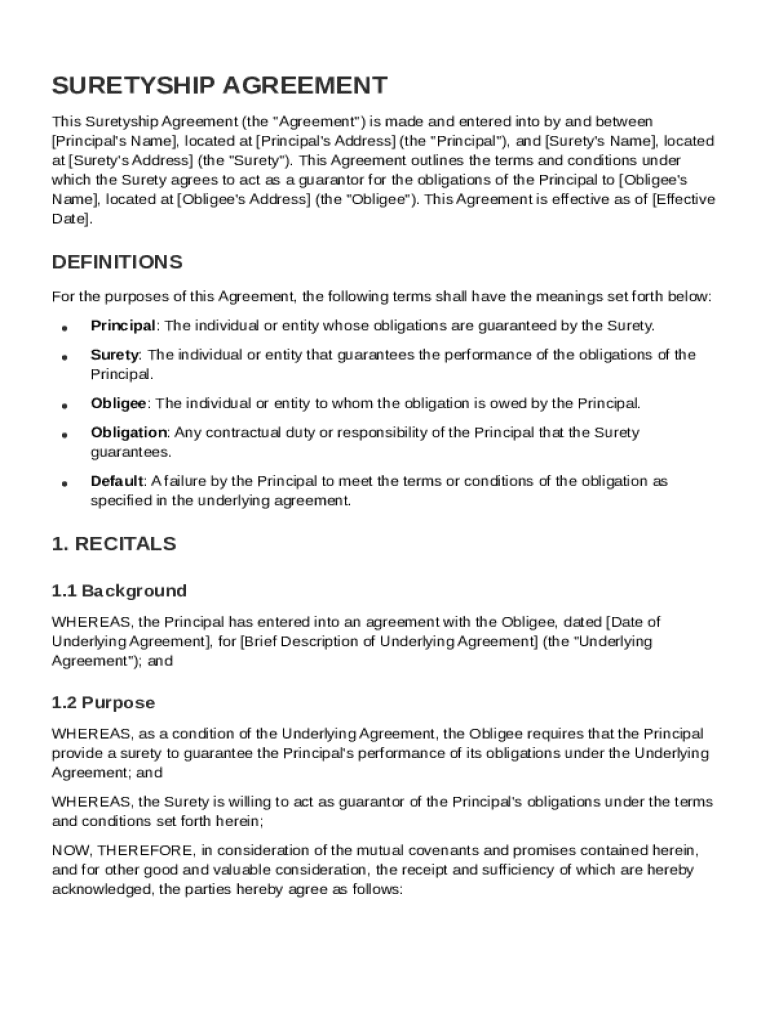
A Suretyship Agreement is a legal contract involving three parties: the Principal, the Surety, and the Obligee. In this arrangement, the Surety agrees to take responsibility for the Principal's failure to meet obligations towards the Obligee. This instrument provides assurance to the Obligee that their interests are protected should the Principal default on their obligations. These agreements are common in construction and financial sectors where parties need to minimize risks associated with project completion and financial transactions.
Examples of Suretyship
- Construction Projects: Contractors often require surety bonds to guarantee the completion of a project as per contract terms. If the contractor fails, the surety will cover the losses or find another contractor to finish the work.
- Financial Agreements: In financial contexts, a bank might ask for a suretyship agreement as a condition for loan approval, ensuring that the loan will be repaid even if the borrower defaults.
Steps to Complete the Suretyship Agreement Template
Filling out a Suretyship Agreement Template requires careful attention to detail to ensure legal validity and clarity. Below are the steps involved:
-
Identify the Parties: Clearly specify the Principal, Surety, and Obligee. Provide full legal names and contact details for accuracy.
-
Define the Obligation: State the specific obligations of the Principal that the Surety is backing, such as completing a construction project or repaying a loan.
-
Outline Terms and Conditions: Detail the terms under which the Surety is obliged to act. This includes conditions of default, indemnification responsibilities, and the extent of financial liability.
-
Signatures and Execution: All parties must sign the agreement. Ensure each signature is witnessed as per legal requirements to prevent future disputes.
-
Formalization: Some agreements might need notarization or registration with relevant authorities. Check local laws to ensure compliance.
Key Elements of the Suretyship Agreement Template
A comprehensive Suretyship Agreement Template should contain several crucial components to protect all parties involved:
- Scope of Suretyship: Defines the limits and scope of the Surety's responsibility.
- Default and Indemnity Provisions: Outline the actions Surety will undertake in case of Principal’s default and the indemnities required.
- Governing Law: Identifies the jurisdiction’s legal framework governing the agreement, typically aligned with the Obligee's location.
- Duration of Suretyship: Specifies the effective time period of the agreement, including start and expiry dates.
Legal Use of the Suretyship Agreement Template
In the U.S., the legal enforceability of a Suretyship Agreement is governed by both federal and state laws, reinforcing the trustworthiness of the agreement. Suretyship agreements must comply with the statute of frauds, necessitating written documentation for enforceability.
Edge Cases in Legal Use
- State Variations: Some states may have specific additional requirements for execution or filing of such agreements.
- Multiple Principals: In cases involving multiple Principals, the agreement must clearly specify individual responsibilities to prevent legal ambiguities.
Important Terms Related to Suretyship Agreement Templates
Understanding the terminology within a Suretyship Agreement can prevent misunderstandings:
- Principal: The party whose obligations are secured by the Surety.
- Surety: The entity that assures the fulfillment of the Principal’s obligations.
- Obligee: The party who receives assurance that obligations will be met.
- Indemnity: A clause ensuring protection against losses incurred due to the Principal’s failure.
State-by-State Differences for Suretyship Agreements
While Suretyship Agreements operate under a uniform framework, some state-specific stipulations may apply:
- California: Requires specific adherence to civil codes regarding construction bonds.
- New York: Offers more stringent requirements regarding financial disclosures for public projects.
- Texas: Imposes unique conditions related to oil and gas sector agreements.
Who Typically Uses the Suretyship Agreement Template
Various entities rely on Suretyship Agreements to mitigate risks:
- Construction Companies: To ensure project completion and performance guarantees.
- Financial Institutions: To secure loan repayments or financial obligations.
- Government Bodies: When awarding public sector projects to ensure contracted compliance.


Software Compatibility for the Suretyship Agreement Template
DocHub offers compatibility with various software platforms, ensuring you can edit and manage Suretyship Agreement Templates seamlessly:
- Google Workspace: Direct integration allows for easy import and export of templates.
- QuickBooks: Use financial data to aid in the completion of contract terms.
- Microsoft Office: Support for DOC and XLS formats facilitates data manipulation and agreement drafting.
With these detailed sections, users can fully understand and efficiently utilize a Suretyship Agreement Template. Each block provides comprehensive insights into the practical, legal, and logistical aspects of creating and managing these significant legal instruments.