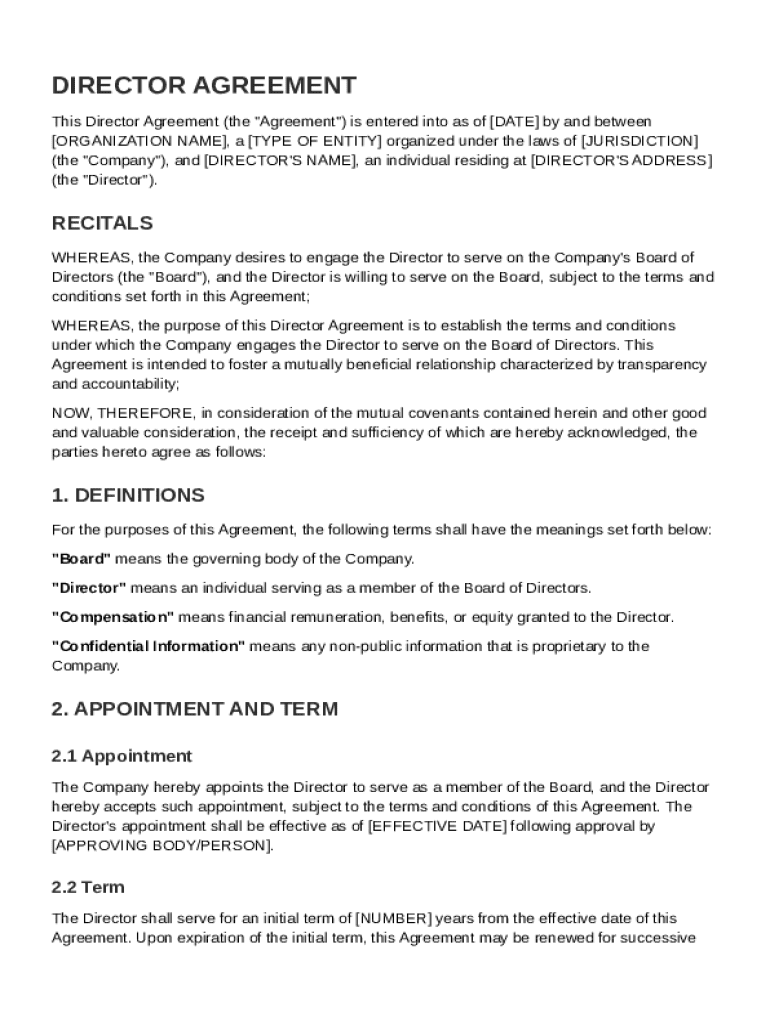







Key Elements of the Director Agreement Template
The Director Agreement Template is a crucial document used to appoint an individual to a company's Board of Directors. It encompasses several key elements that dictate the terms under which a director serves. These include:
-
Appointment and Term of Service: Details about how long the director will serve, the process for appointment, and renewal terms if applicable.
-
Duties and Responsibilities: A comprehensive list of the expectations, roles, and responsibilities that the director must fulfill during their tenure.
-
Compensation and Benefits: Information on financial compensation, additional benefits, and reimbursement policies, if any.
-
Confidentiality Obligations: Specifies the duty to maintain confidentiality concerning company information.
-
Conflict of Interest Policies: Guidelines to prevent conflicts of interest and ensure the director acts in the best interest of the company.
-
Termination Conditions: Explains the scenarios and processes for terminating a director’s appointment.
-
Indemnification: Details about protection offered to the director against legal liabilities incurred in the course of their duties.
-
Governing Law and Amendments: Specifies the jurisdiction under which the agreement operates and the process for making amendments.
How to Use the Director Agreement Template
Using the Director Agreement Template involves several well-defined steps to ensure it meets legal and company requirements:
-
Customize the Template: Begin by adapting the template to fit the specific needs of your company. This includes adding the company name, director's name, appointment date, and other personal details.
-
Review Key Provisions: Ensure each section accurately reflects the agreements reached, especially concerning compensation, duties, and tenure.
-
Seek Legal Counsel: Consult with a legal professional to validate the document's compliance with relevant laws and company policies.
-
Agreement by All Parties: Both company and director should thoroughly review the document to ensure mutual understanding and agreement on all terms.
-
Signature and Storage: The agreement should be signed by both parties, then stored securely in both digital and physical formats for future reference.
Legal Use of the Director Agreement Template
In the United States, the legal implications of using a Director Agreement Template are substantial:
-
Compliance with Corporate Laws: The agreement must comply with federal and state corporate governance laws.
-
Binding Legal Document: Once signed, the document becomes a legally binding agreement between the director and the company.
-
Contractual Obligations: It establishes contractual obligations that can be enforced in court, providing clarity and protection for both parties.
There may be variances depending on the state laws, especially regarding indemnification and conflict of interest policies. It's essential to customize the template according to the specific jurisdiction in which the company operates.
Steps to Complete the Director Agreement Template
Completing a Director Agreement Template involves several methodical steps to confirm accuracy and comprehensiveness:
-
Gather Required Information: Collect all necessary information such as personal details of the director, the company's bylaws, and existing board policies.
-
Draft the Agreement: Use the template to draft an initial version, ensuring all standard clauses are included and correctly formatted.
-
Incorporate Custom Terms: Insert any unique terms or clauses specific to the company’s needs or the director's role.
-
Internal Review: Share the draft with internal stakeholders like HR and legal teams to review for accuracy and compliance.
-
Negotiate Terms: Before finalizing, negotiate any contentious terms with the director to reach a mutually acceptable agreement.
-
Final Review and Signing: Conduct a final review of the agreed draft before both parties sign it.
-
Document Distribution: Distribute signed copies to all relevant parties and ensure proper documentation in company records.
State-Specific Rules for the Director Agreement Template
State-specific rules can significantly impact the terms and enforceability of a Director Agreement. Important considerations include:
-
Divergent Indemnification Laws: Some states have specific indemnification laws that need to be reconciled with what is detailed in the agreement.
-
Varying Corporate Governance Standards: States like Delaware have distinct corporate governance frameworks that may influence the template's structure.
-
Specific Confidentiality Requirements: State laws might dictate particular confidentiality provisions to be included in the agreement.
It is crucial to understand these state-specific variations to ensure the Director Agreement aligns with local legal requirements.
Examples of Using the Director Agreement Template
Examples offer practical insights into the real-world application of Director Agreements:
-
Tech Startup: A startup company uses the Director Agreement Template to formalize the role of a new board member with expertise in venture capital.
-
Non-Profit Organization: A non-profit uses it to appoint a director tasked with enhancing its governance as it scales operations.
-
Corporate Governance: A multinational corporation updates its Director Agreement Templates to incorporate new state laws and corporate policies.
These scenarios demonstrate how the template can be adapted to meet a variety of organizational needs across different industries.
Important Terms Related to Director Agreement Template
Understanding the terminology used in the Director Agreement Template is essential for clarity and legal compliance:
-
Bylaws: Internal rules governing how the company operates and outlines the duties of the directors.
-
ESIGN Act: An act that provides the legalization of electronic signatures in the U.S., enhancing the digital handling of agreements.
-
Fiduciary Duties: Legal obligations of the director to act in the best interest of the company and its shareholders.
These terms underline significant components that should be precisely covered in the Director Agreement.
Who Typically Uses the Director Agreement Template
Director Agreement Templates are utilized by diverse entities across various sectors:
-
Corporations: Both public and private corporations use them to maintain structured corporate governance.
-
Non-Profit Organizations: Essential for non-profits to outline the specific duties and expectations of board members.
-
Small Businesses: Vital for small businesses as they expand and add formal governance structures.
Each type of organization might tailor the template to reflect their unique structures and governance needs.