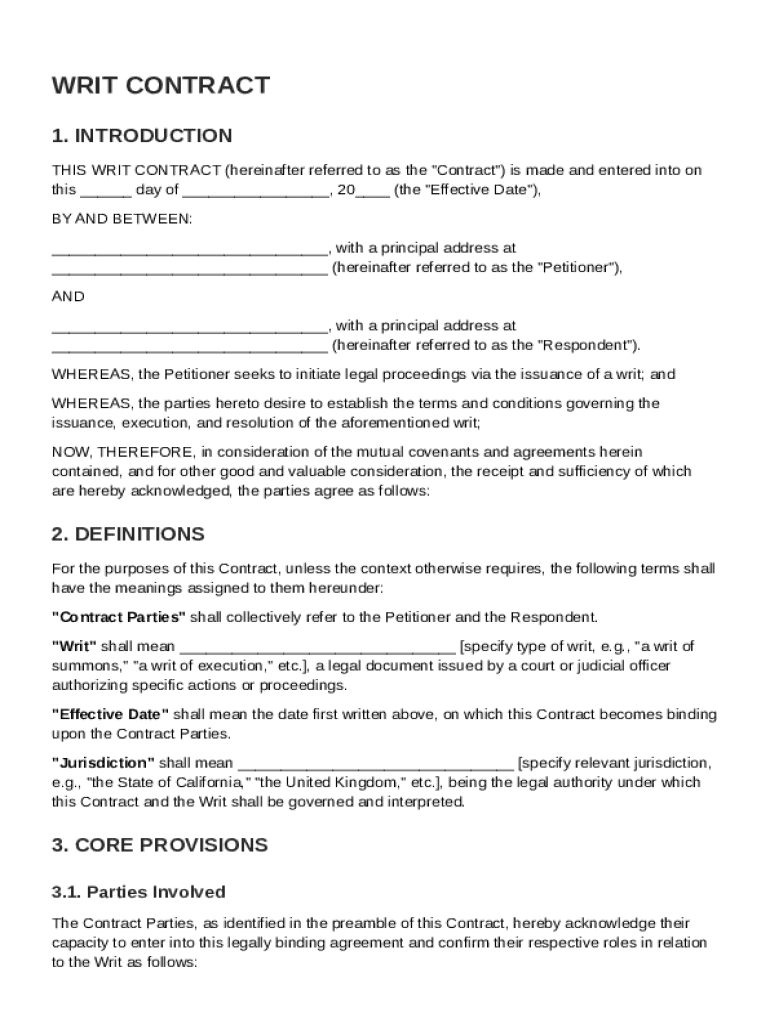







Definition and Meaning
A Writ Contract Template serves as a structured legal framework between a Petitioner and a Respondent, detailing the issuance, execution, and resolution of a legal writ. This document is essential in formalizing the obligations and conditions agreed upon by both parties involved. The template specifies key terms, including the responsibilities of each party, conditions for issuance, and the mechanisms to handle disputes. By defining these elements clearly, the contract minimizes the scope for misunderstandings and ensures mutual accountability throughout the legal proceeding.
How to Use the Writ Contract Template
To effectively utilize the Writ Contract Template, begin by carefully reviewing the document to ensure relevant details are in place. Consider each section of the template and determine how they apply to your specific circumstances:
- Petitioner and Respondent Details: Clearly identify the parties involved, including their legal names and roles.
- Terms and Conditions: Ensure all conditions are explicitly stated, covering the full scope of responsibilities and expectations.
- Execution Steps: Outline how and when the writ will be executed, providing clarity on procedural elements.
It's crucial to tailor the template to fit the unique aspects of your situation, ensuring all required sections are appropriately customized before proceeding.
Steps to Complete the Writ Contract Template
Completing the Writ Contract Template involves several key steps:
-
Gather Relevant Information: Collect necessary details pertaining to both parties and the specific legal matter at hand.
-
Detail the Conditions: Clearly articulate the terms, conditions, and expected outcomes related to the writ.
-
Review Legal Provisions: Ensure all legal references and terminologies in the contract align with applicable laws and regulations.
-
Seek Legal Counsel: If uncertain about any section, consult with a legal professional to validate the accuracy and clarity of the information provided.
-
Finalize and Sign: Once satisfied with the contract’s completeness, obtain signatures from all parties involved to confirm mutual agreement.
Key Elements of the Writ Contract Template
Several core components are vital to a comprehensive Writ Contract Template:
-
Definitions: Clarifies specific terms used in the contract to avoid any ambiguity.
-
Responsibilities and Duties: Outlines the specific obligations of the Petitioner and Respondent.
-
Amendment Procedures: Provides a clear pathway for modifying the contract when necessary, including mutual consent requirements.
-
Dispute Resolution Mechanism: Details the process for handling disagreements, specifying whether mediation, arbitration, or litigation is preferred.
Each of these elements plays a pivotal role in ensuring that the contract functions effectively as a legal instrument, providing a robust framework for managing the writ's lifecycle.
Legal Use of the Writ Contract Template
The Writ Contract Template is pivotal in legally binding agreements between involved parties. When employed correctly:
-
Conformance to Legal Standards: It ensures adherence to applicable laws and statutory requirements.
-
Enforceability: Enhances the enforceability of terms, safeguarding the interests of both the Petitioner and Respondent.
-
Clarity and Transparency: Offers a clear depiction of obligations, reducing the likelihood of disputes through its comprehensive and transparent nature.
Leveraging a well-crafted template helps maintain legal integrity, protecting both parties under legally defined terms and conditions.
Important Terms Related to the Writ Contract Template
Understanding the terminology is crucial when using a Writ Contract Template:
-
Issuance: Refers to the formal process of creating and serving the writ within legal constraints.
-
Execution: Involves carrying out the actions specified in the writ, ensuring compliance with the outlined procedures.
-
Resolution: Describes how any disputes arising from the writ are to be resolved, typically including steps such as negotiation or arbitration.
Familiarity with these terms allows users to navigate the contract's framework with a clear understanding of its implications and processes.
State-Specific Rules for the Writ Contract Template
State regulations can significantly impact how a Writ Contract Template is implemented:
-
Legal Compliance: Different states may have varying regulatory requirements regarding the issuance and execution of writ contracts.
-
Jurisdictional Variations: Specific state laws may dictate distinct procedures or additional components, necessitating localized adjustments to the contract.
Awareness of state-specific rules is crucial to ensuring legal compliance and operability of the contract within the relevant jurisdiction.
Examples of Using the Writ Contract Template
Practical examples illustrate the versatility of the Writ Contract Template:
-
Debtor-Creditor Scenarios: When a creditor seeks enforcement of a debt repayment from a debtor, using a writ contract can streamline the enforcement process.
-
Property Disputes: In cases where legal action is necessary to resolve property disputes, the template articulates the terms for issuance and execution effectively.
These scenarios highlight the template's applicability in diverse legal contexts, reinforcing its utility in facilitating orderly legal resolutions.
State-by-State Differences
Understanding state-by-state differences enhances the Writ Contract Template's application:
-
Execution Formalities: Each state may have distinct requirements for formally executing a writ, affecting timelines and procedural steps.
-
Standard Clauses: Inclusion of standardized clauses may vary, as states often have unique legal stipulations necessitating customizations to align with local laws.
By acknowledging these differences, users ensure the template is adapted effectively to comply with state laws, fostering conformity and legal robustness across various jurisdictions.