
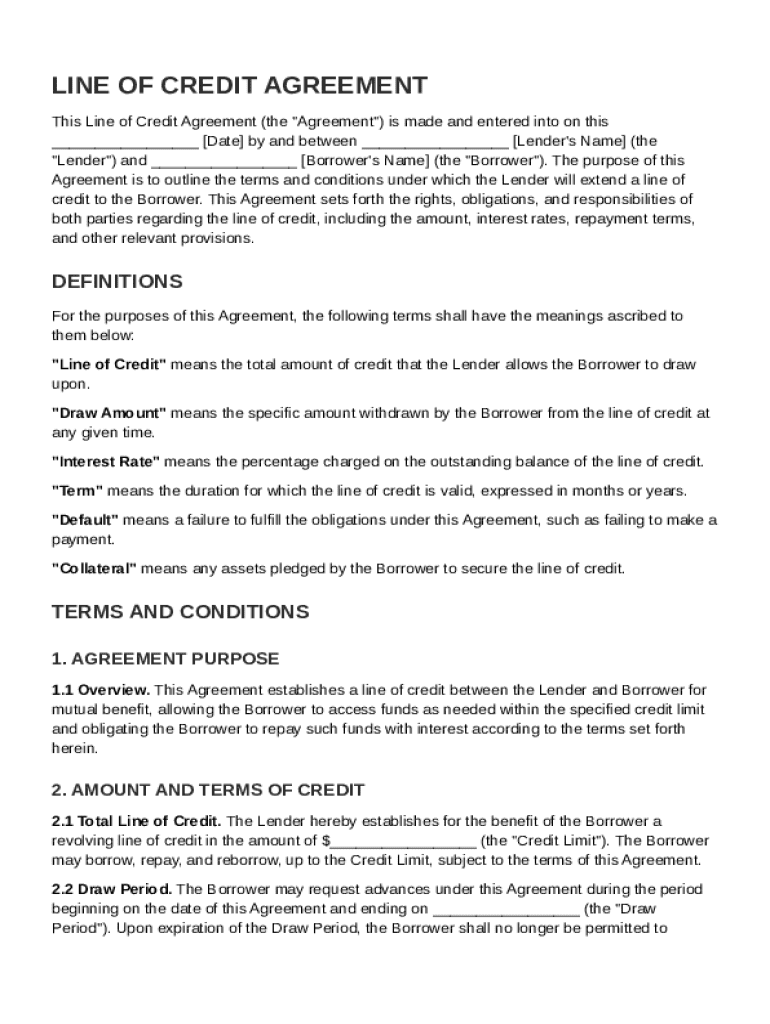







Definition & Meaning
A Line of Credit Agreement Template details the specific terms and conditions by which a lender extends a line of credit to a borrower. This template serves as a foundational document to establish the borrowing relationship, outlining responsibilities, rights, and obligations of both parties involved. A line of credit is a flexible borrowing option that allows the borrower to withdraw funds up to a specified limit, repay, and borrow again.
Key Definitions
- Line of Credit: A predetermined credit limit that a borrower can access as needed.
- Draw Amount: The specific amount borrowed against the available credit line.
- Interest Rate: The percentage charged on borrowed funds, often variable in nature.
Key Elements of the Line of Credit Agreement Template
The template comprises several critical elements that ensure clarity and mutual understanding between borrower and lender. It includes:
- Credit Limit: The maximum amount available for borrowing.
- Repayment Terms: Details about how and when repayments are expected.
- Collateral Requirements: Specifies assets pledged by the borrower to secure the credit line.
- Events of Default: Conditions under which the agreement is breached, allowing the lender to demand immediate repayment.
- Governing Law: The jurisdiction's legal framework governing the agreement.
Steps to Complete the Line of Credit Agreement Template
Completing the template involves systematic steps to ensure all essential details are correctly entered and understood. Here’s a step-by-step guide:
- Read and Understand: Familiarize yourself with all sections of the agreement.
- Input Accurate Information: Enter borrower and lender details, credit limit, and interest rate.
- Specify Repayment Terms: Clearly set out repayment schedules and methods.
- Define Collateral: Identify any assets pledged to secure the line.
- Include Default Clauses: Detail conditions that constitute a default.
- Review and Agree: Both parties should review terms closely to ensure understanding.
- Sign and Execute: Finalize by signing, making it a legally binding document.
Important Terms Related to the Line of Credit Agreement Template
Understanding the terminology in the agreement is crucial for effective use. Key terms often include:
- Principal: The original sum borrowed through the line of credit.
- APR (Annual Percentage Rate): Reflects the cost of borrowing on a yearly basis.
- Credit Utilization: The ratio of credit used relative to the total available credit.
- Covenant: A promise by the borrower to adhere to specific conditions.
Commonly Misunderstood Terms
- Variable Rate vs. Fixed Rate: A variable rate can change based on market conditions, while a fixed rate remains constant.
- Grace Period: A set period during which payment can be made without incurring a penalty.
Who Typically Uses the Line of Credit Agreement Template
This template is commonly used by various entities and individuals needing flexible access to funds:
- Small Business Owners: For managing cash flow and operational expenses.
- Entrepreneurs: To finance startup ventures and unforeseen business needs.
- Real Estate Investors: For quick access to capital, enabling timely investments.
- Individuals: Those needing flexibility for large purchases or financial emergencies.


Legal Use of the Line of Credit Agreement Template
The template adheres to legal stipulations required for binding financial agreements. It is imperative for the document to:
- Comply with Federal and State Laws: Ensure alignment with relevant U.S. financial regulations.
- Provide Transparent Terms: Clear articulation of all charges, penalties, and conditions.
- Include Signatures: Both parties must sign to enforce the agreement's terms legally.
Software Compatibility and Digital vs. Paper Version
Modern needs dictate compatibility with various digital platforms:
- DocHub Compatibility: Allows for seamless editing, saving, and sharing the agreement in digital formats such as PDF.
- Google Workspace: Facilitates integration with Google Drive for ease of access and version control.
- Digital Signatures: Enables electronic execution of the document, assuring legality and efficiency.
Digital vs. Paper
- Efficiency: Digital versions allow for quick dissemination and editing.
- Storage: Electronic filing is cost-effective and space-saving compared to physical storage.
State-by-State Differences
When using the line of credit agreement template across the United States, it is vital to recognize state-specific variations, such as:
- Interest Rate Caps: Certain states impose limits on maximum allowable interest rates.
- Required Disclosures: Some jurisdictions mandate additional borrower disclosures.
- Usury Laws: Regulations preventing exorbitant interest charges vary by state.
Understanding these distinctions ensures compliance and tailoring of the agreement to fit state-specific legal frameworks.




