01. Edit your form online
Type text, add images, blackout confidential details, add comments, highlights and more.

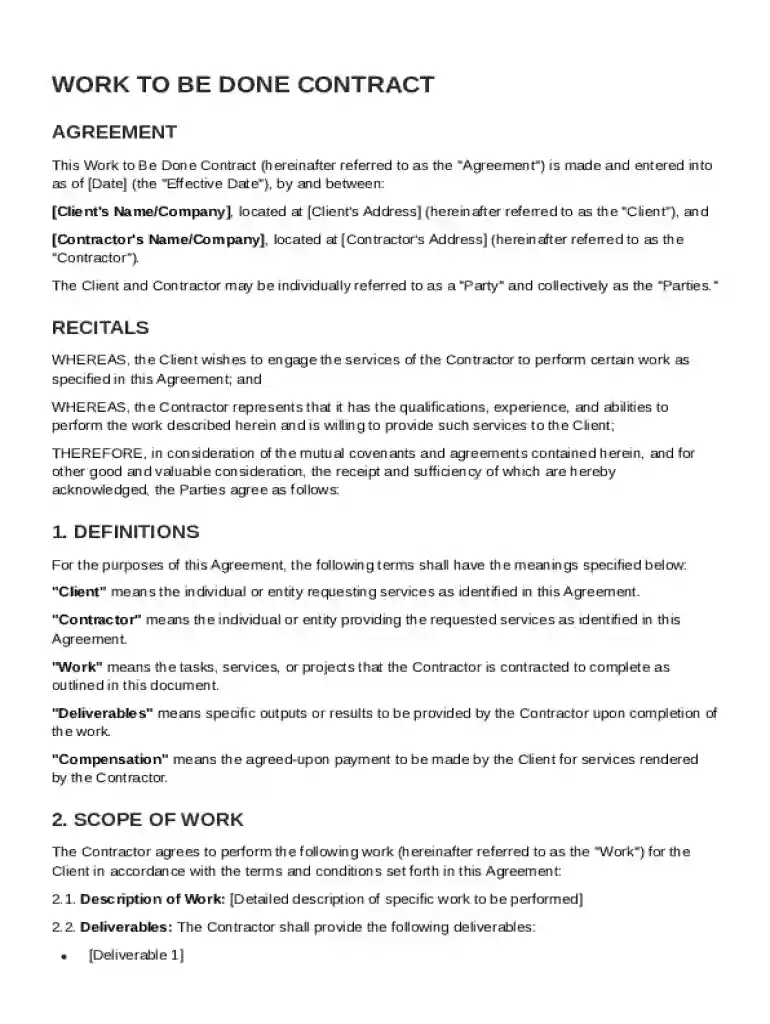
Type text, add images, blackout confidential details, add comments, highlights and more.

Draw your signature, type it, upload its image, or use your mobile device as a signature pad.

Send it via email, link, or fax. You can also download it, export it or print it out.
The Work To Be Done Contract Template is a comprehensive document designed to outline the mutual expectations, responsibilities, and legal protections between a client and a contractor. This contract is critical in establishing clear terms for both parties, minimizing the potential for disputes. It typically includes the following sections:
Definitions: Establishes the terminology used throughout the contract to ensure clarity. This section defines terms such as "client," "contractor," "scope of work," and other industry-specific terms to prevent misunderstandings.
Scope of Work: Details the specific services or tasks the contractor will perform. It clarifies the duties involved, deliverables expected, and timelines for completion. This section is vital for ensuring that both parties understand the extent of work and obligations.
Compensation Details: Outlines the financial aspects of the agreement, including payment terms, rates, and schedule. Indicating whether payments are made upon completion of work or in installments is crucial for managing expectations.
Responsibilities: Enumerates the duties of both the client and the contractor outside of the primary task execution, such as providing necessary resources or access to work sites.
Change Request Processes: Describes the procedures for handling any modifications to the original scope of work. It may include provisions for project adjustments due to unforeseen circumstances and any associated cost implications.
To effectively finalize the Work To Be Done Contract Template, follow these steps:
Initial Preparation: Gather all relevant information, including the project scope, terms of payment, and schedules.
Drafting the Contract: Use the template to begin entering the specifics of the agreement. Be precise with descriptions to avoid ambiguities.
Reviewing: Both parties should carefully review the contract to ensure all terms align with the agreed-upon conditions.
Revisions: Update any sections that require changes or additional details based on feedback from either the client or contractor.
Final Approval: Once both parties are satisfied with the document, the contract can be finalized for signing.
This contract template is commonly utilized by various professionals and industries, including:
Freelancers and Consultants: Independent contractors providing services such as design, writing, or consultation services.
Construction Companies: Engaging in projects that require clearly defined work scopes, timelines, and milestone payments.
Small Businesses: Utilizing contractors for specialized tasks like marketing, accounting, or IT services.
Large Corporations: Enlisting external vendors or service providers for specific projects or temporary assistance.


Working with this contract template requires adhering to legal guidelines to ensure its enforceability:
Compliance with State Laws: Contracts must be compliant with state-specific legal requirements, as laws can vary concerning payment terms, termination conditions, and dispute resolutions.
Confidentiality Obligations: A section dedicated to non-disclosure agreements that protect sensitive information shared during the transaction.
Indemnification and Liability: Clear clauses that outline liability limits for both parties and indemnification for damages arising during the execution of work.
Understanding the terminology used in the contract is essential for its proper execution:
Indemnification: Refers to the obligation of one party to compensate the other for certain damages or losses incurred.
Termination Clauses: Specifies how the agreement can be legally terminated by either party under certain conditions.
Dispute Resolution: Outlines the methods for resolving disputes that may arise, including arbitration or mediation.
Each state may impose different rules on how contracts are formed and enforced:
California: Requires including detailed descriptions of work and may require certain licensing for contractors.
New York: Emphasizes written contracts for services exceeding specific monetary thresholds, especially in construction.
Texas: Stipulates that specific information about project performance and completion timelines should be clearly defined.
Real-life applications of this contract template showcase its adaptability:
Graphic Design Projects: Articulating design deliverables, revision processes, and final approval stages.
Event Management: Clarifying logistics planning, execution, and breakdown responsibilities with contractors.
Software Development: Defining sprints, deliverables, and milestone payments.
In modern practice, the choice between digital and paper formats can affect workflow efficiency:
Digital: Offers ease of editing, version control, and electronic signatures, enhancing flexibility and speed in contract management.
Paper: Provides tangibility but requires physical storage and can hinder easy access or modifications.
Understanding these elements ensures that the Work To Be Done Contract Template serves its purpose in creating clear, enforceable agreements between clients and contractors.
At DocHub, your data security is our priority. We follow HIPAA, SOC2, GDPR, and other standards, so you can work on your documents with confidence.