
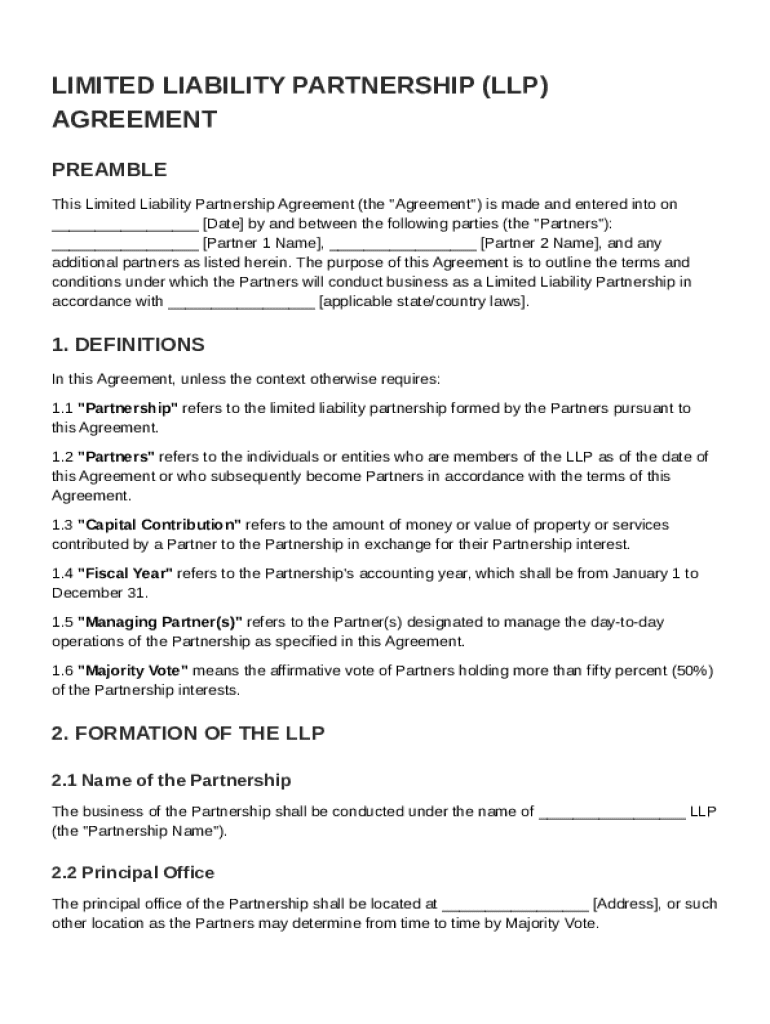







Definition and Meaning
A Limited Liability Partnership (LLP) Agreement Template is a legal framework used to establish a partnership where partners have limited personal liability for the debts and actions of the partnership. This template is crucial for organizing legal and operational aspects of an LLP, ensuring each partner's rights and responsibilities are clearly defined. The template typically includes sections on management roles, distribution of profits and losses, procedures for admitting new partners or removing existing ones, and more. By providing a structured outline, an LLP Agreement Template helps streamline the setup process for partnerships while maintaining legal compliance.
Key Elements of the LLP Agreement Template
An LLP Agreement Template encompasses several critical components necessary for the smooth functioning of the partnership. These elements ensure clarity and alignment among partners regarding their roles and expectations:
- Defined Roles and Responsibilities: Clearly outlines the duties and obligations of each partner, preventing potential conflicts.
- Profit and Loss Allocation: Details how profits and losses are divided among partners, which is crucial for financial planning and transparency.
- Decision-Making Processes: Establishes guidelines for making essential business decisions, usually through voting or majority approval.
- Capital Contributions: Specifies the amount and form of capital each partner must contribute, whether cash, property, or services.
- Partnership Duration and Dissolution: Dictates the terms of ending the partnership or the process to follow should a partner wish to exit.
How to Use the LLP Agreement Template
Utilizing an LLP Agreement Template involves several steps that ensure the document is tailored to the specific needs of the partnership. Here's a structured approach to guide you through the process:
- Review the Standard Template: Begin by examining the template for any clauses that need customization to suit your partnership's unique requirements.
- Consult with Legal Experts: It is advisable to work with legal professionals to adapt the template, especially for sections dealing with liability, taxation, and compliance.
- Input Specific Details: Enter all necessary business details, such as partner names, business activities, capital contributions, and profit-sharing ratios.
- Discuss with All Partners: Ensure all partners review the agreement and propose changes if necessary. This step is vital for achieving consensus.
- Finalize the Agreement: Once all partners agree, the document should be finalized, signed, and, if required, notarized for legal validation.
Important Terms Related to LLP Agreement Template
Understanding key terms within an LLP Agreement Template is essential for ensuring all parties are on the same page. Some of these terms include:
- General Partner: A partner with management authority in the LLP and potentially unlimited liability.
- Limited Partner: A partner with liability limited to their capital contribution, without involvement in daily operations.
- Capital Account: An account detailing each partner's contributions and withdrawals within the LLP.
- Fiduciary Duties: Obligations requiring partners to act in the LLP's best interest, maintaining loyalty and care.
- Buyout Clause: Terms that allow a partner to buy out another partner's stake under specific conditions.
Steps to Complete the LLP Agreement Template
Completing the LLP Agreement Template involves a multi-step process that ensures thoroughness and legality:
- Collect Necessary Information: Gather all information pertinent to the partnership, including personal details of partners and business objectives.
- Draft the Agreement: Use the template to draft the agreement, filling in all customizable fields with precise data.
- Internal Review: Circulate the draft among partners for feedback and approval to ensure all terms are agreeable.
- Revise and Amend: Make necessary revisions based on partner feedback and additional legal insights.
- Execute the Agreement: Obtain signatures from all partners, affirming their consent and commitment to the terms outlined.
Legal Use of the LLP Agreement Template
The LLP Agreement Template serves as a vital legal document that defines the framework within which a limited liability partnership operates:
- Legal Protection: By limiting personal liability, partners can protect personal assets from business-related debts and obligations.
- Compliance with State Laws: Ensure the agreement abides by specific state laws governing LLPs, which can vary significantly.
- Binding Contract: Once signed, the LLP Agreement becomes a binding legal contract enforceable in court if disputes arise.
Who Typically Uses the LLP Agreement Template
Various types of business entities and professionals utilize the LLP Agreement Template to structure their partnerships. Common users include:
- Startups and Small Businesses: Newly formed businesses that prefer a flexible yet legally solid operational framework.
- Professional Services: Firms such as law or accounting practices that benefit from an LLP's mix of liability protection and operational flexibility.
- Entrepreneurs and Investors: Individuals or groups looking to enter joint ventures without exposing personal assets to undue risk.


State-Specific Rules for the LLP Agreement Template
LLP regulations can differ widely from one U.S. state to another, affecting the setup and management of partnerships:
- Formation Requirements: States have varying procedural requirements for registering an LLP, such as filing specific documents.
- Local Compliance: Certain states may have specific operational guidelines, such as annual reporting or fee structures unique to that state.
- Tax Obligations: State-specific tax implications may affect how profits are taxed and how partners report income.
Examples of Using the LLP Agreement Template
Real-world applications of the LLP Agreement Template demonstrate its versatility across different business scenarios:
- Legal Firms: Law practices frequently operate as LLPs to provide malpractice-related liability shielding for partners while maintaining collaborative operations.
- Consultancy Group: Consultants working across different sectors can form an LLP to combine expertise and share profits proportionally.
- Investment Syndicates: Groups pooling resources to invest in a project may use an LLP to ensure profits align with investments while protecting personal stakes.




