
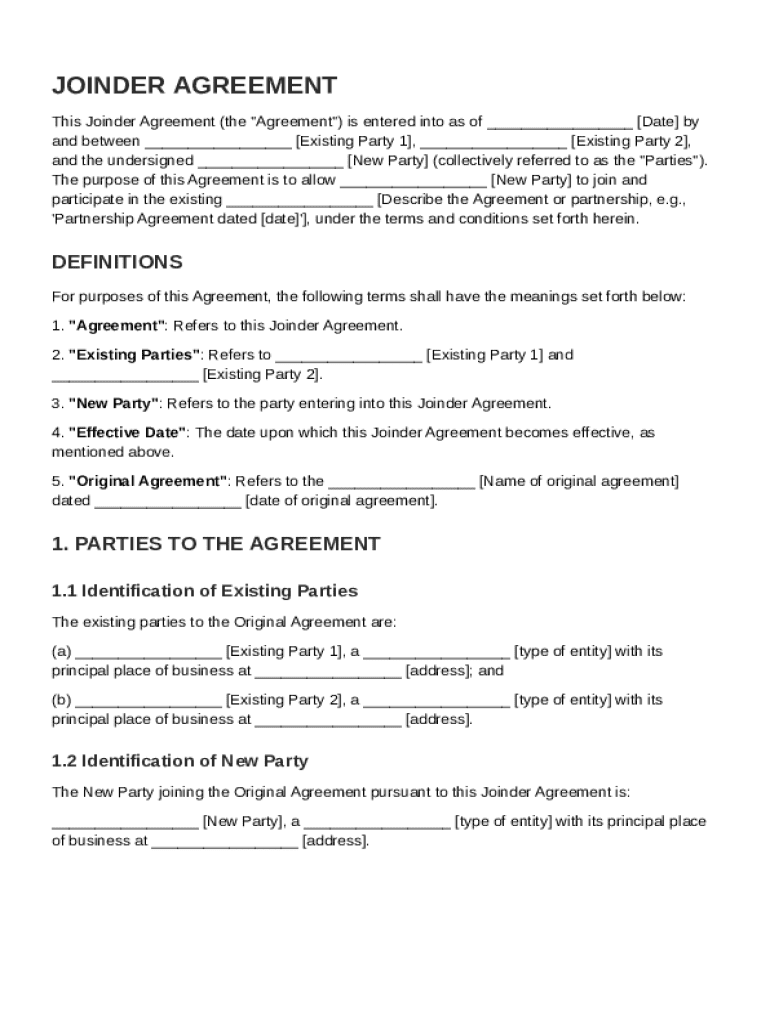







Definition and Meaning of a Joinder Agreement
A Joinder Agreement is a supplemental document utilized to incorporate a new party into an existing partnership or agreement. This document carefully delineates the terms and conditions that govern the new party's involvement. Key aspects include the identification of the parties, acknowledgment of consent to the original agreement, and the effective date. It ensures that the new member is formally accepted under the same rights and obligations as the original signatories. In legal contexts, it functions to extend the binding nature of the initial agreement to any additional stakeholders. The document might also specify modifications, if any, to harmonize with legal and operational frameworks.
Steps to Complete the Joinder Agreement Template
- Identify the Parties: Begin by listing all parties involved, including the newly joining member. This section should clearly define the roles and responsibilities of each entity.
- Consent to the Original Agreement: The joining party must formally acknowledge and consent to the previously established agreement terms. This step ensures that all entities are aligned in their understanding.
- Specify the Effective Date: Clearly state when the joinder takes effect, marking the official start of the new party's involvement.
- Define Key Terms and Conditions: Outline any additional terms or modifications that specifically apply to the new member while maintaining consistency with the original agreement.
- Include Representations and Warranties: Both the existing and new parties should provide representations and warranties to verify their legal capacity and intent to enter into the agreement.
- Incorporate Governing Law and Modifications Clause: Specify the jurisdiction governing the agreement and any provisions for future amendments to ensure legal compliance.
Key Elements of the Joinder Agreement Template
- Identification Information: Comprehensive details about the parties involved, including names, designations, and roles.
- Consent and Acknowledgment: A section requiring the new party to acknowledge understanding and agreement with the original contract's terms.
- Effective Date: The specific date when the new party becomes officially part of the agreement.
- Representations and Warranties: Clauses that affirm the competence and intent of all parties to uphold their obligations.
- Governing Law: The legal jurisdiction under which the agreement will be interpreted and enforced, which could vary depending on state or federal laws.
- Modifications: Terms that outline how amendments to the agreement should be handled.
Legal Use of the Joinder Agreement Template
The Joinder Agreement serves a critical role in formalizing the membership of a new party within an existing legal framework. It ensures continuity and legal enforceability of rights and obligations across all stakeholders. The agreement adheres to U.S. federal and state laws, providing a robust structure that respects both statutory requirements and contractual liberties. In scenarios where litigation or disputes arise, the joinder facilitates a clear reference point for the roles and responsibilities of each party. Legal practitioners often use these agreements to manage partnership formations, corporate expansions, and multi-party collaborations.
Important Terms Related to Joinder Agreement Templates
- Parties: Entities involved in the agreement including original signatories and the new member.
- Effective Date: The date on which the new party's involvement becomes active.
- Representations and Warranties: Assurances provided by parties regarding their authority and intent within the agreement.
- Jurisdiction: The legal framework governing the agreement.
- Amendments: Changes made to the original contract terms to include new parties or conditions.
State-Specific Rules for the Joinder Agreement
Joinder Agreements must align with specific state regulations, which can vary significantly across jurisdictions. In some states, additional disclosures or notarizations might be required to validate the document. While the core structure of a Joinder Agreement remains consistent, particular clauses such as those related to dispute resolution and governing law might differ based on state mandates. Practitioners should confirm compliance with state-specific corporate or partnership statutes to ensure the agreement’s validity.
Examples of Using the Joinder Agreement Template
In practice, a Joinder Agreement might be used when a new business partner joins an existing LLP (Limited Liability Partnership). It outlines their share of profits, management role, and responsibilities. Another instance could involve a shareholder who wishes to join a corporation, requiring clear terms on share allocation and voting rights. These templates are also pivotal in franchises when a new franchisee is onboarded, ensuring clear communication of brand guidelines and operational expectations.
Software Compatibility for the Joinder Agreement Template
Digital management of Joinder Agreements is a necessity in today’s corporate environment. Platforms, such as DocHub, offer seamless compatibility with cloud-based services like Google Workspace. This enhances document accessibility and collaborative editing capabilities, accommodating users who prefer online, real-time modifications over traditional paper processes. Tools integrated with platforms like DocHub ensure documents remain secure and legally binding as they are shared, edited, and signed electronically.




