Definition and Meaning of the ISDA Agreement Template
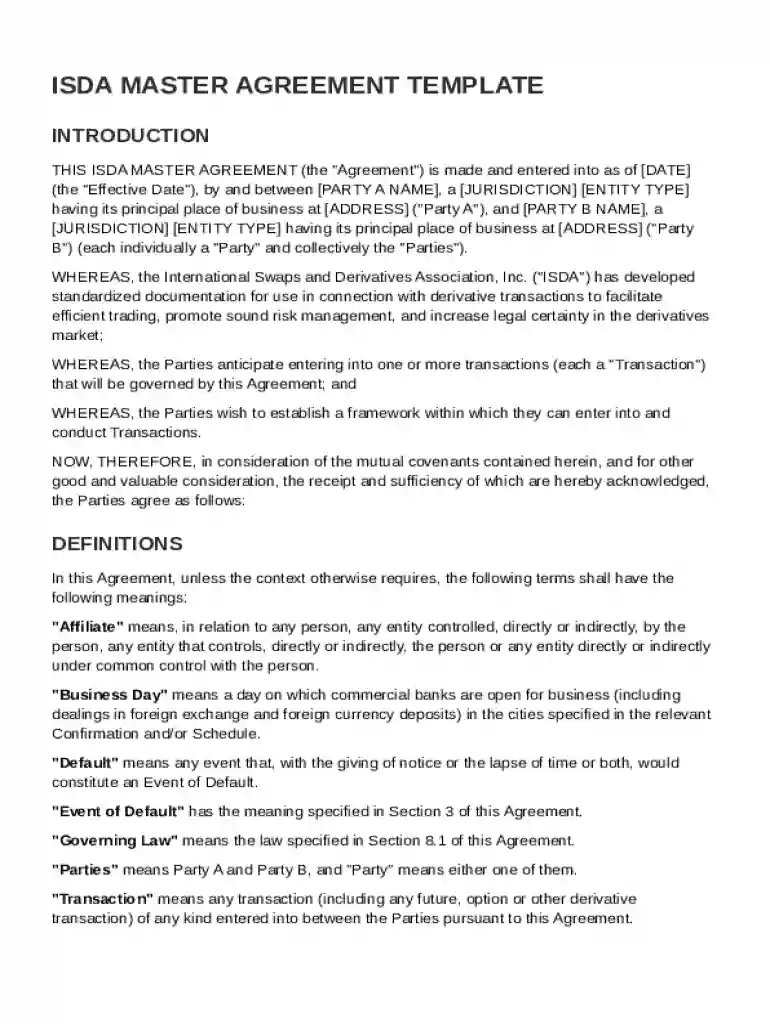
The ISDA Master Agreement Template is a foundational legal document used to govern over-the-counter (OTC) derivatives transactions between two parties, commonly referred to as Party A and Party B. This template standardizes the framework for these transactions by providing clear definitions and general terms that both parties agree to adhere to. The agreement aims to streamline trading operations and manage risks effectively while ensuring legal certainty across the derivatives market. It is essential for parties involved in derivatives trading to comprehend this template to ensure mutual understanding and compliance.
How to Use the ISDA Agreement Template
Utilizing the ISDA Agreement Template involves several key steps, crucial for both legal accuracy and operational efficiency:
- Review Initial Terms: Begin by thoroughly reading the definitions and general provisions to understand the baseline requirements.
- Customize Provisions: Modify sections that allow for specific terms unique to the transaction, such as credit support or collateral arrangements.
- Negotiate with the Counterparty: Engage in discussions with the other party to clarify any adjustable components and establish agreed-upon terms.
- Draft Schedule: Complete the accompanying schedule to specify details such as payment procedures, choice of governing law, and dispute resolution policies.
- Finalize Execution: Both parties should sign the completed agreement, thus formalizing the derivatives transaction framework.
Key Elements of the ISDA Agreement Template
The ISDA Agreement Template consists of various critical elements that ensure robust and transparent trading between parties:
- Definitions Section: Provides detailed explanations of keywords and phrases used throughout the document.
- General Terms and Representations: Outlines the obligations and warranties undertaken by each party.
- Events of Default: Specifies conditions under which a party may terminate the agreement.
- Termination Clauses: Details the procedures and consequences of early termination.
- Payment Procedures: Explains the method and timetable for transactions and settlements.
- Indemnities: Addresses the indemnification obligations of each party to protect against potential losses.
Steps to Complete the ISDA Agreement Template
Completing the ISDA Agreement Template involves a systematic approach to ensure all areas are addressed accurately:
- Initial Review and Understanding: Read through the entire document to familiarize yourself with the framework and requirements.
- Data Gathering: Compile necessary information such as party details, transaction specifics, and any bespoke terms.
- Drafting Modifications: Clearly outline any negotiated alterations or additions that are specific to the transaction.
- Collaborative Completion: Work with the counterparty to ensure mutual agreement on terms and adjustments.
- Legal Review: Have legal counsel inspect the agreement to verify compliance with applicable laws and industry standards.
- Execution: Secure signatures from both parties after reaching full consent on the document’s terms.
Legal Use of the ISDA Agreement Template
The ISDA Agreement Template plays a significant role in legally bounding derivative transactions, facilitated by adherence to the following:
- Compliance with the ESIGN Act: Ensures that electronic signatures utilized in execution are legally binding and recognizable.
- Governing Law: The parties choose the applicable legal jurisdiction, which typically establishes the enforceability of the agreement.
- Dispute Resolution Mechanisms: Outlines clearly defined processes for resolving any disagreements between parties, including arbitration or litigation if necessary.
Important Terms Related to the ISDA Agreement Template
Understanding crucial terms associated with the ISDA Agreement Template is vital for effective execution:
- Counterparty Risk: The probability that one party might default on its contractual obligations.
- Mark-to-Market: A method of valuing a derivatives position based on its current market price rather than its book value.
- Credit Support Annex: An optional annex that facilitates the provision of collateral by one or both parties to mitigate credit risk.
- Netting: The offsetting of positions or payment obligations to reduce overall exposure.
Examples of Using the ISDA Agreement Template
Practical examples showcase the application of the ISDA Agreement Template in varying scenarios:
- Hedging Foreign Exchange Risk: A multinational corporation enters into a derivatives transaction using the ISDA agreement to hedge currency fluctuations.
- Interest Rate Swaps: Financial institutions use the template to standardize interest rate swap agreements, facilitating smoother cash flow management.
- Commodity Trading: Entities involved in trading commodities such as oil or metals utilize the template to manage the financial risk associated with price changes.
Business Types that Benefit Most from the ISDA Agreement Template
Numerous business entities find significant value in adopting the ISDA Agreement Template:
- Financial Institutions: Banks and investment firms use it to regulate complex financial instruments and risk management strategies effectively.
- Corporations with Global Operations: These entities leverage derivatives to hedge against risks associated with global market fluctuations.
- Pension Funds and Hedge Funds: Such organizations use the template to manage the risk-return profiles of their investment portfolios.
Versions or Alternatives to the ISDA Agreement Template
While the ISDA Master Agreement is the most widely accepted framework, variations and alternatives do exist:
- 1992 and 2002 Versions: Two principal versions, each with distinct legal language and operational clauses, cater to different market requirements.
- Custom Variants: Firms may develop tailored agreements that incorporate specific terms not covered in the standard template.
- Non-ISDA Agreements: Other contract types may be used depending on transaction nature or jurisdictional preferences, although they may lack the universality and recognition of ISDA.