






Definition and Meaning
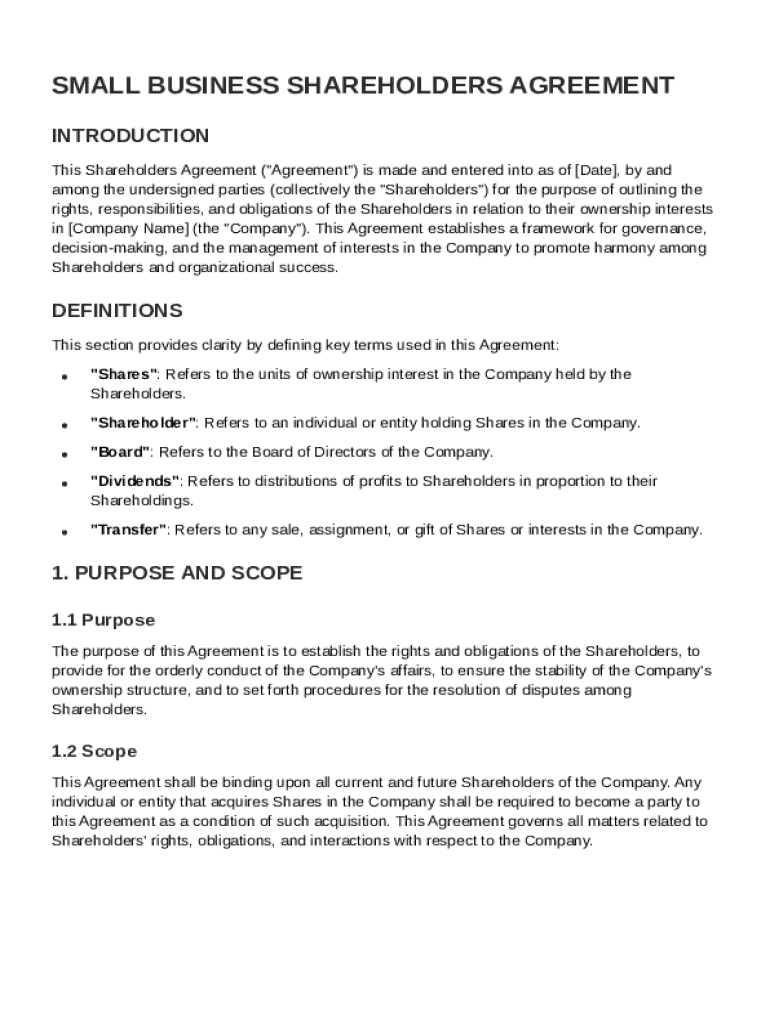
The Small Business Shareholders Agreement Template is a legally binding document that delineates the rights and responsibilities of shareholders within a small business. It serves as a fundamental framework for the governance of the company, addressing crucial topics like ownership interests, decision-making processes, and share transfers. This agreement not only helps in maintaining harmony among shareholders but also defines terms related to day-to-day operations and potential dispute resolutions.
Shareholders agreements typically include sections that clarify shareholder rights, obligations, and liability limitations. The template can be customized to reflect specific business needs, ensuring that all partners have a clear understanding of their role and responsibility within the organization. This document often also covers financial arrangements such as dividend distributions and detailed reporting requirements, aiding in transparent company management.
Why Use the Small Business Shareholders Agreement Template
Using a Small Business Shareholders Agreement Template provides numerous benefits for companies. It helps protect shareholders' interests by setting clear expectations and procedures for various scenarios, such as a shareholder wanting to sell their shares or leave the business. The agreement can prevent future conflicts by establishing pre-agreed methods for resolving disagreements, often including mediation or arbitration clauses.
Furthermore, having this agreement in place reassures investors and potential partners by showing that there is a robust governance structure, which can make the business more appealing and trustworthy. The template also ensures compliance with legal frameworks, reducing the risk of litigation by fulfilling statutory obligations and adhering to best practices.
Key Elements of the Small Business Shareholders Agreement Template
The template addresses several critical components necessary for successful business operations. Key elements include:
- Definitions of terms: Clearly outlines specific terminology used throughout the document to avoid ambiguity.
- Shareholder rights and responsibilities: Details each shareholder's duties, voting rights, and entitlements.
- Financial matters: Discusses aspects like dividends, capital contributions, and financial reporting requirements.
- Dispute resolution mechanisms: Provides agreed steps for resolving conflicts, helping to prevent expensive legal battles.
- Amendment and termination provisions: Outlines procedures for modifying or terminating the agreement, ensuring flexibility as the business evolves.
- Share transfer rules: Specifies how shares can be sold or transferred to ensure controlled and fair transactions.
These elements are designed to foster clear communication, align interests among shareholders, and support the smooth functioning of the business.
Important Terms Related to the Template
Understanding the terminology within the Small Business Shareholders Agreement Template is crucial. Important terms often found within these agreements include:
- Preemptive rights: Allows existing shareholders the right to buy additional shares before new external shareholders.
- Tag-along and drag-along rights: Protects minority shareholders in the event of a sale, either by allowing them to join the sale or compelling them to sell under specific circumstances.
- Vesting schedules: Often related to how and when shares are distributed to founders or key employees over time.
The precise definitions and applications of these terms will depend on the specific needs and goals of the business.
Steps to Complete the Small Business Shareholders Agreement Template
- Gather necessary information: Collect relevant data about the shareholders, their shareholdings, and the company's objectives.
- Review standard clauses: Understand and customize the template to fit the specific operational and strategic needs of the business.
- Determine financial arrangements: Decide on dividend policies, financial contributions, and any monetary obligations.
- Outline dispute resolution processes: Agree on acceptable methods for conflict resolution involving shareholders.
- Consult legal experts: Ensure compliance with local and federal laws by having the document reviewed by a legal professional.
- Get agreements signed: Once finalized, ensure all shareholders review and sign the document, acknowledging their understanding and commitment.
- Regularly update the agreement: Reflect any substantial changes in shareholders or company strategy in the document to maintain its relevance over time.
Software Compatibility and Integration
The DocHub platform offers seamless support for managing the Small Business Shareholders Agreement Template. Its compatibility with a wide range of file formats, including DOC and PDF, facilitates easy integration with existing documents. This adaptability ensures that users can work efficiently without worrying about file conversion issues.
- Google Workspace Integration: Direct imports from Google Drive enhance productivity, allowing real-time edits and streamlining the sharing process.
- Electronic signatures: DocHub's electronic signature feature ensures legal compliance while simplifying the execution of agreements.
These functionalities ensure a streamlined and efficient workflow for users engaging with the template.
Business Types that Benefit Most from the Template
Businesses poised to see the most value from a Small Business Shareholders Agreement Template include:
- Startups: As they establish initial ownership structures and seek investment while maintaining founder control.
- Small to medium enterprises (SMEs): Ensuring clear communication and ownership management as the business scales.
- Family businesses: Facilitating structured and fair involvement when family members are shareholders.
- Joint ventures: When multiple parties come together for a common business interest, having a clear shareholders' agreement can guide relations and commitments.
These organizational types often encounter challenges tackled by this template, making it an indispensable tool.
Real-World Examples of Using the Template
Consider a technology startup looking to secure venture capital. By using a Small Business Shareholders Agreement Template, the founders can clearly articulate the roles and obligations of investors, potentially accelerating the funding process. The agreement might include key terms attractive to investors, such as board representation or protective provisions, thus aligning interests and facilitating agreement.
In another scenario, a family-owned restaurant chain might utilize the template to formalize relationships and responsibilities among family members actively involved in the business. This practice can help avoid future disputes by mitigating assumptions and preventing miscommunication regarding decision-making processes and profit distribution.