
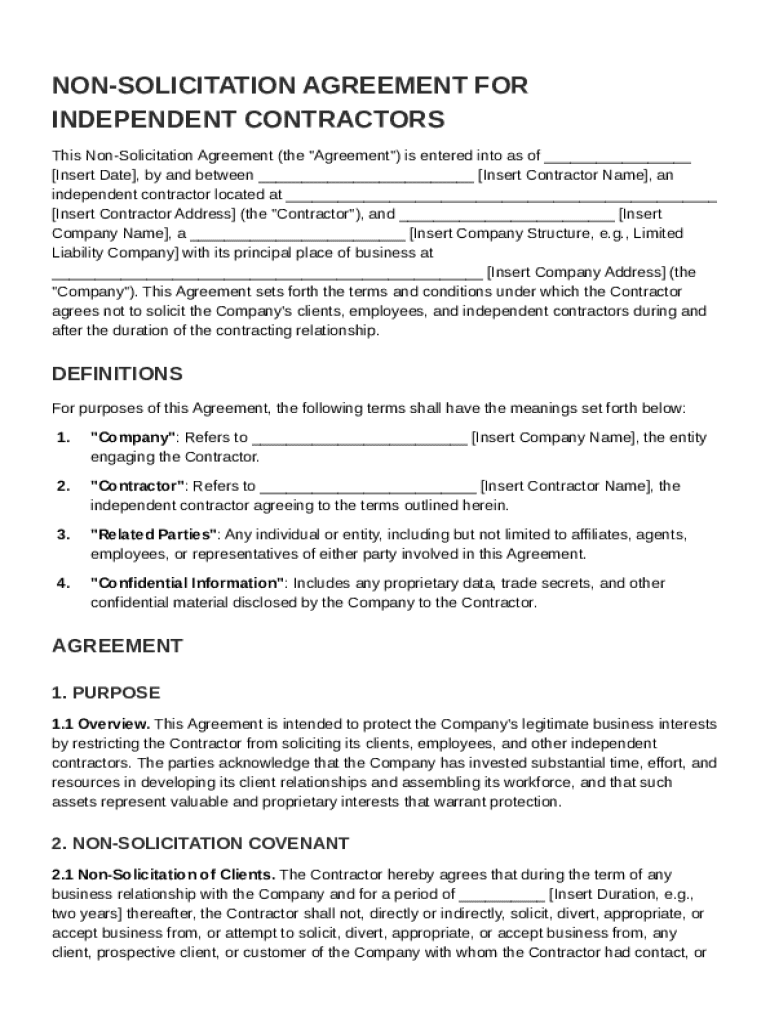







Definition & Meaning
A Non-Solicitation for Independent Contractors Agreement Template is a legal document used by businesses to protect their interests by preventing independent contractors from soliciting the company's clients, employees, or other contractors during and after their engagement. This agreement establishes clear boundaries and obligations, ensuring the contractor agrees to refrain from engaging in competitive activities that could harm the company's business relationships.
Key Components
- Non-Solicitation Clauses: Specifies what constitutes solicitation and outlines prohibited activities.
- Duration: Defines the time period during which the non-solicitation conditions apply.
- Geographic Scope: Identifies the geographical area where the agreement is enforceable.
Real-World Use Case
Consider a marketing consultant hired by a firm to create and implement a new campaign. Within the Non-Solicitation Agreement, the consultant agrees not to approach the firm's clients with whom they've interacted during the project period.
Key Elements of the Non-Solicitation for Independent Contractors Agreement Template
This template includes several pivotal elements that ensure clarity and enforceability:
Non-Solicitation Covenants
These covenants explicitly describe what the independent contractor is restricted from doing, typically including:
- Direct Solicitation: Barring the contractor from directly contacting clients or employees to offer services or employment.
- Indirect Solicitation: Preventing the solicitation through third parties or indirect communication channels.
Remedies for Breach
The agreement outlines potential remedies if the contractor fails to adhere to the terms. Examples include:
- Injunctions: Legal orders to cease the solicitation activities.
- Monetary Damages: Requirement to pay damages for any financial losses incurred by the company due to solicitation.
How to Use the Non-Solicitation for Independent Contractors Agreement Template
Employing the template effectively involves several key steps to ensure legal and practical functionality:
Step-by-Step Implementation
- Customize the Template: Adjust the general language to reflect the specific terms of your engagement with the independent contractor.
- Define Key Terms: Clearly articulate terms like "solicitation," "clients," and "confidential information."
- Consult Legal Professionals: Get a legal review to confirm that the template meets jurisdiction-specific requirements.
Practical Example
Suppose a company is engaging the services of a freelance software developer. The company would edit the template to include non-solicitation terms specific to software products and services.
Legal Use of the Non-Solicitation for Independent Contractors Agreement Template
The legal validity of this agreement is grounded in its ability to protect legitimate business interests, primarily concerning trade secrets and client relationships.
Jurisdictional Compliance
- Essential Legal Foundation: Ensure terms do not impose unreasonable restrictions that would render them unenforceable under local law.
- State-Specific Variations: Review and adapt the agreement according to state-specific legal precedents that may influence enforceability.
Example
In California, non-solicitation agreements are subject to strict scrutiny. Therefore, it is crucial to ensure the terms are reasonable and comply with local labor laws.
Important Terms Related to Non-Solicitation for Independent Contractors Agreement Template
Understanding the terminology within the agreement is crucial for both parties:
Commonly Used Terms
- Solicitation: The act of attempting to obtain business or human resources from the company.
- Client: Any individual or organization with whom the company has a business relationship.
- Protected Period: Specific timeframe during which the terms apply post-engagement.
Steps to Complete the Non-Solicitation for Independent Contractors Agreement Template
Completing the agreement involves distinct phases to ensure comprehensive coverage and acceptance:
Necessary Steps
- Review Initial Draft: Thoroughly read the initial version of the agreement for accuracy and comprehensiveness.
- Negotiate Terms: Discuss and agree on any modifications with the independent contractor.
- Execute the Agreement: Both parties sign and date the document, officially enforcing the terms.
State-Specific Rules for the Non-Solicitation for Independent Contractors Agreement Template
Adherence to state laws is vital to ensure the enforceability of the agreement:
Variations Across States
- California: Restricts non-solicitation clauses, focusing on protecting employee rights rather than client non-solicitation.
- New York: Allows more flexibility, provided the agreements are reasonable in scope and duration.
Ensuring Compliance
Research state law and consult with legal counsel to tailor the agreement appropriately for the geographical scope.
Who Typically Uses the Non-Solicitation for Independent Contractors Agreement Template
This template is widely used across various sectors to safeguard business interests:


Common Users
- Small and Medium Enterprises (SMEs): Leveraging external talent without risking client poaching.
- Tech Firms: Protecting intellectual property and client relationships.
- Marketing Agencies: Ensuring that contractors do not approach clients for personal gain post-engagement.

Software Compatibility and Integration
Seamless integration into existing document workflows is a priority:
Supported Platforms
- Google Workspace: Direct integration with Google Drive and Gmail for document management.
- Compatibility with Cloud Support: Utilizes platforms like Dropbox and OneDrive.
Efficiency Enhancement
Corporate environments use DocHub to manage, edit, and sign documents, streamlining processes significantly.




