Shared Parenting Agreement Template 2026

Get Form
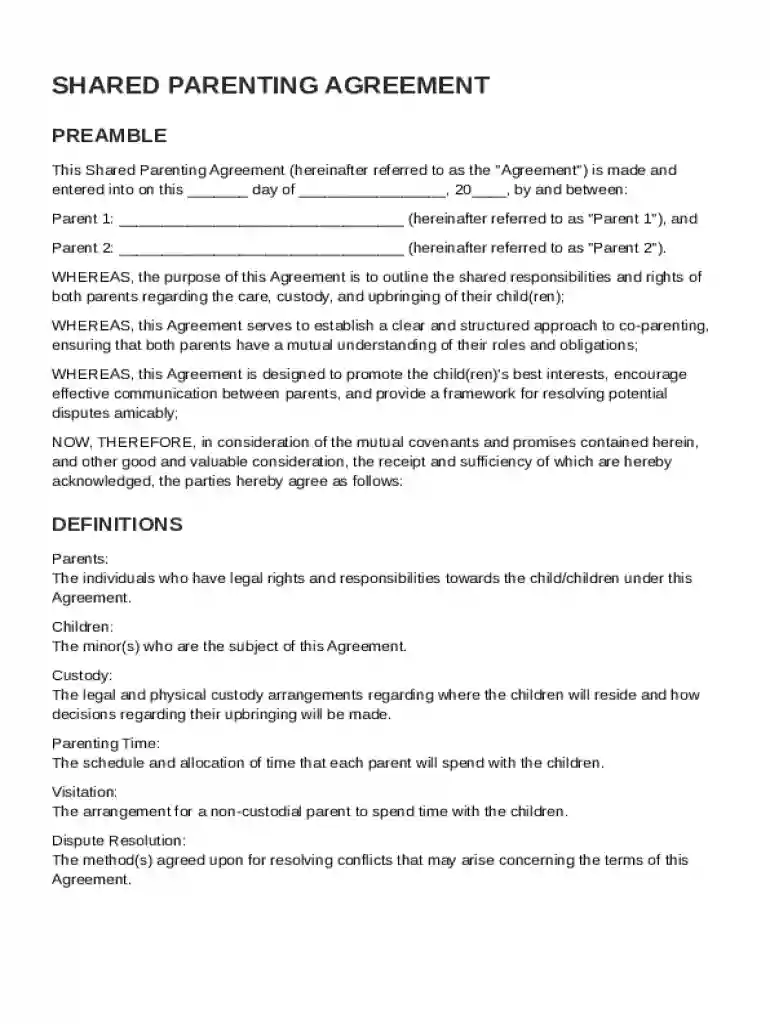
Shared Parenting Agreement Template Preview on Page 1

Here's how it works

01. Edit your form online
Type text, add images, blackout confidential details, add comments, highlights and more.

02. Sign it in a few clicks
Draw your signature, type it, upload its image, or use your mobile device as a signature pad.

03. Share your form with others
Send it via email, link, or fax. You can also download it, export it or print it out.

Definition and Meaning

The Shared Parenting Agreement Template is a structured document that formalizes the responsibilities and rights of parents post-separation or divorce. It outlines the framework for co-parenting, focusing on the best interests of the child through cooperative parenting efforts. This template includes various sections such as custody arrangements, dispute resolution methods, and financial obligations. By using this template, parents can ensure that both parties understand and agree on the upbringing and welfare of their children. It emphasizes clear communication and provides guidelines that minimize conflicts, ensuring a stable environment for the children involved.

Key Elements of the Shared Parenting Agreement Template

A well-drafted Shared Parenting Agreement Template contains several critical elements. These elements form the backbone of the parenting plan and must be detailed to avoid ambiguity:

  • Custody Arrangements: Specifies whether custody is joint or sole, detailing the decision-making rights of each parent.
  • Parenting Time Schedules: Defines how time with the child is divided between parents, including weekdays, weekends, holidays, and vacations.
  • Financial Responsibilities: Outlines child support obligations, sharing of educational and medical expenses, and other monetary obligations.
  • Modification Procedures: Sets guidelines for requesting changes to the agreement in response to changed circumstances or children's growing needs.

These elements ensure that the agreement is comprehensive and legally enforceable, minimizing potential future disputes.

Steps to Complete the Shared Parenting Agreement Template

Completing a Shared Parenting Agreement Template involves a systematic approach to ensure all aspects are addressed thoroughly. Below are the essential steps:

  1. Gather Necessary Information: Collect details about each parent's contact information, the children's personal and schooling details, and financial obligations.
  2. Discuss and Agree on Terms: Engage both parents in discussions to come to a consensus on custody, visitation, and financial responsibilities.
  3. Draft the Agreement: Use the template to input agreed-upon terms systematically. Ensure clarity and avoid legal jargon where possible.
  4. Review with Legal Counsel: It is advisable to consult a family law attorney to review the agreement for compliance with state laws.
  5. Finalize and Sign: Once both parties agree and any legal reviews are complete, sign the agreement in the presence of a notary public if required.

These steps provide a clear path to creating a fair and comprehensive parenting agreement.

Legal Use of the Shared Parenting Agreement Template

In the United States, a Shared Parenting Agreement is a legally recognized document used in family law to set terms for the care of children. It is particularly vital after separation or divorce to structure co-parenting efforts. The agreement must comply with state-specific laws, as family law varies widely across states. Courts often use these agreements as part of custody rulings whenever disputes arise. Importantly, for the agreement to be enforceable, both parents must voluntarily sign it, indicating mutual consent and understanding of the terms. This framework ensures children receive consistent care, regardless of parental relationship dynamics.

State-Specific Rules for the Shared Parenting Agreement Template

State laws can significantly influence the structure and enforceability of a Shared Parenting Agreement. Some states, like California, emphasize joint custody and equal parenting time, while others might have different default custody arrangements. For instance:

  • California: Prioritizes children's frequent and continuous contact with both parents.
  • Texas: Offers standard possession orders as a guideline but allows customization through mutual agreements.
  • New York: Considers the child's best interests with a nuanced approach to modifying custody arrangements.

Understanding these variations is crucial as they affect both the formation and potential modification of the parenting agreement.

Important Terms Related to Shared Parenting Agreement Template

Comprehending specific legal terms related to Shared Parenting Agreements can improve the drafting and effectiveness of the document:

  • Joint Custody: Where both parents share decision-making responsibilities.
  • Sole Custody: When only one parent has the legal authority to make significant decisions for the child.
  • Mediation Clause: As part of the agreement, specifies that disputes should first be addressed through mediation before legal action.
  • Parenting Coordinator: A neutral third party who assists in resolving high-conflict co-parenting issues.

Each term has legal implications that can influence the entire child-rearing arrangement.

Examples of Using the Shared Parenting Agreement Template

Consider a scenario involving parents, John and Jane, who are recently divorced. They used a Shared Parenting Agreement Template to outline equal parenting time and financial responsibilities. The agreement specified that John would pick up their child every Thursday evening, leading to structured schedules reducing conflict and enhancing cooperation. Another example includes parents who live in different states. Their agreement ensured holiday time was split equitably, allowing the children to experience both parents equally. These agreements are adaptable, serving diverse familial backgrounds and unique arrangements effectively.

Software Compatibility for Shared Parenting Agreement Template

Using digital tools like DocHub for creating and managing a Shared Parenting Agreement Template brings several benefits. The platform is compatible with various software systems and file formats:

  • Integration with Google Workspace: Seamlessly import documents from Google Drive for immediate editing.
  • Compatibility with PDF Editors: Edit and annotate directly in PDF format without conversion hassles.
  • Cloud Storage Syncing: Access and store your agreements in OneDrive or Dropbox for enhanced accessibility.

This technological compatibility ensures that users can efficiently handle their documentation process while maintaining data integrity and security.

How to Use the Shared Parenting Agreement Template

Implementing the Shared Parenting Agreement Template effectively requires a few essential practices. Start by customizing sections to reflect each parent's capabilities and the child's needs. Use the template as a framework to ensure balanced parenting time, adapting it to changing circumstances like new jobs or relocations. Review it regularly in case modifications are necessary. Utilize digital tools for easy sharing and updates, ensuring both parents have access to the most recent version. This pragmatic approach enhances consistency and facilitates smoother co-parenting dynamics across different living situations.

be ready to get more

Complete this form in 5 minutes or less

Get form

Got questions?

We have answers to the most popular questions from our customers. If you can't find an answer to your question, please contact us.
Contact us
If youre asking for `50 50 shared custody the closest to what really exists is an order that specifies children divide their time equally between both parents and a shared residence order (although an order that doesnt mention residence at all does exactly the same thing!)
Emotions: The inability of parents to consistently control their emotions, and avoid emotional decision making, is the most common mistake we see in child custody cases. The reason: it is such an easy mistake to make, and so pervasive in all aspects of the case.
The common perception has historically favored mothers, but recent shifts in family law show that this assumption is no longer universally accurate. Courts today aim to make custody decisions based purely on the childs best interests, balancing various factors regardless of parental gender.
Here are some of the most common examples: The 50/50 Custody Split: Equal Time, Shared Responsibilities. A 50/50 custody split involves dividing the childs time equally between both parents. The 60/40 and 70/30 Arrangements: Adjusting Parental Involvement. Alternating Weeks and Extended Weekends: Finding Balance.
Until a court order confirms otherwise the father has a right to equal custody of the child. If the child is born into the marriage then the father has automatic parental responsibility over the child.

Security and compliance

At DocHub, your data security is our priority. We follow HIPAA, SOC2, GDPR, and other standards, so you can work on your documents with confidence.

Learn more
ccpa2
pci-dss
gdpr-compliance
hipaa
soc-compliance
be ready to get more

Complete this form in 5 minutes or less

Get form

People also ask

The following are six common ways for parents to split child custody evenly using a two-week time frame. Splitting Child Custody Every Other Week. Splitting Custody Every Other Week Plus One Overnight. A 3-3-4-4 Custody Schedule. A 2-2-5-5 Child Custody Schedule. A 2-2-3 Custody Schedule. Splitting Custody Every Other Day.
The 2-2-5-5 joint custody schedule is a parenting plan used to split child custody time equally between two parents. Its a good option for parents who want to maintain a close relationship with their children and share responsibilities fairly.
Benefits of Co-Parenting Stability: Kids in a co-parenting setup experience consistency in expectations, communication, and schedules from co-parents, which makes them feel stable and safe. As such, they are better armed to face overwhelming life situations.

Related links