
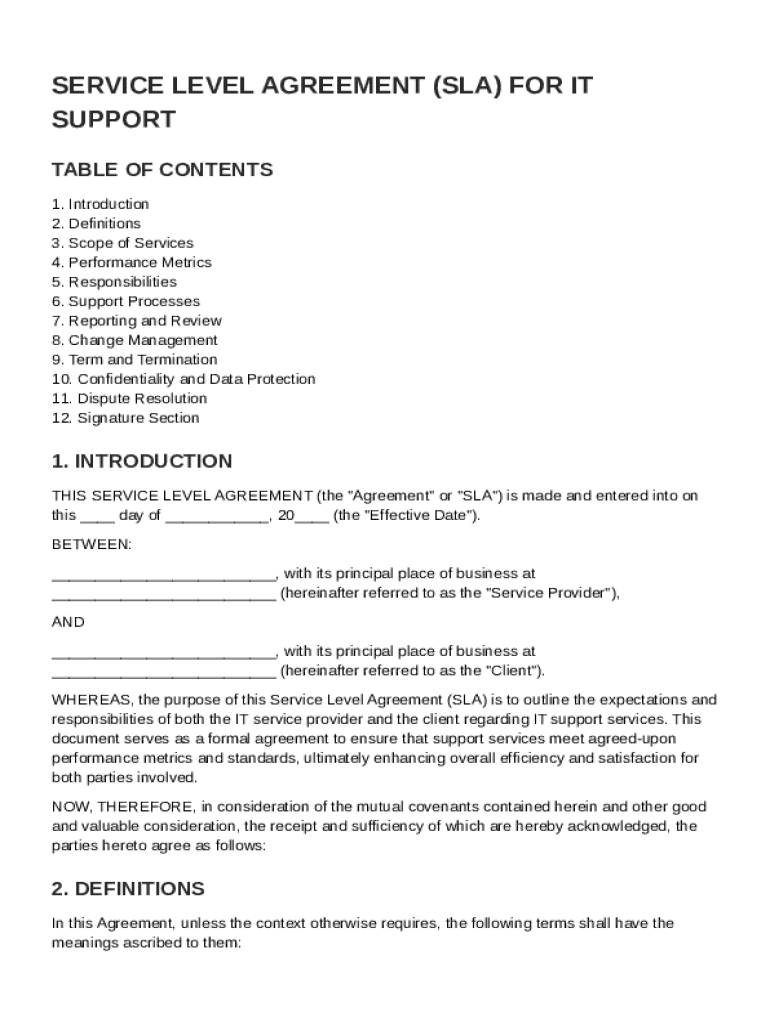







Definition and Meaning
A Service Level Agreement (SLA) for IT support is a formal document that outlines the relationship between a service provider and a client. It details specific responsibilities, performance metrics, and expected service levels related to IT support. This agreement ensures clarity by specifying the scope of services provided, response times for incidents, and the ways in which services will be measured and reported. SLAs are vital for setting mutual expectations, providing both parties with a clear understanding of the service standards.
Key Elements of the Service Level For IT Support Agreement Template
An effective SLA for IT support includes several critical components to ensure comprehensive coverage. Key elements include:
- Service Scope: Details of what IT support entails, including specific tasks and areas of responsibility.
- Performance Metrics: Pre-defined criteria to measure the effectiveness and quality of IT support services.
- Response and Resolution Times: Timeframes within which the service provider commits to responding to and resolving issues.
- Reporting Processes: Methods and frequency of reporting service performance to the client.
- Change Management Procedures: Protocols for implementing changes in the service delivery process.
- Confidentiality Obligations: Measures to protect the client's sensitive information.
- Dispute Resolution Methods: Processes for addressing and resolving disagreements or issues that arise.
How to Use the Service Level for IT Support Agreement Template
Using the Service Level Agreement template effectively involves several steps which ensure that the document meets the specific needs of both the service provider and the client:
- Review and Customize: Begin by examining the template and customizing it to reflect the scope and nature of the IT services you provide.
- Define Performance Levels: Clearly outline the desired performance standards and how these will be measured and reported.
- Set Clear Deadlines: Agree on realistic timeframes for issue responses and resolutions.
- Consult Both Parties: Both parties should review the agreement to ensure it aligns with their expectations and capabilities.
- Formalize the Agreement: Once finalized, both parties should sign the document to make it legally binding.
Why You Should Use a Service Level For IT Support Agreement Template
Utilizing a Service Level Agreement template for IT support offers several benefits:
- Clarity: The template provides a structured approach to define and agree upon service expectations.
- Risk Reduction: Clearly defined terms reduce the risk of misunderstandings that could lead to disputes.
- Performance Monitoring: It helps in establishing performance metrics that allow for regular monitoring and reporting.
- Legally Binding: The agreement provides legal protection and serves as a point of reference should disputes arise.
Important Terms Related to Service Level For IT Support Agreement Template
Understanding the terminology used in SLAs is critical. Key terms include:
- Incident: Any event which is not part of the standard operation of a service, potentially causing disruption.
- Resolution: The process of addressing and correcting an incident.
- Uptime: A measure of the time a service is up and available.
- Downtime: The period during which a service is not operational.
- Escalation: A predefined process for raising unresolved issues to higher authority levels.
Steps to Complete the Service Level For IT Support Agreement Template
Completing the SLA template effectively involves several structured steps:
- Identify Parties: Clearly state the name and details of both the service provider and the client.
- Define Service Terms: Write down specific details such as service scope, performance metrics, and response times.
- Outline Obligations: Clearly specify the responsibilities and duties of each party.
- Include Confidentiality Clauses: Add terms related to the handling and protection of sensitive information.
- Set Dispute Resolution Mechanisms: Establish processes for resolving potential conflicts or disagreements.
- Review and Sign: Ensure both parties understand and agree with all terms before signing.
Legal Use of the Service Level For IT Support Agreement Template
While SLAs are valuable tools for ensuring service efficiency and clarity, they must comply with legal standards to be enforceable:
- Compliance: Ensure the agreement aligns with relevant federal, state, and local laws.
- Data Protection: Incorporate legal requirements for data protection, including adherence to privacy laws.
- Validity: Check that all parties involved have the legal capacity to enter into the contract.
Examples of Using the Service Level For IT Support Agreement Template
Service level agreements can be applied in various IT contexts, providing structure and clarity:
Case Study: Managed IT Services
Consider a managed IT service provider offering round-the-clock support to a large financial institution. An SLA would outline specific response times for critical incidents, ensuring rapid resolution to avoid data loss or work stoppage.
Case Study: Cloud Service Provider
For a cloud service provider, the SLA might emphasize uptime guarantees, ensuring clients that their online services will rarely (if ever) become unavailable. This agreement can include specific clauses on data recovery and redundancy measures.
These examples highlight the importance of a well-crafted SLA in fostering strong, transparent relationships between IT service providers and their clients.




