






Definition & Meaning
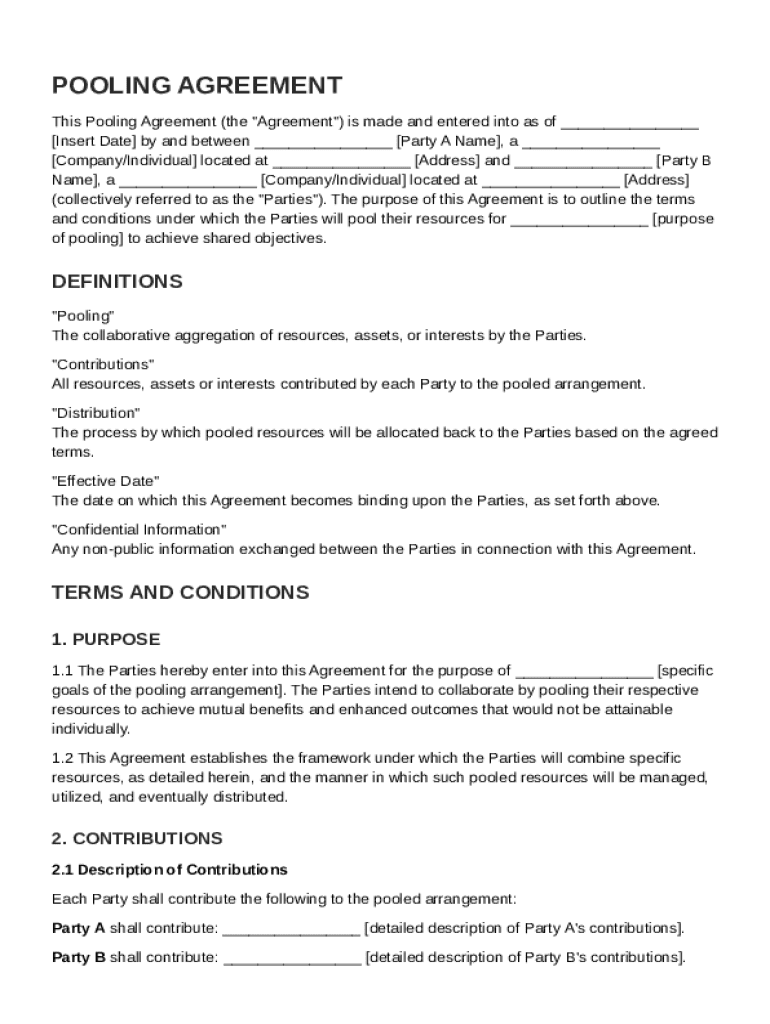
A pooling agreement is a legal document that outlines the terms and conditions under which two or more parties agree to combine their resources to achieve common objectives. This form typically sets the framework for collaborative efforts, defining critical concepts such as 'Pooling,' 'Contributions,' and 'Distribution.' The agreement serves as a guideline for how pooled resources are managed, decisions are made, and resources are distributed, ensuring clarity and understanding among the parties involved.
How to Use the Pooling Agreement Template
Utilizing a pooling agreement template can streamline the drafting process of a pooling agreement by providing a structured format. This template offers predefined sections that guide users to input required information effectively. Users begin by downloading the template, either from relevant online document platforms or as provided by legal services. The template is a tool that assists parties in specifying their contributions, roles, and responsibilities.
- Download: Acquire the template from a trusted platform or document service.
- Edit: Use document editing software to fill in the customizable fields.
- Review: Thoroughly check entries for accuracy and completeness.
- Finalize and Sign: Once edited, stakeholders should review and sign to confirm their agreement.
Key Elements of the Pooling Agreement Template
A robust pooling agreement template typically includes several key elements that contribute to the agreement's clarity and effectiveness. The essential components ensure that the arrangement between parties is detailed and mutually understood. Here's what a comprehensive template might include:
- Purpose of Pooling: Clear articulation of the objectives and goals.
- Contributions: Details on what each party will contribute, whether financial, services, or materials.
- Management Structure: Outline of how the arrangement will be managed, including roles and responsibilities.
- Decision-Making Process: A description of how decisions regarding the pooled resources will be made, identifying leading parties or decision-makers.
- Distribution of Resources: Criteria and methods for resource allocation.
- Confidentiality Agreement: Clause to protect sensitive information shared among parties.
- Legal Clauses: Includes liability, indemnification, governing law, and amendment procedures.
Steps to Complete the Pooling Agreement Template
Completing a pooling agreement template involves several methodical steps to ensure all necessary information is addressed:
- Gather Information: Collect all pertinent details about the parties, contributions, and objectives.
- Personalize the Template: Enter the specific information in the designated fields of the template.
- Outline Responsibilities: Clearly define the obligations and responsibilities of each party.
- Set Up Decision-Making Processes: Establish a formal decision-making framework.
- Add Legal Provisions: Ensure inclusion of all necessary legal clauses dealing with liability, amendments, and conflict resolution.
- Review and Verify: Double-check that all information is complete and accurate.
- Sign: All parties sign to validate the agreement, possibly using electronic signature capabilities if available.
Who Typically Uses the Pooling Agreement Template
Pooling agreement templates are commonly used by entities that seek to combine resources for a shared purpose.
- Businesses: Companies can use this template to pool financial or material resources for mutual benefit, such as in joint ventures.
- Nonprofits: Organizations might pool donations or resources for a larger cause.
- Government Agencies: Different departments might pool budgets or equipment to tackle common projects.
- Research Institutions: Universities or labs could pool scientific resources or data for collaborative research efforts.


Important Terms Related to Pooling Agreement Template
Understanding the terminology in a pooling agreement is crucial for comprehending its full scope and implications. These key terms typically include:
- Pooling: The process of grouping resources for a collective objective.
- Contributions: What each party brings to the table, whether it’s financial, intellectual, or material.
- Distribution: How the pooled resources are allocated among the parties.
- Amendments: Guidelines for how the agreement can be modified post-signature.
- Governing Law: The legal jurisdiction under which the agreement is enforced.
Legal Use of the Pooling Agreement Template
When utilizing a pooling agreement template, it's important to ensure that its use complies with legal standards. A legally valid pooling agreement:
- Must include clear language that accurately reflects the parties' intentions and contributions.
- Should comply with relevant state and federal laws, particularly regarding partnership and commercial law.
- Requires signatures of authorized representatives from each party involved to be enforceable.
- Needs to address potential liabilities and include indemnification clauses to mitigate risks.
- Often requires review by a legal professional to ensure conformity with applicable legal standards.
State-Specific Rules for the Pooling Agreement Template
Pooling agreement requirements can vary significantly by state, especially concerning business and contract law. Some considerations include:
- State Jurisdiction Laws: Each state might have specific rules governing how such agreements should be formatted and enforced.
- Registration Requirements: Certain states may require the pooling agreement to be registered or filed with a government body, depending on its nature.
- Local Legal Requirements: Some states might necessitate additional clauses or modifications to reflect local legislation better.
- Tax Implications: States could impose different tax treatments on pooled resources, depending on their use and outcome.
Understanding these nuances is critical for ensuring legal compliance and smooth operation across state jurisdictions.