




01. Edit your form online
Type text, add images, blackout confidential details, add comments, highlights and more.

Type text, add images, blackout confidential details, add comments, highlights and more.

Draw your signature, type it, upload its image, or use your mobile device as a signature pad.

Send it via email, link, or fax. You can also download it, export it or print it out.
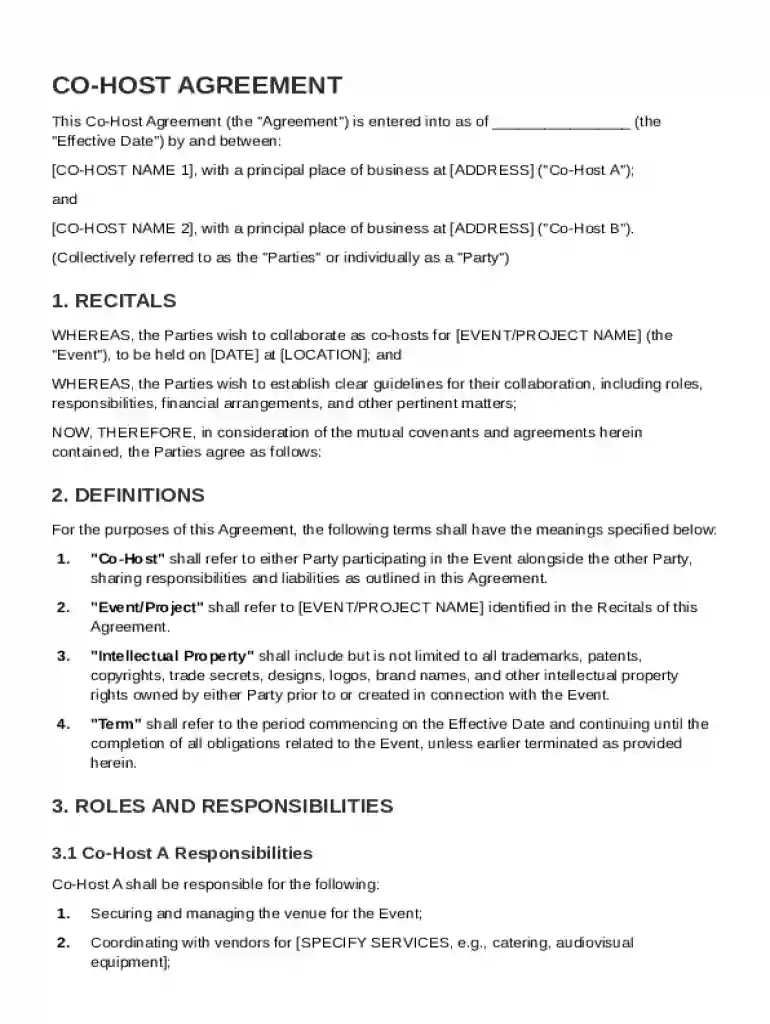
A Co-Host Agreement Template is a legally binding document that outlines the collaboration between two parties, hereafter referred to as Co-Host A and Co-Host B, for the purpose of organizing a specific event. This template serves as a comprehensive guide to establishing the roles, responsibilities, and expectations of each co-host, ensuring that both parties are aligned and committed to the successful execution of the event. Typically, these agreements include sections detailing the financial contributions, responsibilities regarding event logistics, and the division of any revenue generated from the event. By formalizing these details, the agreement aims to minimize the potential for misunderstandings or conflicts between the co-hosts.
The Co-Host Agreement Template covers several key elements essential for a successful partnership. These typically include:
Roles and Responsibilities: A detailed account of what each co-host is expected to contribute in terms of event planning, execution, and follow-up.
Financial Contributions: Specification of how costs will be divided and managed, including who will front any initial expenses and how profits or losses will be shared.
Revenue Sharing: The method of allocating any revenue generated by the event, such as ticket sales or sponsorships.
Communication Methods: Agreed-upon methods and frequency of communication to ensure that both parties remain informed and can make timely decisions.
Intellectual Property Rights and Confidentiality: Parameters ensuring any shared content or proprietary information is protected and remains confidential.
Conflict Resolution Procedures: A plan for managing disagreements or misunderstandings, often involving mediation or arbitration.
Terms of Termination: Conditions under which the agreement may be dissolved, including notice periods and potential penalties.
Filling out a Co-Host Agreement Template involves several critical steps to ensure that all necessary components are accurately addressed:
Identify the Parties Involved: Begin by specifying the names and contact details of Co-Host A and Co-Host B.
Detail Roles and Responsibilities: Clearly outline what each party will be responsible for, such as event planning, venue booking, or marketing.
Establish Financial Terms: Specify financial responsibilities, including how expenses will be shared and accounted for, and how profits will be divided.
Outline Revenue Sharing Mechanics: Define how any revenue will be distributed, taking into account ticket sales, sponsorships, or merchandise.
Set Communication Standards: Agree on the frequency and methods of communication, be it in person, over the phone, or via email.
Address Confidentiality and IP Rights: Clarify how any shared intellectual property will be managed and protected.
Decide on Conflict Resolution Mechanisms: Provide clear steps for resolving any disputes, including mediation or arbitration processes if necessary.
Sign and Date the Agreement: Ensure both parties sign the document to confirm their understanding and commitment to its terms.
The Co-Host Agreement Template is commonly used by individuals and organizations involved in event planning and management. These may include:
Event Planners and Organizers: Professionals who organize events regularly and often collaborate with other planners or sponsors.
Non-Profit Organizations: Groups that partner to host charity events, fundraising galas, or awareness workshops.
Businesses and Corporations: Companies that collaborate to host corporate events, industry conferences, or marketing campaigns.
Artists and Performers: Musicians, theater companies, or entertainers that co-host performances or art shows.


The legality of the Co-Host Agreement Template is a critical consideration. For it to be legally enforceable:
The Agreement Must Be In Writing: Both parties should have a signed, dated document.
Consideration Must Be Present: Each party must offer something of value, such as time, money, or proprietary expertise.
Capacity to Enter Contracts: Both Co-Host A and Co-Host B must have the legal ability to enter into the contract, typically meaning they are of sound mind and legal age.
Legal Purpose: The event and the corresponding agreement must be lawful in nature.
Real-world scenarios for using a Co-Host Agreement Template include:
A food festival co-hosted by a city government and a culinary association, where one party handles vendor setup and the other deals with permits and marketing.
A charity run organized by two non-profits, sharing responsibility for logistics and participant registration, while jointly benefitting from the funds raised.
A tech conference co-hosted by two companies, dividing costs and responsibilities for speaker arrangements, venue rental, and post-event surveys.
While the core elements of a Co-Host Agreement remain consistent, state-specific regulations may affect how certain components are addressed:
Contract Law Variations: Each state may have unique requirements for contract formation and enforcement, affecting dispute resolution or termination terms.
Tax Regulations: Revenue sharing and financial contributions might be influenced by state tax laws, necessitating clarity in how income is reported.
Event Licensing and Permits: Requirements for necessary licenses or permits may vary, affecting responsibilities outlined in the agreement.
Both co-hosts should consult with legal professionals familiar with local laws to ensure compliance.
For seamless handling of the Co-Host Agreement Template, it's beneficial to use digital platforms like DocHub, which offer:
Editing and Annotation Tools: Modify documents, add notes, and insert comments directly on the template.
Electronic Signature Capabilities: Easily add legally binding signatures to finalize the agreement.
Cloud Storage Integration: Import and export documents to and from services like Google Drive without requiring additional software installations.
Such platforms streamline the completion and management of agreement templates, enhancing collaboration between co-hosts.
At DocHub, your data security is our priority. We follow HIPAA, SOC2, GDPR, and other standards, so you can work on your documents with confidence.


An unlicensed Host should not be paid per booking and no fees can be tied to a booking, cannot advertise on a website even if it links to a different platform,Read more
Following is a list of the documents by category. Affiliation Vicarious liability overview Term sheet (affiliate agreement) Subsidiary structuresRead more


