
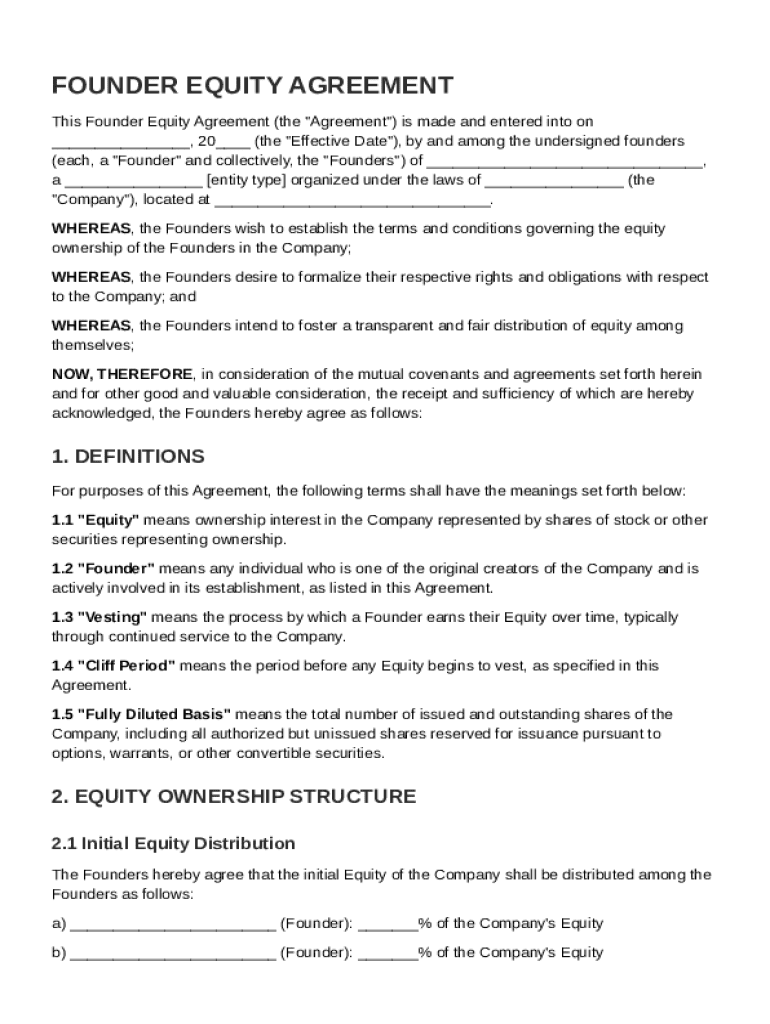







Definition & Meaning
The Founder Equity Agreement Template is a legal document that outlines the terms and conditions for equity ownership among the founders of a company. This template is designed to formalize the distribution of ownership interests, establish vesting schedules, and define the rights and obligations of each founder. It ensures transparency and fairness by providing a clear framework for how founder equity is managed and transferred. The agreement typically includes clauses addressing dispute resolution, restrictions on equity transfer, and other miscellaneous provisions necessary for harmonious founder relations.
Key Elements of the Founder Equity Agreement Template
An effective Founder Equity Agreement Template contains several critical elements:
- Equity Distribution: Specifies how much equity each founder receives initially, typically expressed as a percentage of the total shares or units.
- Vesting Schedules: Outlines the timeline and conditions under which founders earn their equity, preventing immediate full ownership. Vesting schedules often include a cliff period and regular vesting thereafter.
- Rights and Obligations: Details the rights each founder has concerning the equity, such as voting rights, profit-sharing, and decision-making authority. It also outlines each founder's obligations to the company and to each other.
- Transfer Restrictions: Sets terms for how and when equity can be sold or transferred, often requiring existing shareholders or the company to have the first right of refusal.
- Dispute Resolution: Provides mechanisms for resolving disagreements among founders, which can include mediation or arbitration clauses.
- Miscellaneous Provisions: Includes additional clauses that cover confidentiality, non-compete agreements, and any conditions specific to the company's operations.
Steps to Complete the Founder Equity Agreement Template
Completing the Founder Equity Agreement Template involves several essential steps:
-
Identify Founders and Define Roles: Clearly list all individuals who qualify as founders and their respective roles within the organization. This step ensures clarity and sets expectations from the outset.
-
Determine Initial Equity Distribution: Decide on each founder's percentage of ownership based on contributions such as capital, intellectual property, or labor.
-
Establish Vesting Conditions: Set the terms for vesting schedules, including any cliffs or stepwise vesting timelines, to align with the company's long-term objectives.
-
Outline Rights and Obligations: Clearly define what each founder's equity includes, such as voting rights and responsibilities, to minimize future disputes.
-
Specify Transfer Restrictions and Dispute Resolution: Include clauses that manage the transfer of shares and preferred methods for handling disputes, ensuring these align with the founders' collective interests.
-
Review Legal Compliance and Amendments: Examine the template for compliance with local legal requirements and provisions for modifications, as company dynamics evolve.
-
Finalize and Sign the Agreement: After careful review and consultation with legal professionals if needed, all parties should sign the agreement, making it legally binding.
Important Terms Related to Founder Equity Agreement Template
Understanding key terms is crucial for proper comprehension and execution of a Founder Equity Agreement:
- Equity: Represents ownership in the company, granting the holder rights to profits and decision-making.
- Vesting: The process through which founders earn their equity over time, typically tied to their continued participation in the business.
- Cliff and Gradual Vesting: "Cliff" refers to the initial vesting period where no equity is vested until a specific date. "Gradual" refers to incremental vesting periods following the cliff.
- Right of First Refusal: The company's right to purchase shares that a founder wishes to sell before they are offered to external parties.
- Dilution: The reduction of existing founders' ownership percentages due to the issuance of additional equity.
Legal Use of the Founder Equity Agreement Template
The legal utility of a Founder Equity Agreement Template is manifold. It serves as a safeguard against misunderstandings by clearly outlining the consideration (value) each founder contributes in exchange for equity. This agreement ensures that all founders adhere to predetermined vesting schedules and restrictions on equity transfer to protect the company's ownership stability. Furthermore, legally binding provisions like dispute resolution and transfer restrictions help maintain order and fairness during potential conflicts. It's advisable to consult with a legal professional when customizing the template to better align it with state-specific rules and enforceability.
State-Specific Rules for the Founder Equity Agreement Template
Each state in the U.S. may have specific legal statutes or requirements impacting the execution and enforceability of a Founder Equity Agreement. It's important to consider:
- Governing Law Clauses: Most agreements include a clause specifying which state's laws will govern the agreement. Selecting a business-friendly state could provide favorable conditions.
- Registering Entities: Certain states require the business entity to be registered or maintain specific records to enable the enforcement of the agreement.
- Variation in Enforcement: The enforceability of certain contract terms, like non-compete clauses or vesting schedules, can vary significantly from state to state.
Business Types That Benefit Most From Founder Equity Agreement Template
Several business types gain significant advantages from structuring their operations around a Founder Equity Agreement:
- Startups: High potential for rapid growth and funding rounds necessitates clear equity distribution, especially to satisfy investor expectations.
- Technology Firms: The frequent addition of technical co-founders means clear vesting and transfer terms are critical.
- Professional Services: Firms where initial contributions of labor and intellectual property form the basis for equity distribution.
- Joint Ventures: Partnerships among entities or individuals where contributions and benefits need to be equitably apportioned.
Versions or Alternatives to the Founder Equity Agreement Template
While the Founder Equity Agreement Template serves as a solid foundational document, businesses may explore alternatives or related documentation based on specific needs:
- Shareholder Agreements: Broader documents that can encompass founder equity terms alongside governance issues pertinent to all shareholders.
- Operating Agreements: Essential for LLCs, often integrating aspects of equity agreements for flexibility in management and profit distribution.
- Partnership Agreements: Detailed outlines for partners that often include specific equity arrangements as part of the overall partnership dynamics.
These alternatives can be either supplements or fully integrated solutions based on the business's legal and operational requirements.




