






Definition and Meaning of the Financial Payment Agreement Template
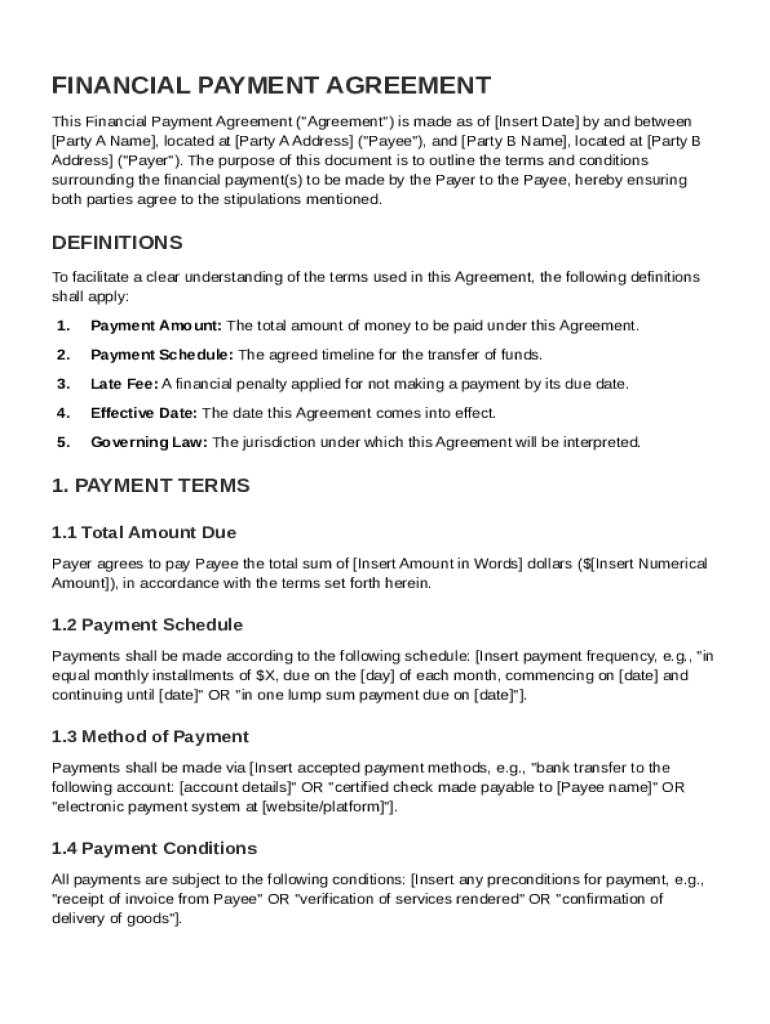
The Financial Payment Agreement Template is a structured document used to define crucial terms and conditions related to financial payments between a Payer and a Payee. It serves as a legal framework that specifies various aspects of payment arrangements, including payment amounts, schedules, methods, and the definitions of key terms used within the agreement. This template is essential for ensuring both parties have a mutual understanding of their obligations and responsibilities.
The agreement details consequences for late payments or defaults, providing a clear outline of what happens if one party fails to meet their commitments. It establishes the legal authority of each party involved and stipulates the governing law that will apply to the agreement. Additionally, the document includes clauses for amendments and severability, ensuring that even if one part of the agreement is deemed unenforceable, the remaining sections maintain their validity.
How to Use the Financial Payment Agreement Template
Utilizing the Financial Payment Agreement Template involves several key steps to ensure that it effectively serves its purpose. The template provides a foundation upon which specific details pertinent to the transaction at hand can be added.
-
Customizing the Template:
- Input specific details such as the names of the parties involved (Payer and Payee), the payment amount, and the agreed payment schedule.
- Specify the method of payment, whether it be electronic transfer, check, or another form of payment.
-
Reviewing Legal Obligations:
- Ensure that all legal obligations and rights are clearly outlined and understood by both parties.
- Verify that the governing law and the jurisdiction for potential dispute resolution are specified.
-
Adding Security Measures:
- Outline any security or collateral agreements that might be applicable.
- Define any penalties for late payment or non-compliance explicitly to prevent future disputes.
-
Finalizing and Signing:
- After completing the necessary customizations and ensuring mutual understanding and agreement, both parties should sign the document.
- Confirm that the document is legally binding upon signing. It can be signed either physically or with a legally enforceable electronic signature.
Key Elements of the Financial Payment Agreement Template
The template consists of several crucial components designed to capture all aspects of the financial agreement effectively.
- Parties Involved: Clearly identifies the Payer who makes the payment, and the Payee who receives it.
- Payment Terms: Details of the payment schedule, including the amount, frequency, and duration of payments.
- Payment Method: Specifies how payments will be made and outlines acceptable forms of payment.
- Default Penalties: Defines penalties for late payments or defaults, which may include additional fees or interest.
- Governing Law: Specifies which legal jurisdiction's laws will govern the agreement.
- Amendments Clause: Describes how any changes to the agreement will be handled.
- Signature Section: Provides a place for all parties to sign, recording their legal acceptance of the terms.
Important Terms Related to the Financial Payment Agreement Template
Understanding specific terminology is crucial for the effective use of the Financial Payment Agreement Template.
- Principal Amount: The original sum of money borrowed or agreed to be paid, excluding any interest or fees.
- Interest Rate: The percentage charged on the principal amount, applicable in agreements involving loans.
- Collateral: Assets pledged by the borrower to secure a loan.
- Default: The failure to fulfill the legal obligations of the agreement, often resulting in penalties.
- Severability: A clause ensuring that if part of the agreement is invalidated, the rest remains in effect.
Steps to Complete the Financial Payment Agreement Template
Completing the Financial Payment Agreement Template requires careful attention to detail and a sequential approach to fill in the required information accurately.
- Gather Necessary Information: Collect all relevant details from both parties, including identification and financial terms.
- Fill in the Template: Input data such as names, payment details, and specific terms into the template.
- Review Terms: Both parties should review the agreement to ensure clarity and mutual understanding.
- Legal Review: Consider consulting with a legal professional to verify that all terms comply with local laws and regulations.
- Finalize and Sign: Have both parties sign the agreement, ensuring each person receives a copy for their records.
Who Typically Uses the Financial Payment Agreement Template
Various individuals and organizations utilize the Financial Payment Agreement Template to facilitate clear and legally binding payment arrangements.
- Small Business Owners: Often use this template to formalize repayment terms with clients or vendors.
- Freelancers and Independent Contractors: Use the template to ensure clarity and security regarding payment for services rendered.
- Landlords and Tenants: May use the agreement for outlining rent payment terms.
- Lenders and Borrowers: Employ the document to set terms for loans and repayments.


Legal Use of the Financial Payment Agreement Template
Utilizing this template to formulate financial agreements ensures that the arrangements are legally binding and enforceable by law.
- The agreement is effective upon signing by both parties, making it a critical document in case of disputes.
- The template helps in meeting compliance requirements by outlining all necessary legal obligations clearly.
- By providing a platform for amendments, the agreement remains flexible and adaptable to changing circumstances without sacrificing legal validity.
State-Specific Rules for the Financial Payment Agreement Template
While the Financial Payment Agreement Template provides a general structure, it is important to consider state-specific regulations and requirements.
- Jurisdictional Variations: Different states may have unique requirements regarding interest rates, usury laws, and repayment terms.
- State-Enforced Clauses: Some states require specific disclosures or provisions in financial agreements that must be included.
- Local Compliance: Ensure that the agreement complies with relevant state laws to prevent potential legal challenges.
Understanding these state-specific differences is critical for ensuring that the agreement is fully compliant and enforceable in every applicable jurisdiction.