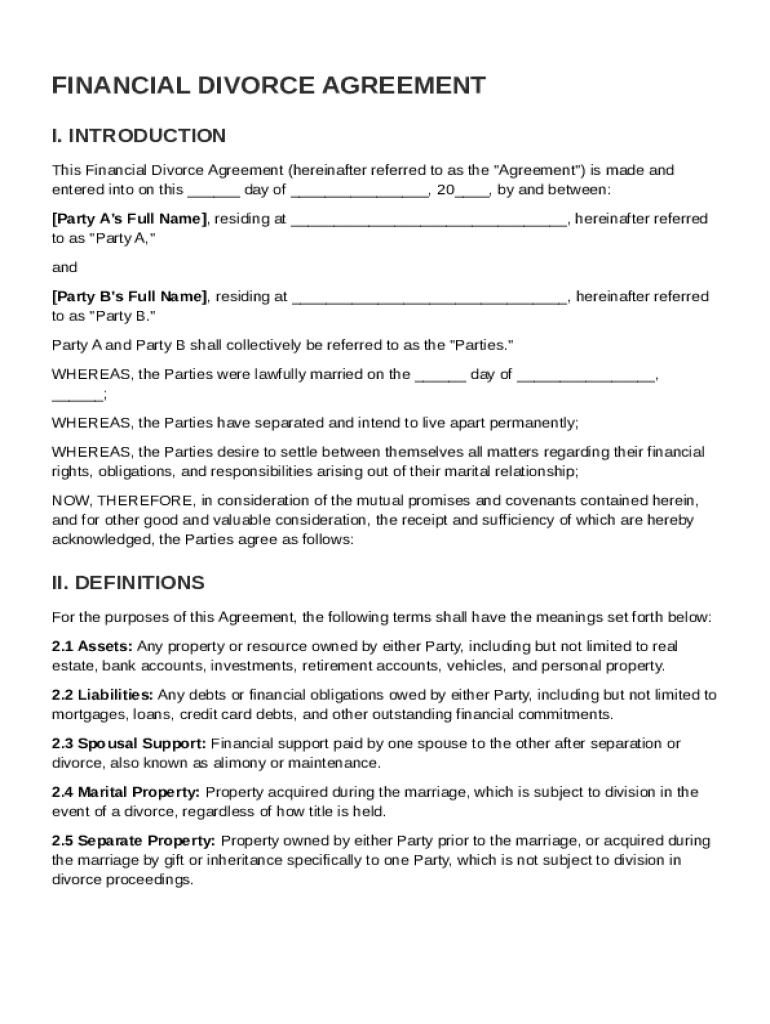







Definition & Meaning
A Financial Divorce Agreement Template serves as a formal document designed to outline the terms of financial settlement during a divorce. This template helps in detailing the division of assets, liabilities, spousal support, and any responsibility towards child support. Its primary function is to ensure both parties have a clear understanding of their financial obligations and entitlements post-divorce. By defining key elements such as marital and separate properties, responsibilities for debts, and tax implications, the document establishes a foundation for a fair and equitable division of financial aspects during a divorce process.
Key Elements of the Financial Divorce Agreement Template
The Financial Divorce Agreement Template encompasses several crucial sections that collectively address all financial concerns arising in a divorce. Key elements include:
- Asset and Liability Definitions: Clear distinction between individual and marital properties and debts.
- Spousal Support Arrangements: Guidelines for financial support from one spouse to another.
- Child Support Obligations: Financial provisions for children, including amounts and duration, if applicable.
- Tax Implications: Considerations for tax liabilities and benefits post-divorce.
- Confidentiality Clauses: Provisions to keep the terms of the agreement private, where applicable.
- Dispute Resolution: Processes agreed upon by both parties to resolve any future conflicts regarding the agreement.
These components are critical to providing clarity and minimizing conflicts, ensuring all aspects of financial separation are comprehensively covered.
Steps to Complete the Financial Divorce Agreement Template
Completing the Financial Divorce Agreement Template involves several structured steps to ensure accuracy and comprehensiveness:
- Gather Financial Information: Collect all necessary data regarding assets, liabilities, income, and expenses.
- Identify Marital vs. Individual Assets and Debts: Clearly categorize and document ownership and financial responsibilities.
- Determine Support Needs and Capabilities: Assess and document potential needs for spousal or child support.
- Draft Initial Terms: Outline the initial division of responsibilities and entitlements.
- Review and Revise: Have both parties review the document for completeness and agree on the terms.
- Finalize and Sign: Each party signs the document, acknowledging their understanding and acceptance of the terms.
These steps help ensure that the document is legally valid and that both parties are in agreement.
How to Use the Financial Divorce Agreement Template
Utilizing the Financial Divorce Agreement Template involves carefully following laid out procedures to fill in the details accurately. Here's how:
- Download and Open the Template: Access the template to start the editing process.
- Complete Personal and Financial Details: Fill in the required personal and financial information for both parties involved.
- Use Built-in Guidelines: Follow any embedded instructions or guidelines within the template to ensure all sections are adequately filled.
- Make Use of Checklists: Checklists help verify that no details are missed.
- Seek Legal Advice if Needed: Consult a legal professional to review the template and ensure its compliance with applicable laws.
This systematic approach ensures the agreement aligns with both legal requirements and personal circumstances.
Examples of Using the Financial Divorce Agreement Template
Here are practical examples illustrating the versatility of the Financial Divorce Agreement Template:
- Case 1: A couple with a large joint asset portfolio can use the template to specify asset division down to detailed categories such as stocks, real estate, and retirement accounts.
- Case 2: A spouse who is to receive alimony can document specific monthly support amounts and durations according to pre-agreed terms.
- Case 3: Parties with children can elaborate on child support payments, custody arrangements, and other child-related financial considerations.
These examples highlight how the template can be tailored to fit various complex financial arrangements and family circumstances.
Legal Use of the Financial Divorce Agreement Template
Using the Financial Divorce Agreement Template legally involves ensuring that all elements comply with applicable laws and regulations:
- Ensures Validity: It must be consistent with state laws governing divorce agreements.
- Acknowledgment by Both Parties: Signatures are required from both parties, which acts as legal consent to the terms.
- Involvement of Legal Counsel: Consulting with lawyers can help in identifying any legal repercussions or unaddressed issues within the agreement.
- Notarization: Some distributions require notarization, adding another layer of legal validity.
These considerations ensure the agreement is enforceable in a court of law and provides legal protection to both parties.
State-Specific Rules for the Financial Divorce Agreement Template
The template's enforceability can depend on state-specific rules that govern divorce settlements. Key points include:
- Equitable Distribution vs. Community Property States: Some states divide assets based on fairness, while others split them equally.
- Support Calculation Variances: Each state may have different guidelines for calculation of spousal and child support.
- Unique Filing and Notarization Requirements: Some states necessitate specific processes for filing or require additional documentation.
Adapting the template to meet these state-specific rules ensures compliance and reduces the risk of disputes or legal challenges.
Required Documents
Completing a Financial Divorce Agreement requires various documents to support the details within the template. These include:
- Financial Statements: Including income, expenses, debts, and asset documentation.
- Previous Tax Returns: To validate financial standing and help assess future obligations.
- Evidence of Assets and Liabilities: Property titles, bank statements, and investment records.
- Proof of Income: Recent pay stubs or other earnings records.
Collecting these documents in advance expedites the completion process and helps ensure all provided information is accurate and verifiable.