






Definition & Meaning
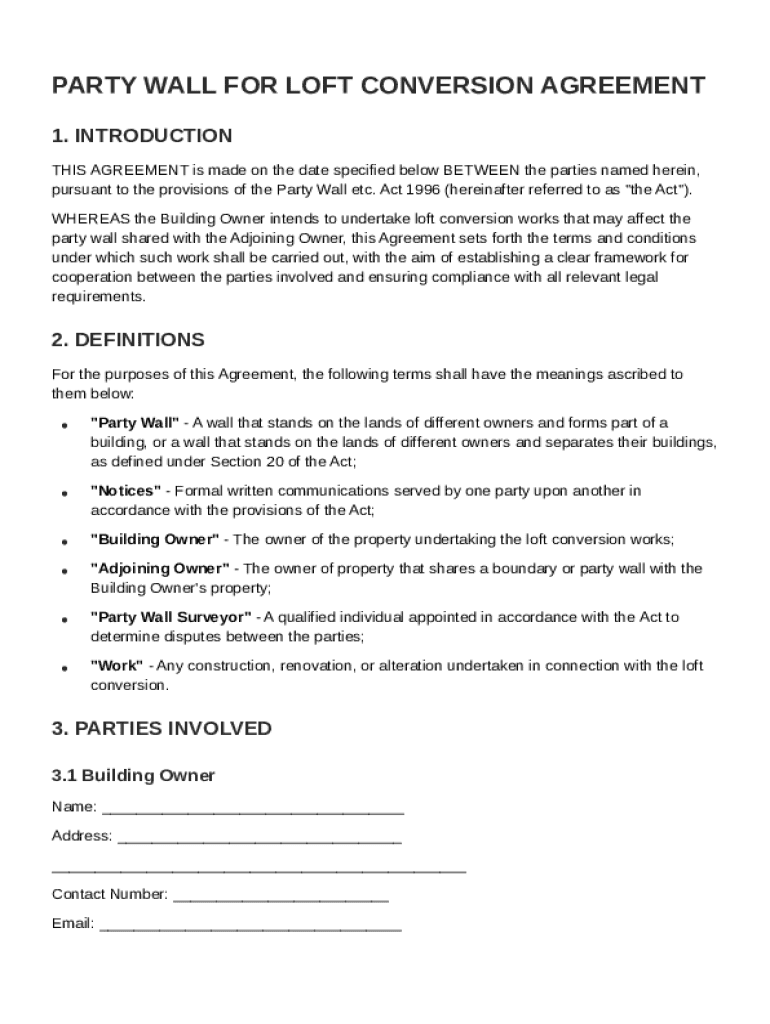
A Party Wall Agreement for Loft Conversion is a legal document that outlines the agreements between a building owner planning to carry out a loft conversion and the adjoining property owner. According to the Party Wall etc. Act of 1996, this agreement specifies the rights and responsibilities of each party concerning shared walls or boundaries. Key components within the document include a description of the proposed work, access rights, notification procedures, and the appointment of surveyors for resolving any disputes that may arise. It serves to protect both parties' interests and to ensure that all renovations proceed smoothly and legally.
How to Use the Party Wall for Loft Conversion Agreement Template
To use the Party Wall for Loft Conversion Agreement Template effectively, one should follow systematic steps that ensure comprehensive coverage of all necessary elements. Begin by identifying the key parties involved: the building owner and the adjoining owner. Next, outline the proposed work details, including any structural changes to the wall. Utilize the template to specify notification timelines and any required access permissions. Ensure the document includes surveyor details and any procedures for addressing disagreements. The template should be signed by both parties to validate the agreement legally.
Key Elements of the Party Wall for Loft Conversion Agreement Template
The Party Wall for Loft Conversion Agreement Template contains several crucial elements that must be meticulously completed:
- Proposed Work Description: Details of the construction work intended on the shared wall.
- Notification Requirements: Outline the timeline and method for notifying the adjoining owner of construction plans.
- Access Rights: Specify when and how access to the adjoining property may be required.
- Surveyors: Include the appointment of a surveyor to mediate any disputes.
- Liability and Insurance: Define the responsibilities and insurance coverages for potential damages.
- General Provisions: Enumerate any additional clauses pertinent to the agreement.
Each section ensures clarity and anticipation of potential pitfalls, promoting harmony between involved parties.
Important Terms Related to Party Wall for Loft Conversion Agreement Template
Understanding important terms related to the Party Wall Agreement enhances clarity and compliance with legal requirements:
- Adjoining Owner: The individual whose property is adjacent to the proposed loft conversion site.
- Surveyor: A professional tasked with ensuring compliance and resolving disputes related to party wall agreements.
- Party Wall: The shared wall or boundary between two properties under construction consideration.
- Notification: The formal process of informing an adjoining owner about intended construction work.
- Dispute Resolution: The procedures and mechanisms in place for resolving disagreements between parties.
Familiarity with these terms ensures that both parties fully understand their rights and obligations.
Steps to Complete the Party Wall for Loft Conversion Agreement Template
Completing the Party Wall Agreement requires a structured approach:
- Identify involved parties: Clearly list the building and adjoining owners.
- Draft the proposed work description: Specify the nature and scope of the loft conversion project.
- Detail notification procedures: Define how and when the adjoining owner will be informed about the construction.
- Outline access requirements: Describe access needs and restrictions concerning adjoining properties.
- Select and document surveyors: Choose a surveyor, and detail their role and contact information.
- Establish liability provisions: Clarify responsibilities and include necessary insurance details.
- Review and sign: Both parties should thoroughly review and sign the finalized agreement.
By following these steps, agreements are structured to prevent misunderstandings or future disputes.
State-Specific Rules for the Party Wall for Loft Conversion Agreement Template
While the Party Wall etc. Act of 1996 provides a broad framework, states in the U.S. may have additional requirements:
- Notification Timelines: Some states might mandate longer notification periods than the standard outlined in the Act.
- Surveyor Qualifications: Specific states may require surveyors to hold certain state-specific licenses or certifications.
- Supplementary Insurance Requirements: States may impose additional insurance standards to protect property values.
Understanding state-specific regulations ensures compliance and legal support across different jurisdictions.
Legal Use of the Party Wall for Loft Conversion Agreement Template
The Party Wall Agreement Template must adhere to several legal protocols to be binding:
- Compliance with the Party Wall etc. Act of 1996: The agreement should meet all standards outlined in this Act.
- Proper Execution: Ensure both parties sign under proper legal knowledge and voluntary agreement.
- Dispute Resolution Procedures: Clearly delineate the processes for mediating disputes, involving surveyors per the Act's requirements.
- Legal Consequences: Outline any legal repercussions for failing to adhere to the agreed terms.
These elements ensure that the agreement upholds legal scrutiny and provides clear legal recourse if required.
Examples of Using the Party Wall for Loft Conversion Agreement Template
Understanding practical scenarios of using a Party Wall Agreement aids in visualizing its application:
- Residential Loft Conversion: Homeowners in urban areas frequently use this template to manage loft conversion projects, ensuring neighbors are informed and consent is documented.
- Commercial Property Developments: For businesses expanding their premises vertically, this agreement secures harmony with neighboring commercial entities.
- Historic Buildings: When altering historic properties, this document helps preserve structural integrity and respect the interests of neighboring heritage property owners.
Each scenario demonstrates the template's versatility in various loft conversion contexts, safeguarding the rights of both building owners and neighbors.