
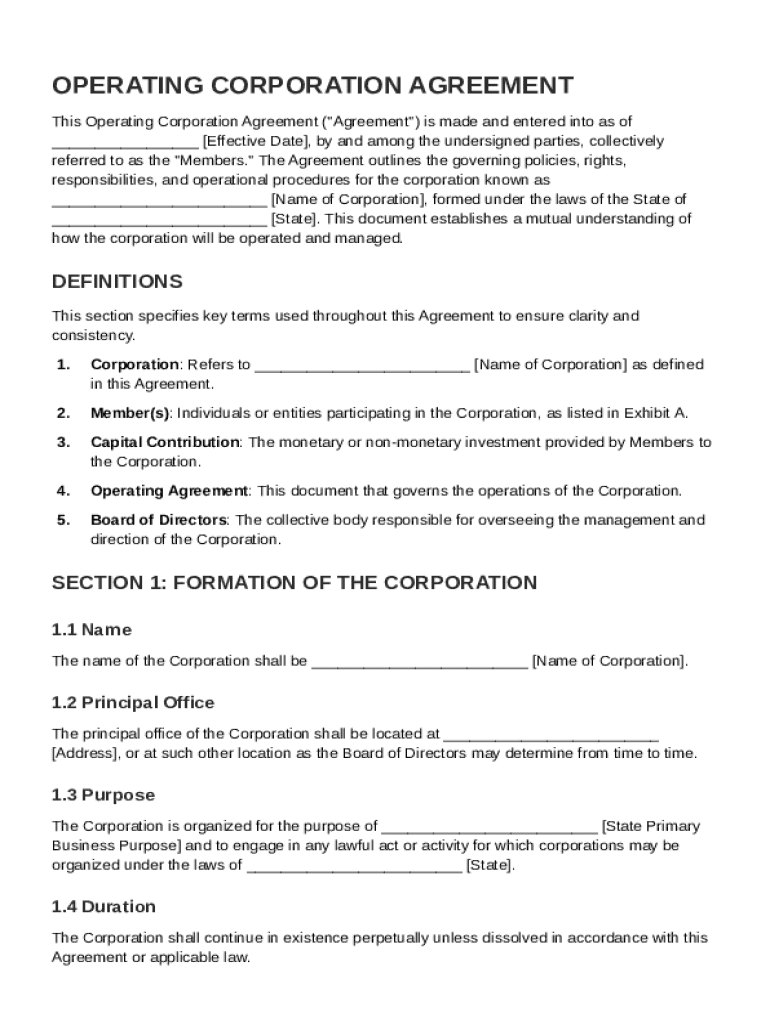







Definition & Meaning
The Operating Corporation Agreement Template is a critical document designed to outline the governance, rights, responsibilities, and operational procedures of a corporation. It is particularly important for entities registered under state law in the United States. This template offers a structured framework containing essential elements such as the formation of the corporation, the roles and responsibilities of Members, Capital Contributions, and the Board of Directors. Furthermore, it details financial aspects like fiscal years and distributions, indemnification provisions, and the conditions for the dissolution of the corporation. By providing these structured components, the template helps ensure clarity and consistency in corporate operations.
Key Elements of the Operating Corporation Agreement Template
The Operating Corporation Agreement Template consists of several vital elements that contribute to its functionality and effectiveness.
-
Formation of the Corporation: This section establishes the corporation's legal existence under state law, detailing initial formation steps and structural considerations.
-
Management Structure: Including the Board of Directors and corporate officers. It outlines how decisions within the corporation are made and identifies key roles such as Chief Executive Officer, Treasurer, and Secretary.
-
Membership Admission: This portion specifies how new Members are admitted into the corporation, including necessary qualifications and application processes.
-
Financial Matters: Covers various financial operations such as Capital Contributions, the fiscal year, distributions to Members, and internal financial controls.
-
Indemnification Provisions: Protection clauses for Members and Directors to shield them from liabilities under specific conditions.
How to Use the Operating Corporation Agreement Template
Utilizing the Operating Corporation Agreement Template effectively involves a series of thoughtful steps aimed at tailoring it to a corporation's unique needs.
-
Customization: Begin by thoroughly reviewing the template, ensuring all default clauses align with the corporation's objectives and legal requirements.
-
Detailing Roles and Responsibilities: Clearly define the roles and duties of Members and board officers within the template for better accountability.
-
Financial Planning: Develop a clear financial strategy within the template, ensuring fiscal policies and distribution frameworks are accurately reflected.
-
Legal Compliance: Consult with legal counsel to confirm that the document meets all relevant state law requirements.
-
Sharing and Approval: Distribute the draft agreement among stakeholders for feedback and secure formal approval from the board.
State-Specific Rules for the Operating Corporation Agreement Template
Operating Corporation Agreements must be tailored to comply with state-specific regulations, which can affect their formation and enforcement.
-
Variations in State Law: Different states have unique requirements for corporate governance, such as specific quorum thresholds, annual report submissions, and fiduciary duties.
-
Required Filings: Some states mandate the filing of specific sections of the agreement or related documentation with the Secretary of State's office.
-
Legal Provisions: States might have distinctive rules concerning indemnification, voting rights, and Member qualifications, which could influence the template’s content.
Why Should You Use an Operating Corporation Agreement Template
The usage of an Operating Corporation Agreement Template brings numerous advantages to a corporation:
-
Consistency in Governance: It provides a uniform structure for decision-making and conflict resolution, enhancing governance consistency.
-
Legal Protection: Helps safeguard the corporation and its Members against legal disputes by clearly delineating roles, responsibilities, and procedures.
-
Efficiency in Operations: Streamlines corporate functions by offering a clear roadmap for routine and strategic activities, from management meetings to financial operations.
-
Flexibility and Clarity: Ensures that the corporation’s operational context is flexible enough to adapt to changes while maintaining clarity on core governance principles.
Steps to Complete the Operating Corporation Agreement Template
Filling out the Operating Corporation Agreement Template requires careful attention to detail and a sequential approach:
-
Initial Setup: Input fundamental details about the corporation, including its name, registered address, and purpose.
-
Define Member Contributions: Accurately document the capital contributions and any specific terms associated with Member investments.
-
Describe the Governance Structure: Detail the corporate hierarchy, including the appointment process for Directors and their responsibilities.
-
Outline Financial Protocols: Establish guidelines for fiscal management, including distribution policies and accounting procedures.
-
Amendment and Dissolution Clauses: Clearly define the conditions and processes for amending the agreement or dissolving the corporation.
-
Review and Revise: Engage stakeholders in reviewing the draft for accuracy, feasibility, and alignment with corporate goals.
-
Final Approval: Secure necessary approvals through Member votes or board resolutions, ensuring the agreement is signed by all relevant parties.
Legal Use of the Operating Corporation Agreement Template
The Operating Corporation Agreement serves a foundational legal purpose:
-
Governance Framework: Offers a legal structure for the corporation’s internal governance, facilitating compliance with state and federal regulations.
-
Member Protection: Provides indemnification for Members and Directors, limiting personal liability under defined circumstances.
-
Contractual Enforcement: Acts as a binding contract among the corporation’s Members and officers, legally enforceable in disputes.
-
Regulatory Compliance: Aligns operational activities with legal standards, such as those specified in the ESIGN Act or state corporate law.
Important Terms Related to the Operating Corporation Agreement Template
Understanding specific terms within the agreement is crucial for its effective use.
-
Members: Individuals or entities contributing capital to the corporation and possessing rights, privileges, and obligations as prescribed by the agreement.
-
Capital Contributions: Financial or non-financial investments made by Members, essential for determining equity and profit-sharing arrangements.
-
Board of Directors: The governing body responsible for overseeing the corporation’s strategic direction and management.
-
Indemnification: Protective clauses that offer legal and financial security for Directors and Members against specific liabilities.
-
Fiscal Year: The defined annual accounting period used for financial reporting and distribution of profits.
Examples of Using the Operating Corporation Agreement Template
Applying the Operating Corporation Agreement Template can vary across different corporate contexts.
-
Startup Corporations: Young companies use the template to establish a foundational governance structure that accommodates rapid growth.
-
Non-Profit Organizations: Tailor the template to reflect mission-driven objectives while ensuring compliance with non-profit regulations.
-
Family-Owned Businesses: Establish terms that reflect family traditions and succession planning, creating a clear operational roadmap.
-
Joint Ventures: Partners in multi-entity collaborations can use the template to delineate roles and capital contributions effectively.
These examples highlight the versatility and adaptability of the Operating Corporation Agreement Template across diverse business scenarios.




