






Definition and Purpose of a Business to Business Non-Compete Agreement
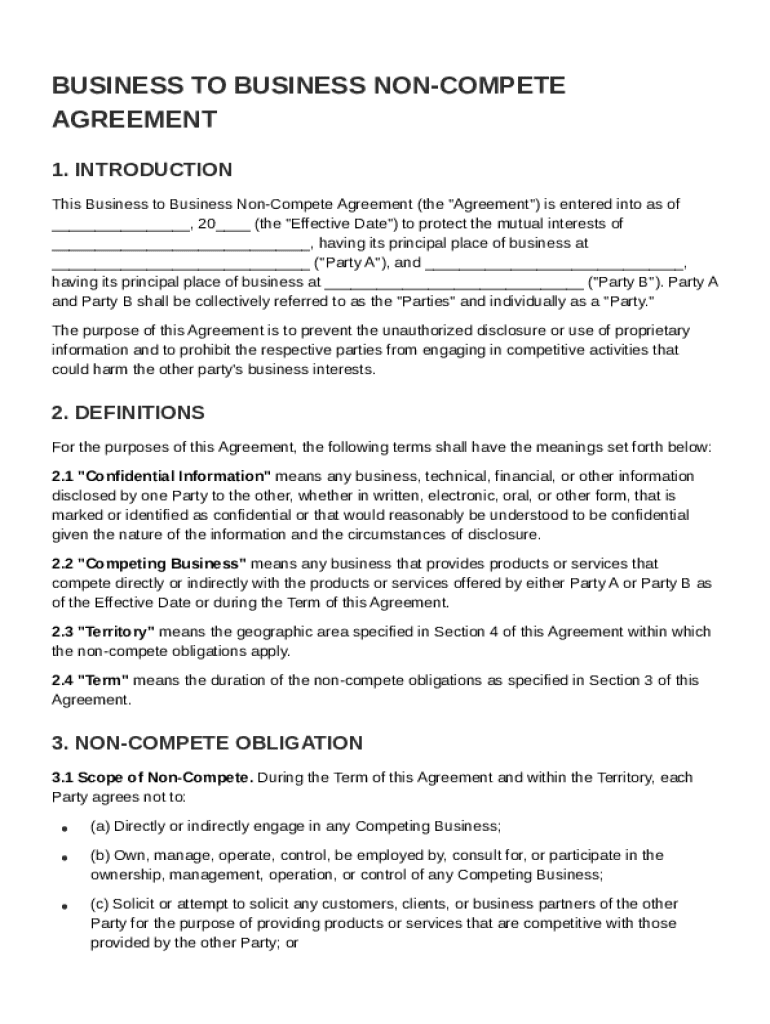
A Business to Business Non-Compete Agreement is a written contract between two companies, referred to as Party A and Party B, aimed at protecting proprietary and confidential interests. This document articulates terms under which both parties agree to refrain from engaging in activities that pose competition to each other. These restrictions often include not disclosing sensitive information, non-solicitation of clients, and avoiding the development of similar products in a specified geographic region. Such agreements are integral in industries where competitive advantage hinges on the protection of trade secrets and client relationships.
Practical Examples
- Technology Firm Agreements: Companies in the tech sector use these agreements to protect software designs and algorithms when collaborating with partners.
- Franchise Operations: A national franchise may use this contract when dealing with local operations to prevent the latter from setting up competing businesses.
Utilizing the Business to Business Non-Compete Agreement Template
The Business to Business Non-Compete Agreement Template is designed to streamline the drafting process of these critical documents, providing a structured format that ensures all necessary elements are included.
Steps to Customize the Template
- Consult Legal Advisors: Engage with legal professionals to understand stipulations specific to your industry.
- Identify Key Clauses: Use the template to identify core clauses on confidentiality, territory scope, and duration.
- Adapt to Your Needs: Tailor the template to reflect unique aspects of your business partnership and competitive landscape.
Key Elements Included in the Agreement Template
The key elements within the Business to Business Non-Compete Agreement Template provide comprehensive protection for business relationships:
- Confidential Information: Clauses safeguarding the exchange and protection of proprietary data.
- Non-Solicitation of Clients: Provisions preventing the parties from poaching each other's customers.
- Time Frame and Territory: Duration and geographic scope where the non-compete terms apply.
In-Depth Clause Examples
- Confidentiality Obligations: Detail what constitutes confidential information and how it should be handled.
- Remedies for Breach: Lay out potential restitution methods if one party fails to comply with agreed terms.
Steps to Complete the Business to Business Non-Compete Agreement Template
Completing the agreement involves several critical steps to ensure legality and enforceability:
- Review Current Legal Requirements: Verify state laws affecting the enforceability of non-compete clauses.
- Include Signatures and Witnesses: Ensure both parties and legal witnesses sign the document for validity.
- Distribute Copies: Provide each party with a signed copy for their records and compliance.
State-Specific Considerations for the Agreement
In the United States, non-compete agreements are subject to varying degrees of enforceability, heavily influenced by state regulations. For example, California generally prohibits non-compete clauses with few exceptions.
State-by-State Differences
- California: Generally imposes stringent limitations on non-compete clauses.
- Florida: Enforces non-competes if they are reasonable in time, area, and line of business.
Legal Use and Compliance
The legal validity of a Business to Business Non-Compete Agreement is determined by adherence to applicable state laws and the inclusion of essential legal elements.
Compliance Tips
- Consistent Review: Regularly update the agreement to align with current laws and business needs.
- Judicial Oversight: Familiarize with potential judicial interpretations that might affect the agreement’s application.
Who Typically Uses these Agreements
Typically, businesses in highly competitive sectors such as technology, pharmaceuticals, and finance adopt these non-compete agreements.


Common Business Models
- Partnerships and Alliances: Firms collaborating on products or services that may potentially become competition.
- Startups: Protecting fledgling companies from established competitors attempting to capitalize on their business model.
Important Terms Related to the Template
Understanding the terms deeply embedded in these agreements is crucial for accurate application.
Key Terminology
- Proprietary Information: Data or technology unique to a business providing a competitive edge.
- Non-Disclosure Agreement (NDA): Often bundled with non-competes to reinforce confidentiality.
This comprehensive coverage ensures businesses can effectively implement and enforce non-compete provisions to preserve strategic advantages.