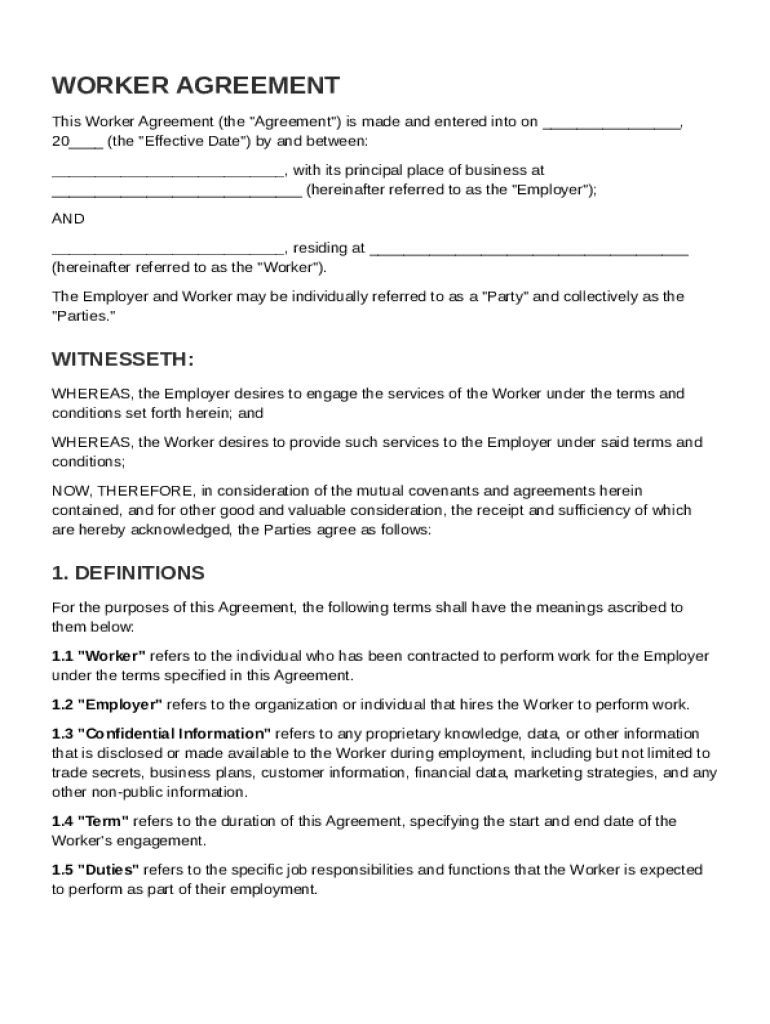







Key Elements of the Worker Agreement Template
The Worker Agreement Template is a comprehensive contract designed to outline the terms and conditions of employment between an employer and a worker. This crucial document formalizes the relationship and expectations between both parties, ensuring clarity and alignment in their professional engagement. Key elements include:
- Definitions: Precise terminology is used to define roles and responsibilities within the agreement, ensuring both parties have a mutual understanding.
- Employment Type: Specifies whether the employment is full-time, part-time, contract-based, or temporary, detailing the nature of the worker's role.
- Job Responsibilities: Lists the tasks and duties expected of the worker, providing clear guidelines for their performance.
- Compensation Details: Includes salary or hourly wages, payment schedule, and any additional benefits or bonuses.
- Work Schedule: Outlines working hours, days off, and any provisions for overtime.
- Confidentiality Obligations: Sets the terms for maintaining privacy and protecting sensitive information belonging to the employer.
- Termination Procedures: Details the conditions under which the agreement can be ended and the process for doing so.
- Governing Law: Identifies the legal framework that will apply to the agreement, typically based on the location of employment.
- Amendments and Severability: Provisions for modifying the agreement and protocols if part of the contract is invalid.
How to Use the Worker Agreement Template
To effectively utilize the Worker Agreement Template, follow these steps:
- Review and Customize: Begin by thoroughly reviewing the template. Customize the sections to suit your specific employment requirements, ensuring all relevant details are included.
- Consult Legal Counsel: It may be beneficial to have a legal professional review the modified agreement to ensure compliance with local laws and regulations.
- Input Job-Specific Details: Enter the specifics related to the job role, including duties, compensation, and work schedules, tailoring them to reflect the employer's operational needs.
- Discuss with the Worker: Before finalizing, discuss the agreement with the prospective worker to ensure mutual understanding and acceptance.
- Finalize and Sign: Have both the employer and worker review the completed agreement. Once both parties agree, proceed to sign the document to make it legally binding.
Important Terms Related to Worker Agreement Template
Understanding the terminology used within the Worker Agreement Template is vital for both parties involved. Key terms include:
- "Parties": Refers to the employer and the worker involved in signing the agreement.
- "Employment At-Will": Indicates that either party may terminate the employment arrangement at any time, with or without cause.
- "Non-Compete Clause": A clause that restricts the worker from engaging in business activities that compete with the employer's interest both during and after employment.
- "Intellectual Property": Addresses ownership rights relating to creations and inventions produced by the worker in the course of their employment.
- "Severance Package": Compensation provided to the worker upon employment termination under certain conditions.
Legal Use of the Worker Agreement Template
The Worker Agreement Template serves as a legal document, establishing enforceable rights and obligations between the employer and worker. Its legal use involves:
- Compliance with Labor Laws: Ensuring the agreement adheres to all relevant regulations and statutes governing employment relations.
- Protection of Rights: Safeguarding the rights of both parties, particularly concerning wages, hours, and working conditions.
- Conflict Resolution: Providing a basis for resolving disputes that may arise during the course of employment.
- Documentation for Tax Purposes: Offering documented proof of employment terms for tax reporting and audit readiness.
- Legal Recourse: Establishing grounds for legal action if breaches or violations occur.
State-Specific Rules for the Worker Agreement Template
In the United States, employment laws can vary significantly from one state to another. It is crucial to consider state-specific rules when drafting a Worker Agreement Template:
- Minimum Wage Laws: Different states have varying minimum wage requirements, which should be reflected in the compensation details.
- Employee Benefits: Certain states mandate specific benefits, such as paid sick leave or health insurance, that must be included.
- Right-to-Work Laws: Affect union participation and should be reviewed for applicability in the agreement.
- Overtime Regulations: States may differ in their criteria for overtime pay eligibility and computation.
- Termination Policies: State laws may dictate specific grounds and procedures for lawful employment termination.
Steps to Complete the Worker Agreement Template
Completing a Worker Agreement Template involves a systematic approach to ensure all essential components are accurately filled:
- Fill in Identifying Information: Begin by entering names, addresses, and contact details for both the employer and the worker.
- Define Job Role and Description: Clearly articulate the job title, duties, and responsibilities expected of the worker.
- Outline Compensation and Benefits: Specify salary, bonuses, benefits, and any special compensation arrangements.
- Set the Employment Terms: Establish the employment type, duration, and expected work schedule.
- Address Confidentiality and Non-Compete: Include clauses that outline confidentiality expectations and restrictions on competitive activities.
- Determine Termination Conditions: Specify the conditions and process for ending the employment relationship.
- Finalize Other Legal Provisions: Ensure all additional legal terms and conditions are included, such as governing law and modification procedures.
- Review and Sign: Conclude by reviewing the entire agreement for accuracy and conciseness, followed by signatures from both parties.
Examples of Using the Worker Agreement Template
The Worker Agreement Template provides flexibility and utility across various employment scenarios. Notable examples include:
- Seasonal Employment: An employer hiring temporary staff for busy peak seasons can use the template to establish short-term employment terms.
- Remote Work: A tech company engaging a remote worker can adapt the template to outline virtual work conditions and expectations.
- Freelance Agreements: Creative professionals like graphic designers or writers can utilize the template to detail project-based work and deliverables.
- Probationary Employment: Businesses hiring employees on a trial basis can employ the template to set expectations during the probation period.
- Corporate Agreements: Large corporations can standardize employment agreements across various departments with customized templates reflecting specific departmental needs.
Digital vs. Paper Version of the Worker Agreement Template
The digital and paper versions of the Worker Agreement Template both serve essential roles, contingent on user preferences and specific circumstances:
-
Digital Version:
- Efficiency: Easily editable, storable, and distributable via electronic platforms, speeding up the drafting process.
- Accessibility: Editable across various devices, enabling quick modifications and approvals from multiple locations.
- Integration: Can be linked with digital signature tools and document management systems for seamless processing.
-
Paper Version:
- Tangible Records: Provides a physical copy for personal archives, particularly useful for individuals who prefer traditional documentation.
- Preference-Based: Reflects a manual approach for users who may find digital interfaces less intuitive.
- Certain Legal or Cultural Norms: In some jurisdictions or scenarios, hardcopy agreements may be preferred or required for legal validity.
Who Typically Uses the Worker Agreement Template
The Worker Agreement Template is employed across multiple sectors by a variety of users, including:
- Human Resource Departments: HR professionals in charge of recruiting and managing employee relations typically utilize this template for consistent and lawful employment documentation.
- Small Business Owners: Entrepreneurs and small business owners seeking formalized agreements with new employees rely on this template for clarity and legal protection.
- Freelancers and Consultants: Independent contractors use customized agreements to formalize terms with clients or agencies.
- Legal Advisors: Attorneys and legal consultants working on behalf of companies or workers may deploy the template for drafting precise employment contracts.
- Corporate Entities: Large organizations implement standardized templates to maintain uniformity across their workforce employment agreements.