Borrow Agreement Template 2026

Get Form
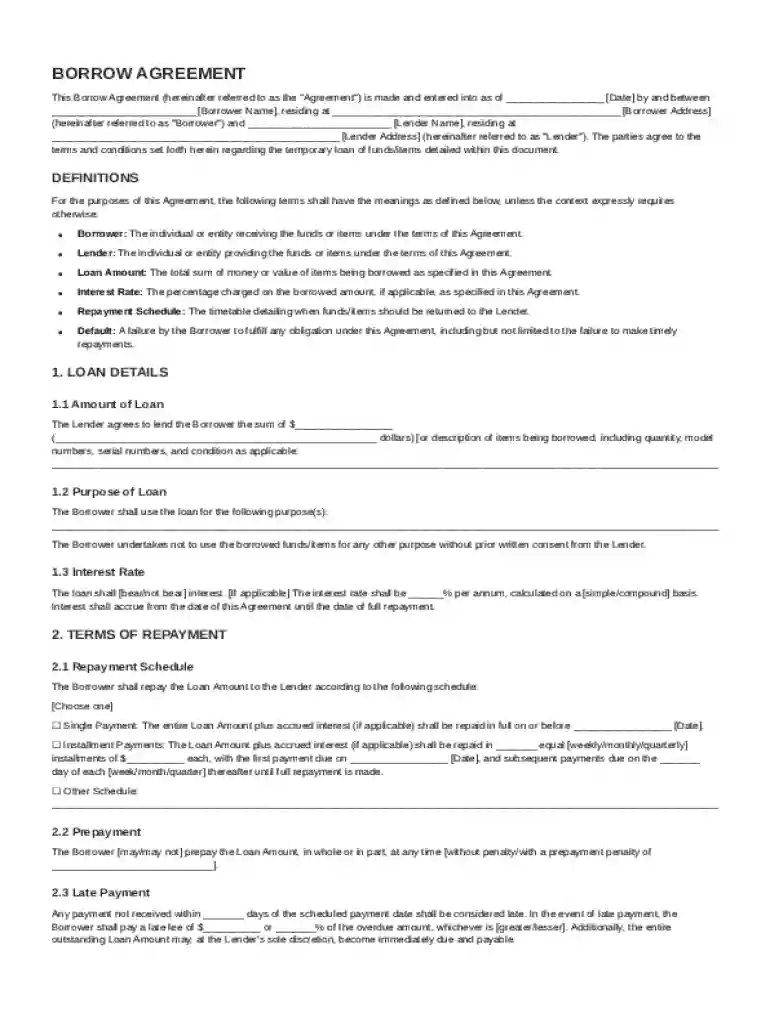
Borrow Agreement Template Preview on Page 1

Here's how it works

01. Edit your form online
Type text, add images, blackout confidential details, add comments, highlights and more.

02. Sign it in a few clicks
Draw your signature, type it, upload its image, or use your mobile device as a signature pad.

03. Share your form with others
Send it via email, link, or fax. You can also download it, export it or print it out.

Definition & Meaning

A Borrow Agreement Template is a legal document used to formalize the terms and conditions under which one party (the borrower) temporarily receives resources from another party (the lender). It delineates essential components like the loan amount, purpose, repayment terms, and conditions under which the funds must be returned. This document helps to protect both parties by ensuring mutual understanding and agreement on the loan conditions. For instance, if a company needs short-term financing from a bank, a borrow agreement documents the loan's specifics, enhancing transparency and accountability for both entities.

Key Elements of the Borrow Agreement Template

The Borrow Agreement Template must include several critical elements to ensure clarity and enforceability. These include:

  • Loan Amount and Purpose: Specifies the amount being borrowed and the intended use. This clarifies expectations and prevents misuse of the funds.
  • Repayment Schedule: Details the repayment terms, including start date, frequency, and installment amounts. This helps both parties manage their financial planning.
  • Interest Rates and Fees: Lists applicable interest rates and any other charges. Knowing these figures upfront allows borrowers to evaluate the cost of borrowing.
  • Default Conditions: Outlines what constitutes a breach of the agreement and the consequences. This often includes late payments or failure to meet other covenants.
  • Governing Law: States the jurisdiction that governs the agreement, which is crucial for resolving legal disputes.

An example of a key element would be an interest rate of 5% defined in the agreement to prevent disputes about the loan cost.

Steps to Complete the Borrow Agreement Template

Completing a Borrow Agreement Template involves several precise steps to ensure accuracy and compliance. Here's a step-by-step guide:

  1. Identify the Parties: Clearly state the full legal names and contact information of both the borrower and lender.
  2. Define the Terms: Outline the amount borrowed, purpose, repayment terms, interest rates, and any fees involved.
  3. Customize the Template: Adjust the template to reflect the specific agreement terms, including any unique clauses or conditions.
  4. Review Legal Requirements: Ensure the document complies with relevant legal standards and regulations.
  5. Sign the Agreement: Parties review and sign the agreement, usually before a notary public to legitimize the signatures.
  6. Distribute Copies: Provide signed copies to all involved parties for their records.

By following these steps, both parties ensure all necessary information is captured properly, reducing the risk of future disputes.

Legal Use of the Borrow Agreement Template

Using a Borrow Agreement Template as a legal document ensures that the loan terms are enforceable in a court of law. It serves as formal evidence of the agreed terms, protecting both the lender's right to repayment and the borrower's rights against unauthorized claim modifications. Legally, the template must be drafted with accurate, clear language and cover all critical elements like repayment schedules and default conditions.

For example, a business borrowing equipment would use the template to stipulate the return conditions and usage period, thereby protecting both the business and the equipment provider from potential losses or misuse.

Who Typically Uses the Borrow Agreement Template

Borrow Agreement Templates are primarily used by individuals, businesses, and institutions engaging in temporary resources or funds exchange. Small business owners often use them to secure short-term loans for operations, while corporations may use them for financial transactions involving significant sums. Educational institutions might employ such templates for loaning equipment to students, ensuring items are returned in good condition.

In a family setting, if a parent lends money to their adult child, a borrow agreement can formalize the loan structure, preserving familial relations by minimizing potential misunderstandings.


decoration image ratings of Dochub

Important Terms Related to Borrow Agreement Template

Understanding the terminologies used within a Borrow Agreement Template is crucial for both parties involved. Some important terms include:

  • Principal: The original sum of money borrowed before interest.
  • Collateral: Assets pledged as security by the borrower for loan repayment.
  • Grace Period: A set timeframe post-due date during which payment can be made without incurring penalties.
  • Prepayment Penalty: A fee charged if the loan is paid off before the scheduled date.

Knowledge of these terms ensures that both borrower and lender possess a clear, mutual understanding of the loan dynamics.

State-Specific Rules for the Borrow Agreement Template

State-specific regulations can affect the enforceability and stipulations of a Borrow Agreement Template. Different states have varying laws regarding interest rates (usury laws), collateral requirements, and default penalties.

For instance, some states might cap the maximum allowable interest rate on personal loans, which can impact the legality and attractiveness of a borrowing agreement. Conducting a thorough review of local laws or consulting with a legal professional familiar with state-specific regulations is advisable to avoid invalid or unenforceable agreements.

Examples of Using the Borrow Agreement Template

Real-world scenarios highlight the practical application of Borrow Agreement Templates. A small business owner might use one to borrow start-up capital from a bank, detailing the loan amount and repayment structure to maintain compliance and transparency. Similarly, an individual lending a significant sum to a friend could use the template to document the loan characteristics, reducing personal and legal risks.

In the corporate world, a company director might draft an agreement when obtaining an emergency loan to finalize a large project, specifying all terms to ensure clear fiscal planning and accountability.

be ready to get more

Complete this form in 5 minutes or less

Get form

Got questions?

We have answers to the most popular questions from our customers. If you can't find an answer to your question, please contact us.
Contact us
A lending agreement is a formal contract between a lender and borrower that specifies the terms, conditions, and obligations related to the loan. Lending agreements spell out all the details of the loan, such as the principal amount, interest rate, amortization period, term, fees, payment terms and any covenants.
A loan agreement is a legal document between a creditor who lends money to a borrower, who repays the loan (with or without interest). It should include the loan amount, interest rate, repayment schedule, security, and the terms for default.
A payment agreement should include: Full names and contact information of both parties (creditor and debtor). The total amount of debt owed and the reason for the debt. A detailed payment schedule, including installment amounts, due dates, and the start and end dates of the payment plan. Accepted payment methods.
Whats included in a Loan Agreement Lender and borrower contact information. Include details of both the lender and the borrower, including their full names and addresses. Loan amount and date. Interest rate. Repayment method and schedule. Late fees and penalties. Co-signer information. Collateral. Additional clauses.
Key aspects of a loan agreement The purpose of the loan. How and when repayments will be made. If interest will be charged, the interest rate, and how it will be worked out. If collateral (an item pledged as security for the loan) is to be used and the circumstances in which the lender can claim it.

Security and compliance

At DocHub, your data security is our priority. We follow HIPAA, SOC2, GDPR, and other standards, so you can work on your documents with confidence.

Learn more
ccpa2
pci-dss
gdpr-compliance
hipaa
soc-compliance

People also ask

Its not always necessary to involve a solicitor in drafting a loan agreement, but it can be helpful, particularly for larger loans or more complex situations. While on the face of it engaging with a solicitor can feel like a formal step, it can take the pressure off both of you and ensure the terms are fair.

Related links