
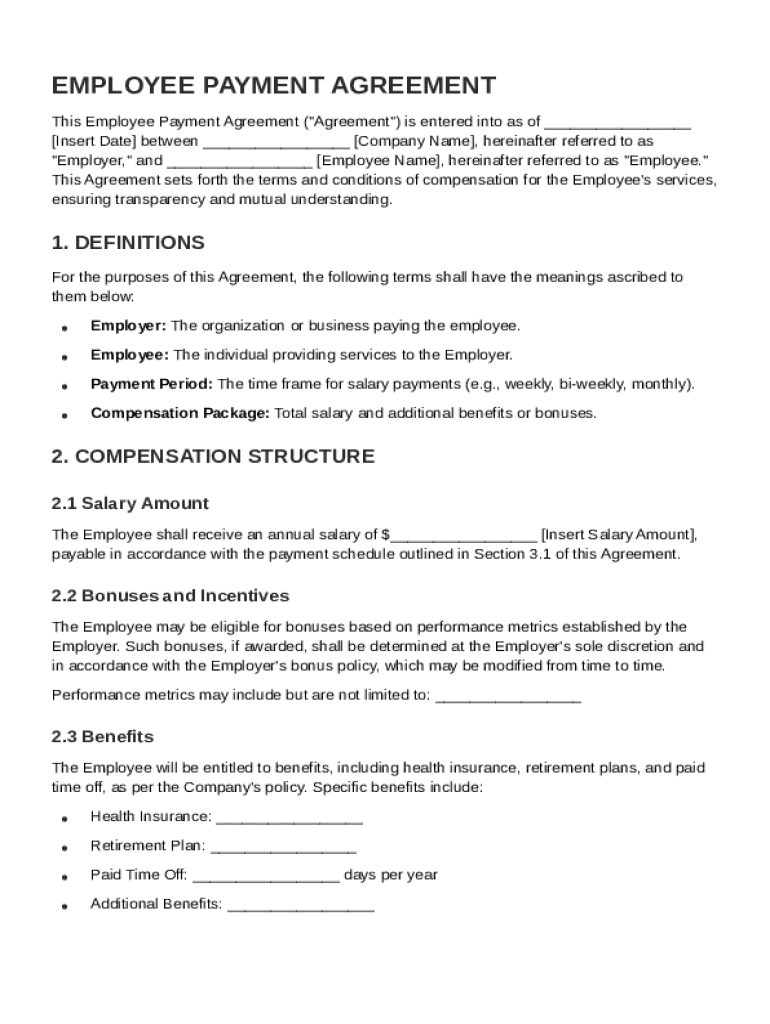







Definition and Meaning of Employee Payment Agreement Template
The Employee Payment Agreement Template is a standardized document detailing the financial relationship between an employer and employee. It covers all aspects of employee compensation, such as salary, bonuses, and payment schedules. This template ensures both parties understand and agree on the terms of remuneration, helping to prevent disputes and misunderstandings. In addition, it addresses deductions, compliance with applicable labor laws, and termination conditions, fostering a transparent working environment.
Key Elements within the Template
The core components of the template include:
- Salary Details: Specifies the base pay and any regularly scheduled bonuses or raises.
- Payment Frequency: Outlines the schedule (e.g., weekly, bi-weekly) for delivering payment.
- Benefits: Lists health insurance, retirement contributions, and other non-monetary compensations.
- Deductions: Notes obligatory deductions like taxes and optional deductions such as charitable contributions.
- Legal Compliance: Ensures all compensation plans follow state and federal labor laws.
- Termination Conditions: Sets out criteria for employment cessation, voluntary or otherwise.
Using the Employee Payment Agreement Template
Utilizing the Employee Payment Agreement Template efficiently can streamline the onboarding process and set clear expectations for the new hire. Before employing the template, it is critical to:
- Review Company Policies: Align the template with your organization's specific compensation policies.
- Customize for Roles: Modify sections to reflect different job responsibilities or levels within the company.
- Seek Legal Counsel: Engage with a legal professional to ensure compliance with jurisdiction-specific labor laws.
Customization Steps
Each organization might need slight adjustments to suit their specific needs:
- Remove sections not applicable to your employees.
- Add any additional benefits or bonuses unique to your company.
- Clearly define job role-specific terms and responsibilities.
Importance of Using an Employee Payment Agreement Template
Having a well-drafted Employee Payment Agreement Template is vital in protecting both employer and employee rights. It minimizes the potential for misunderstandings and offers a legal framework for resolving disputes. By laying out clear terms and conditions, it builds a professional relationship grounded in mutual respect and understanding. Additionally, a structured template simplifies the administrative process, reducing the time spent on hiring paperwork.
Benefits of Consistency
Using a standardized approach provides consistency, ensuring all employees are aware of the expectations and benefits they are entitled to, which promotes fairness and transparency.
Steps to Complete the Employee Payment Agreement Template
Filling out the agreement template requires accuracy and attention to detail. Here’s a typical process:
- Gather Information: Collect details about compensation, benefits, and the employee’s identification.
- Draft the Agreement: Customize the template to include specific employment terms.
- Review and Revise: Conduct a thorough review to ensure accuracy and compliance with relevant laws.
- Employee Review: Allow the employee to read and understand the document thoroughly.
- Finalize the Agreement: Both parties sign the document, solidifying the agreement.
Potential Adjustments
During the drafting phase, consider:
- Including confidentiality agreements where applicable.
- Inserting clauses for future performance-based increments.
Legal Use and Compliance
Employers must ensure that the Employee Payment Agreement Template complies with the legal standards governing employment contracts. This includes adhering to the Fair Labor Standards Act (FLSA) and any state-specific labor regulations. By maintaining compliance, employers safeguard against legal repercussions and uphold fair labor practices.
Consultation with Legal Experts
It is advisable to have a legal expert review the template to confirm all conditions follow federal and state employment laws.
Who Typically Uses the Employee Payment Agreement Template
This template is commonly used by human resources departments, small business owners, and corporate managers. It simplifies the onboarding process for roles that range from temporary positions to executive-level jobs.


Advantages for Small Businesses
For small businesses, particularly those not employing in-house legal teams, this template provides a cost-effective and efficient method of formalizing employment terms without compromising on legal integrity.
State-Specific Rules and Variations
Employment laws can vary significantly by state, affecting how salary, overtime, and benefits are regulated. These differences need to be addressed within your Employee Payment Agreement Template to ensure state compliance.
Adapting to State Regulations
Companies operating in multiple states should consider:
- Customizing templates to adhere to specific state laws.
- Consulting with local employment law experts to avoid any compliance issues.
Examples of Using the Employee Payment Agreement Template
The practical applications of the Employee Payment Agreement Template are numerous:
- Startups: Establish clear compensation frameworks during initial hiring.
- Seasonal Businesses: Define payment terms for temporary employees during peak seasons.
- Remote Workforces: Detail compensation packages that accommodate varying state laws for remote employees.
Real-World Scenarios
- Tech Companies: Using the template to include stock options and profit-sharing plans.
- Retail Chains: Customizing agreements for hourly wage workers while ensuring overtime pay compliance.




