
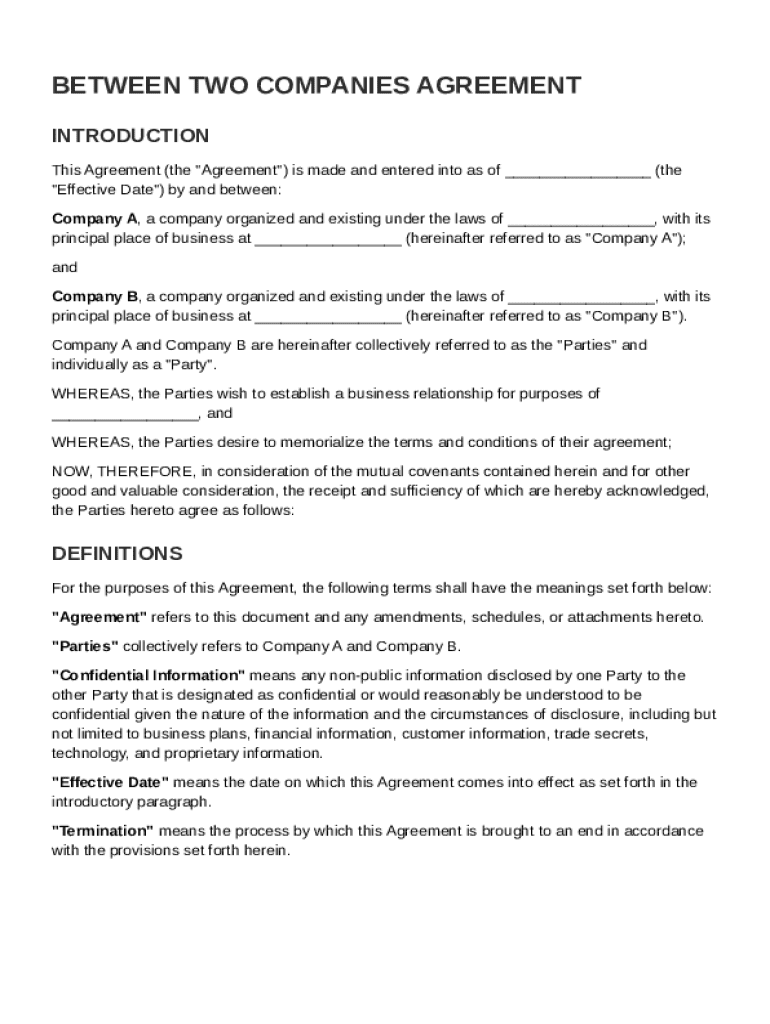







Definition and Meaning
The "Between Two Companies Agreement Template" is a formal document designed to establish the terms and conditions of a partnership or collaboration between two distinct business entities. Typically, this template includes critical components such as the agreement’s purpose, scope of work, financial obligations, confidentiality clauses, intellectual property rights, liability and indemnification, dispute resolution procedures, termination conditions, and miscellaneous provisions. The document serves as a comprehensive framework to define each company's roles and responsibilities, ensuring both parties' interests are protected. It is crucial to frame the partnership within a structured legal context, thereby minimizing potential disputes and fostering a cooperative business relationship.
Steps to Complete the Between Two Companies Agreement Template
-
Gather Necessary Information: Before filling out the template, compile essential details such as the names of both companies, their addresses, and the primary contact individuals.
-
Define the Agreement’s Purpose: Clearly articulate why the companies are entering into this agreement. This could involve joint ventures, co-marketing efforts, research and development projects, or other collaborative endeavors.
-
Outline Scope of Work: Specify the tasks, responsibilities, and deliverables expected from each company. This should be detailed to prevent misunderstandings.
-
Clarify Financial Arrangements: Document the financial contributions each party will make, including compensation, expense sharing, and payment schedules.
-
Establish Confidentiality Clauses: Determine how proprietary information will be handled and the repercussions of breaches of confidentiality.
-
Address Intellectual Property Rights: Clearly define the ownership and rights relating to any intellectual property that may be developed or shared under this agreement.
-
Incorporate Liability and Indemnification: Outline the extent to which each company is liable for damages or legal claims, and any indemnification obligations.
-
Determine Dispute Resolution Guidelines: Specify the process for resolving conflicts, possibly involving mediation or arbitration, before resorting to legal action.
-
Set Termination Conditions: Define the circumstances under which the agreement can be terminated by either party.
-
Include Miscellaneous Provisions: Address any additional elements such as legislative compliance, interpretation of terms, and amendment procedures.
Key Elements of the Between Two Companies Agreement Template
-
Parties Involved: Identification of the two companies entering into the agreement, including their full legal names and principal addresses.
-
Agreement Duration: Specify the start date and duration of the agreement, along with conditions for renewal.
-
Roles and Responsibilities: Detailed descriptions of each party’s roles to avoid overlapping duties or gaps in responsibility.
-
Financial Terms: Agreement on how the costs and profits will be distributed or shared during the partnership.
-
Confidentiality and Non-disclosure: Provisions to protect sensitive information exchanged between parties.
-
Dispute Resolution Mechanism: Clear processes for addressing disagreements that might arise during the collaboration.
-
Termination Clause: Defined procedures and conditions for ending the agreement prematurely if needed.
Legal Use of the Between Two Companies Agreement Template
This agreement template must comply with applicable U.S. state and federal laws to ensure its enforceability. Legal considerations include adhering to contract law standards, ensuring mutual consent, and maintaining clauses that respect public policy and legal guidelines. Both companies may benefit from consulting legal professionals to tailor the template to specific legal needs and jurisdictional requirements. Ensuring all elements of the agreement align with the law helps mitigate the risk of future disputes and ensures both parties can rely on the agreement’s enforceability.
State-Specific Rules for the Between Two Companies Agreement Template
Different states in the United States might have varied rules and regulations that affect how contracts are drafted and enforced. For example, the application of statutes related to business partnerships and contract filings may differ significantly from one state to another. Some states may require specific language in agreements regarding liability waivers or enforcement of non-compete clauses. When drafting the Between Two Companies Agreement Template, it's essential to consider these state-specific rules and possibly seek legal expertise to ensure the contract's compliance with local laws.
Business Types That Benefit Most from the Between Two Companies Agreement Template
Entities across various industries can leverage this agreement template, particularly those involved in sectors like technology, manufacturing, and professional services, where collaboration is pivotal. Companies that frequently engage in joint ventures, research and development projects, or strategic partnerships will find this template invaluable. Additionally, startups and small businesses seeking to scale operations through alliances often rely on structured agreements to clearly define expectations and protect intellectual properties.
Software Compatibility
The Between Two Companies Agreement Template can be utilized alongside various document editing and management software, ensuring broad compatibility for users. With platforms like DocHub, companies can efficiently edit, collaborate, and finalize documents online, integrating seamlessly with Google Workspace for a streamlined workflow. This flexibility allows businesses to access and manage their agreements from multiple devices and locations, enhancing convenience and efficiency in document handling.
Examples of Using the Between Two Companies Agreement Template
-
Tech Collaborations: A software development company joins forces with a tech hardware manufacturer to create an integrated technology solution, using the agreement to define roles and control over intellectual property.
-
Co-Marketing Efforts: Two businesses in complementary industries agree to share resources for a co-branding initiative, leveraging the template to outline financial contributions and marketing duties.
-
Research Projects: A pharmaceutical company collaborates with a research institution on drug development, specifying confidentiality, funding arrangements, and data ownership in the agreement.
These scenarios demonstrate the template's flexibility, providing a solid framework for diverse collaborative initiatives while ensuring clarity and legal protection for all parties involved.


