






Understanding the Non-Compete Non-Solicitation Agreement
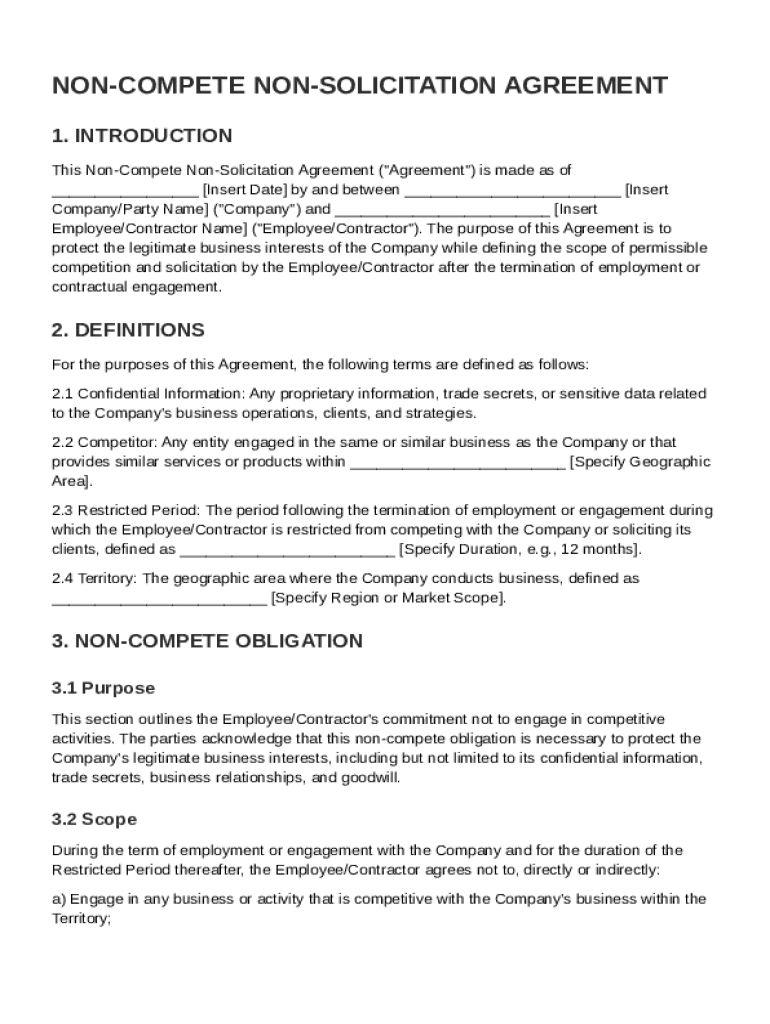
The Non-Compete Non-Solicitation Agreement serves as a protective mechanism for businesses by preventing former employees or contractors from engaging in activities that could compromise the company's interests. This agreement outlines conditions under which a former employee agrees to refrain from competing with or soliciting clients and employees from their previous employer after leaving the company. Key terms such as "Confidential Information" and "Competitor" are clearly defined to ensure both parties understand their obligations.
Key Terms and Definitions
- Confidential Information: Information that is proprietary to the company and not publicly available. This can include business plans, customer lists, and trade secrets.
- Competitor: Any business that provides similar products or services and operates in the same market as the company.
- Restricted Period: The duration of time during which the former employee or contractor is restricted from engaging in competitive activities.
- Territory: The geographical area in which the restrictive covenants apply.
How to Use the Agreement Template
Start by customizing the Non-Compete Non-Solicitation Agreement Template to fit your specific needs. Identify the parties involved and clarify the scope of the restrictions. Specify the Restricted Period and define the Territory. Be sure to include clear terms related to Confidential Information and the repercussions for violating the agreement. This thorough definition helps ensure mutual understanding and legal enforceability.
Step-by-Step Use of the Template
- Identify Parties: Clearly state the names and addresses of both the employer and the employee or contractor in the agreement.
- Define Restrictions: Outline what constitutes competitive activities and specify the duration and geographical limitations.
- Clarify Confidentiality: Clearly define what information is considered confidential.
- Finalize the Document: Ensure all parties read, understand, and agree to the terms before signing.
Key Elements of the Agreement
Several critical elements make up a robust Non-Compete Non-Solicitation Agreement. Fundamentally, it should protect the company's interests while being reasonable and enforceable.
Main Components
- Parties Involved: Explicitly name each party subject to the agreement.
- Duration and Territory: Define the timeframe and geographical boundaries applicable to the restrictions.
- Scope of Restrictions: Clarify what actions are restricted—such as working with competitors or soliciting clients.
- Legal Remedies: Outline available legal actions in case of a breach.
Legal Use of the Agreement
The agreement must comply with applicable U.S. state laws to ensure it is legally binding. Legal enforceability can depend on reasonableness in terms of duration, geographic scope, and competitive activity restrictions. Businesses should consult legal professionals to tailor the agreement appropriately.
State-Specific Rules
Different states have varied rules regarding the enforceability of Non-Compete and Non-Solicitation agreements. For instance, some states may impose stricter guidelines or outright prohibit certain clauses. It is crucial to understand the legal framework within your state to ensure the agreement is valid.
Examples and Real-World Scenarios
Using a Non-Compete Non-Solicitation Agreement can protect a company in several scenarios. For example, when an employee with extensive knowledge of client databases leaves, this agreement prevents them from leveraging that information against the company by joining or starting a competitor.
Practical Applications
- Protecting Trade Secrets: Shield proprietary business strategies and client lists from being utilized by competitors.
- Client Retention: Safeguard client relationships from being exploited by former employees.
Who Uses This Agreement?
Generally, businesses of all sizes utilize Non-Compete Non-Solicitation Agreements to protect their interests. It is particularly crucial for industries with high employee mobility and proprietary information, such as technology companies or firms with a large sales force.
Business Types
Industries that benefit most include tech companies, financial services, and healthcare providers, where intellectual property and consumer relationships are vital.
Obtaining the Template
Securing a Non-Compete Non-Solicitation Agreement Template can typically be done through several methods. Templates are often provided by legal software, business advisory services, or downloadable from trusted document management platforms like DocHub.
Methods of Acquisition
- Online Platforms: Access from document service providers offering customizable templates.
- Legal Advisors: Lawyers specializing in employment law may offer industry-specific templates.
Important Considerations
When drafting or customizing a Non-Compete Non-Solicitation Agreement, consider factors such as duration, enforceability, and industry standards to ensure it aligns with both legal requirements and business needs.
Factors Affecting Enforceability
- Reasonableness: Courts often assess the reasonableness of the agreement in terms of time, territory, and scope.
- Public Policy: Agreements perceived as overly restrictive may face legal challenges on public policy grounds.