






Definition and Meaning
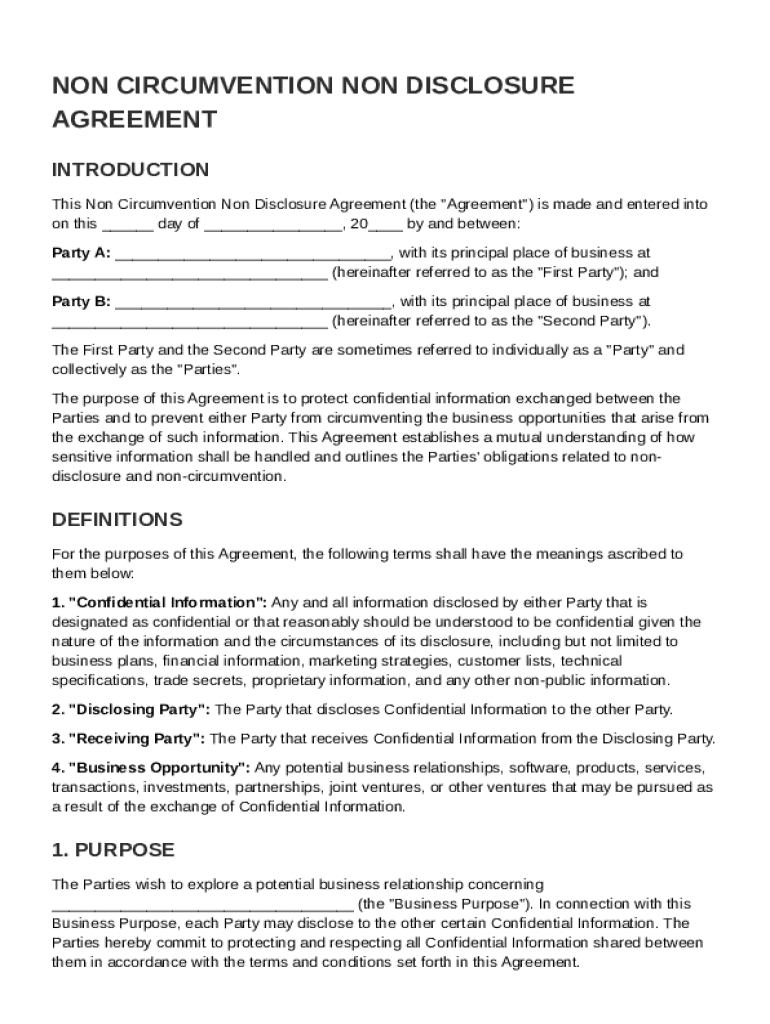
A Non-Circumvention Non-Disclosure Agreement (NCNDA) is a legal contract between parties that defines how confidential information can be exchanged without the risk of circumvention or unauthorized disclosure. The primary goal is to protect the interests of the involved parties while facilitating a potential business relationship. The agreement delineates what constitutes confidential information and explicitly prohibits the receiving party from bypassing the other in future dealings concerning the said information.
Key Components
- Confidential Information: Clearly states what information is considered confidential.
- Obligations of Parties: Outlines duties related to non-circumvention and non-disclosure.
- Duration: Specifies how long the protections apply.
- Exclusions: Lists what information is not covered under confidentiality.
How to Use the Non-Circumvention Non-Disclosure Agreement Template
The NCNDA template provides a structured framework for drafting an agreement tailored to the specifics of a business relationship. Using the template involves customizing the pre-drafted sections to align with the unique needs of the involved entities.
Customization Steps
- Identify the Parties: Clearly list all parties involved and their roles.
- Detail the Confidential Information: Specify the type, scope, and nature of the confidential data.
- Define Obligations: Tailor responsibilities based on the business context.
- Set Duration: Decide the term of the agreement’s protections.
Practical Example
Suppose a technology company partners with a marketing agency. The NCNDA would prevent the agency from going directly to the tech company's clients or while also safeguarding proprietary strategies shared during the collaboration.
Steps to Complete the Non-Circumvention Non-Disclosure Agreement Template
Creating a robust NCNDA requires thorough preparation and precision. Following a systematic approach ensures that all legal aspects are adequately addressed.
- Gather Information: Assemble details about the confidential material and the scope of the collaboration.
- Fill Out the Template: Input specific details related to the parties, obligations, and terms of confidentiality.
- Review Legal Terms: Check legal terminologies through a legal counsel to ensure compliance with applicable laws.
- Sign and Store: Once agreed upon, ensure all parties sign and securely store the agreement copies.
Edge Cases
In mergers and acquisitions, NCNDAs are crucial to prevent a potential buyer from circumventing the seller after obtaining sensitive information during due diligence.
Key Elements of the Non-Circumvention Non-Disclosure Agreement Template
An NCNDA is built around several fundamental elements that must be carefully considered and accurately documented.
Primary Elements
- Confidentiality Clause: Explicitly defines what constitutes confidential information.
- Non-Circumvention Clause: Prohibits parties from bypassing each other to exploit business opportunities.
- Duration and Termination: Specifies how long the agreement is valid and under what conditions it can be terminated.
- Governing Laws: Identifies the legal jurisdiction under which the agreement is governed.
Illustrative Example
In a supplier-distributor relationship, a well-drafted NCNDA will ensure neither party usurps customers or trade secrets revealed during negotiations.
Legal Use of the Non-Circumvention Non-Disclosure Agreement Template
Utilizing an NCNDA involves adhering to certain legal standards to ensure its enforceability. It's not merely a preventive measure but a robust legal tool designed to protect proprietary interests.
Compliance Guidelines
- Jurisdictional Considerations: Align the agreement with state-specific laws for enforceability.
- Legal Consultation: Engage attorneys to verify legal sufficiency and address any potential loopholes.
- Record-Keeping: Maintain detailed records of the agreement's implementation and parties’ compliance.
Common Missteps
Failing to precisely define what constitutes "circumvention" or not setting clear penalties for breaches can render an NCNDA ineffective.
Important Terms Related to Non-Circumvention Non-Disclosure Agreement Template
Understanding the lexicon associated with NCNDAs is vital to ensure clarity and precision in the drafting process.
Terms and Definitions
- Circumvention: Any act where a party sidesteps another to conduct business independently.
- Disclosure: Release of confidential information without the consent of the disclosing party.
- Material Breach: A significant violation that impacts the core purpose of the agreement.
Case Study
In consultancy agreements, defining "material breach" helps prevent misunderstandings when confidential methodologies are shared but improperly used.
Examples of Using the Non-Circumvention Non-Disclosure Agreement Template
Providing concrete examples enhances clarity and illustrates the versatility of NCNDAs across various industries.
Industry Applications
- Tech Startups: Protect algorithms and business plans when discussing with potential investors.
- Manufacturers: Safeguard product designs when collaborating on prototypes with engineering firms.
- Real Estate: Secure sensitive client lists shared between brokers during joint ventures.
Real-World Scenario
In a joint R&D project, a pharmaceutical company may use an NCNDA to prevent a partner from independently developing drugs based on shared research.
Business Types That Benefit Most from the Non-Circumvention Non-Disclosure Agreement Template
Different types of businesses can leverage NCNDAs to protect their competitive interests while engaging in collaborative efforts.
Suitable Business Sectors
- Technology Firms: Protect software source codes and proprietary innovations.
- Media Companies: Secure scripts and production plans against unauthorized use.
- Financial Institutions: Guard client data and financial reports in strategic partnerships.
Benefits to Startups
Emerging companies frequently share groundbreaking ideas in pitches and funding discussions. An NCNDA provides a necessary layer of legal assurance, fostering trust and enabling open communication.