






Definition and Meaning
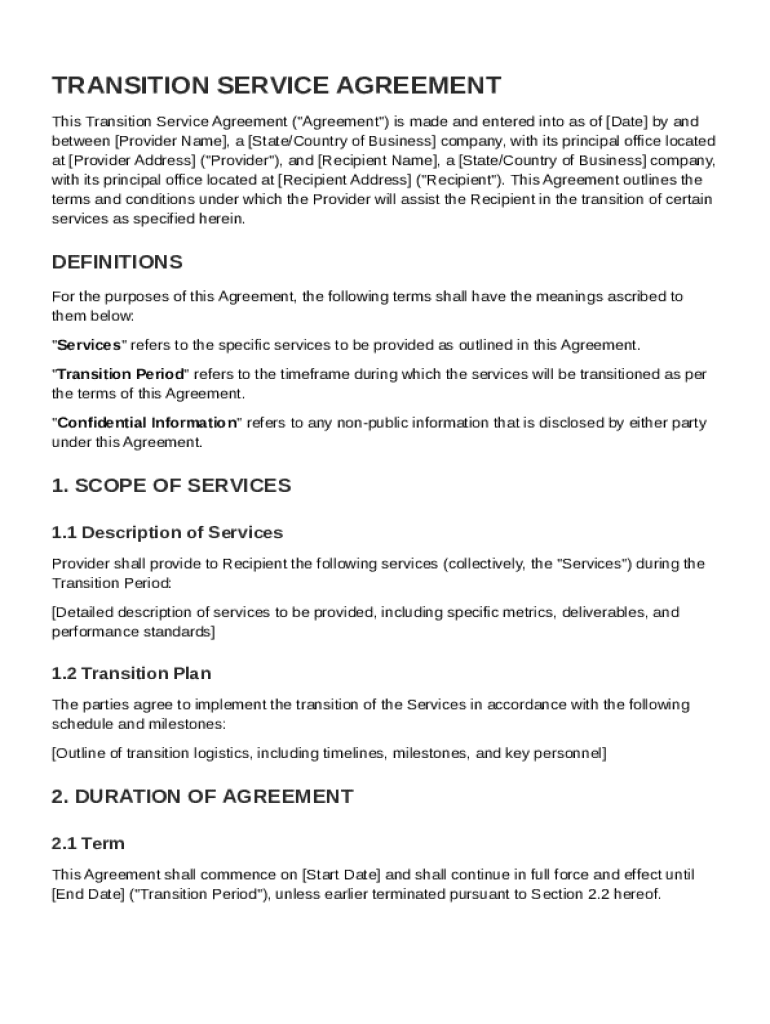
A Transition Service Agreement (TSA) template is a crucial tool in the realm of business transactions and mergers. It formally documents the terms under which a service provider (typically the seller or departing company) will assist a recipient (usually the buyer or incoming company) in transitioning specific services. This template aims to minimize disruptions during the transition phase by clearly outlining each party's roles and responsibilities.
- Service Definitions: The TSA includes precise definitions of the services being transitioned. This might encompass IT support, administrative services, or supply chain management, depending on the nature of the businesses involved.
- Scope of Services: The agreement delineates the scope, ensuring both parties understand the extent and limitations of the services provided. Clear boundaries help prevent misunderstandings during the transition.
Key Elements of the Transition Service Agreement Template
Understanding the critical elements of a TSA template ensures the agreement effectively supports a successful transition.
- Responsibilities: Each party's responsibilities are explicitly outlined. The provider is typically responsible for maintaining continuity of services, while the recipient may be tasked with integrating these services into their operations.
- Payment Terms: Financial considerations, including service fees and payment schedules, are clearly defined to avoid disputes.
- Confidentiality Obligations: The agreement includes confidentiality clauses to protect sensitive information exchanged during the transition process.
- Indemnification and Liability Clauses: These clauses detail how disputes over service delivery or damages are handled, offering financial protection to both parties.
- Governing Law and Dispute Resolution: This section specifies the legal framework and processes for resolving disputes, ensuring both parties agree on how potential conflicts will be managed.
Legal Use of the Transition Service Agreement Template
Ensuring the TSA adheres to legal standards is paramount for the protection of all involved parties.
- Compliance with Laws: The template must align with federal and state regulations, particularly those governing mergers and acquisitions.
- Legally Binding: The agreement is structured to be legally enforceable, with signatures indicating consent to the terms.
- Use Cases: Common in mergers and acquisitions, TSAs are also valuable when outsourced services are transferred back in-house or when a company is dismantling a subsidiary.
How to Use the Transition Service Agreement Template
Utilizing a TSA template correctly can streamline the transition process.
- Customizing the Template: Modify the template to reflect specific services and conditions relevant to the transaction.
- Consulting Legal Experts: Engaging attorneys to review the terms ensures all legal requirements are met and that the agreement is robust.
- Collaborative Approach: Both parties should work closely during drafting to ensure mutual understanding and agreement on all terms.
Steps to Complete the Transition Service Agreement Template
Completing a TSA template involves detailed attention to ensure accuracy and comprehensiveness.
- Identify Services: Clearly list the services to be transitioned.
- Define Timeframes: Establish clear timelines for each phase of the transition.
- Assign Roles: Designate responsibilities to responsible parties within both organizations.
- Detail Payment Arrangements: Confirm payment terms, including amounts and schedules.
- Review and Revise: Both parties should thoroughly review the draft and make necessary revisions.
- Obtain Signatures: Collect authorized signatories from both entities to formalize the agreement.
Important Terms Related to Transition Service Agreement Template
Familiarity with key terms aids in understanding and drafting a TSA.
- Effective Date: The commencement date when the agreement takes effect.
- Termination Clause: Conditions under which the agreement can be terminated early.
- Service Level Agreements (SLAs): Specific performance metrics that services must meet.
- Force Majeure: Provisions that release parties from liabilities due to extraordinary events.
Who Typically Uses the Transition Service Agreement Template
The TSA template is used predominantly in specific business contexts involving service transitions.
- Merging Companies: Entities undergoing mergers or acquisitions use TSAs to transition services smoothly.
- Corporations Divesting Units: Companies selling off parts of their operations employ TSAs to manage service transfers.
- Buyers Acquiring Businesses: Purchasers leverage TSAs to integrate purchased operations efficiently.


Software Compatibility
TSAs, although primarily legal documents, can benefit from specialized software for ease of management.
- Document Management Systems: Platforms like DocHub provide tools for editing, signing, and sharing TSA documents seamlessly.
- Integration with Business Software: Compatibility with software like QuickBooks ensures financial compliance.
Why You Should Use a Transition Service Agreement Template
A TSA offers several advantages in managing transitions effectively.
- Risk Mitigation: By detailing all aspects of the transition, a TSA helps reduce business risks.
- Clarity and Transparency: A well-crafted TSA facilitates clear communication and mutual understanding.
- Efficiency: Establishing predefined processes and timelines ensures the transition is as smooth as possible.
Examples of Using the Transition Service Agreement Template
Real-world scenarios demonstrate the utility and relevance of TSAs.
- Large-Scale Mergers: A tech company acquiring another uses a TSA to maintain IT operations during integration.
- Divestitures: A pharmaceutical company selling a division implements a TSA to transition supply chain responsibilities.
These elements combine to create a comprehensive view of the Transition Service Agreement Template, offering invaluable guidance for businesses navigating complex transitional phases.