






Definition and Meaning
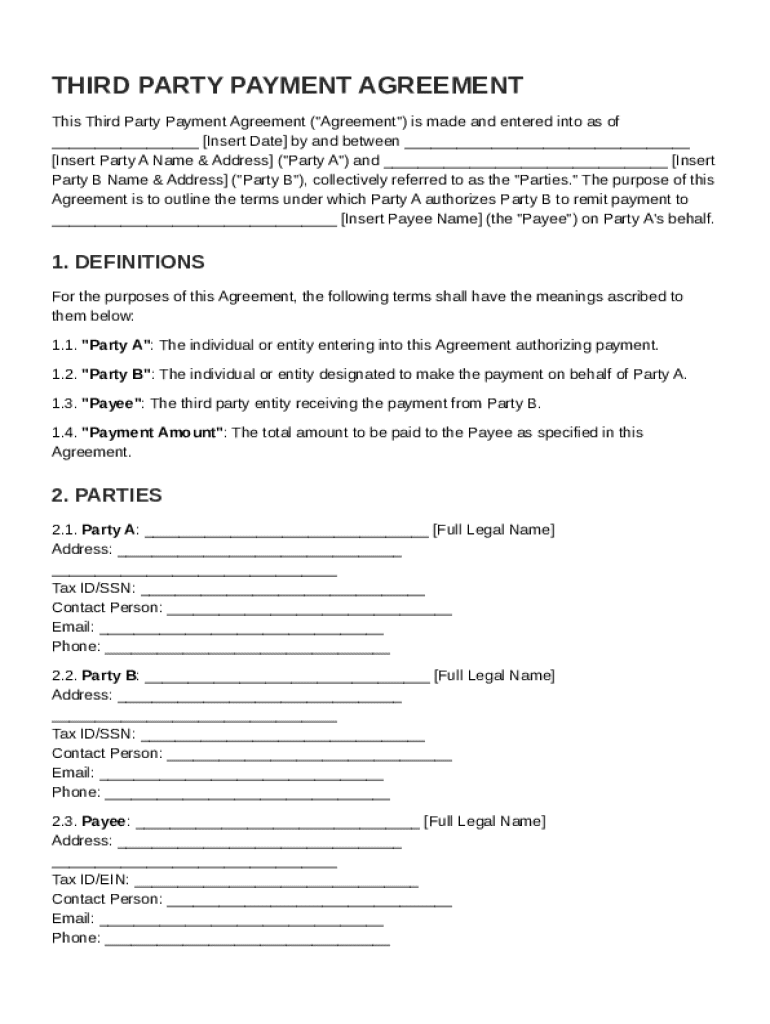
The Third Party Payment Agreement Template is a legal document used to facilitate payment interactions among multiple parties. Typically, this agreement involves Party A, who authorizes Party B to make payments on their behalf to a third party, known as the Payee. This arrangement clarifies the responsibility of each party involved, ensuring that the payment process is smooth, transparent, and legally binding. It includes various clauses such as definitions, authorizations, payment terms, and obligations, which together establish the framework for handling payments securely and efficiently.
Key Elements of the Third Party Payment Agreement Template
This template incorporates several critical elements to ensure all parties are on the same page:
-
Authorization Details: Explicitly states Party A's permission for Party B to make payments on their behalf.
-
Payment Terms: Defines the schedule, frequency, and method of payments to the Payee.
-
Obligations: Outlines the duties and responsibilities of Parties A, B, and the Payee.
-
Confidentiality Agreements: Ensures all parties maintain the privacy of shared information.
-
Termination Clause: Details the scenarios under which the agreement can be terminated by either party.
-
Dispute Resolution: Provides procedures for resolving any conflicts that arise during the payment process.
Each of these elements is crucial for safeguarding the interests of all parties and maintaining the integrity of the transaction.
Steps to Complete the Third Party Payment Agreement Template
Completing the Third Party Payment Agreement Template involves several crucial steps to ensure accuracy and comprehensiveness:
-
Identify Parties Involved: Clearly list Party A, Party B, and the Payee, including their legal names and contact information.
-
Authorization Statement: Formally document the authorization from Party A to Party B regarding payment responsibilities.
-
Payment Terms Specification: Detail the terms, including amount, frequency, and mode of payment.
-
Outline Duties and Responsibilities: Each party's obligations should be specified to prevent any misinterpretations.
-
Include Legal Provisions: Add clauses for confidentiality, dispute resolution, and agreement termination.
-
Review and Sign: Ensure all parties review the agreement thoroughly. Each party should sign the document to denote agreement to the terms.
How to Use the Third Party Payment Agreement Template
Using the Third Party Payment Agreement Template involves several practical steps:
-
Customization: Tailor the template to fit the specific transaction it will be used for. Modify sections to reflect the details unique to the arrangement, such as the payment schedule or any additional terms specific to the parties involved.
-
Collaboration: If multiple changes are needed, ensure all parties have a chance to review and propose edits, utilizing document collaboration features.
-
Finalization: After agreeing to all terms, complete the form in a secure and accessible format, ensuring all parties have the final version for their records.
The template's flexibility is a crucial aspect, making it easy to adapt to varying scenarios and requirements.
Legal Use of the Third Party Payment Agreement Template
The Third Party Payment Agreement Template serves as a legally binding document under U.S. law. Adhering to state-specific legislation ensures that the agreement is enforceable.
-
ESIGN Act Compliance: The template, when signed electronically through secure platforms, complies with the ESIGN Act, maintaining the agreement's validity.
-
Confidentiality and Data Protection: It includes provisions to ensure personal and financial data shared in the agreement is protected under applicable privacy laws.
To maintain its legal validity, all parties should comprehend and consent to the template's terms before execution.
Who Typically Uses the Third Party Payment Agreement Template
Various individuals and businesses benefit from using this template:
-
Individuals: Such as landlords authorizing agents to handle payments to contractors or repair services on their property.
-
Businesses: Using third-party payers for operational expenses like utilities or vendor services.
-
Corporations and Enterprises: Outsourcing payment processes for efficiency and resource management.
The template serves a diverse range of users, providing a structured approach to managing third-party payments legally.


Business Types That Benefit Most from Third Party Payment Agreement Template
Different business structures find value in this agreement:
-
LLCs and Corporations: Often managing complex financial exchanges benefiting from defined terms and responsibilities.
-
Partnerships: Where multiple partners might delegate fiscal responsibilities to another entity or individual within the organization.
-
Freelancers and Sole Proprietors: Using agents to handle payment processes, allowing them to focus on core business activities.
-
Real Estate Firms: Managing client funds for property-related expenses.
Each business type utilizes the template to streamline payment operations, making it a versatile solution for efficient financial management.
State-Specific Rules for the Third Party Payment Agreement Template
State laws can influence the terms and enforceability of the agreement:
-
Governing Laws: Always specify which state's laws will govern the agreement to prevent jurisdictional disputes.
-
Variations in Financial Regulations: Certain states have specific requirements for managing and authorizing payments, which must be reflected in the agreement.
-
Disclosure Requirements: Some states may mandate additional disclosures that need to be included in the agreement for transparency.
Adapting the template to comply with local regulations is essential for ensuring legal enforceability and minimizing disputes.
Required Documents
To seamlessly execute the Third Party Payment Agreement, certain documents should be on hand:
-
Identity Verification: Legal identification for Parties A and B, ensuring authenticity of involved individuals or entities.
-
Financial Statements: Relevant documentation from both payer and the payee can clarify payment capabilities and requirements.
-
Previous Agreements: If applicable, any preceding agreements that impact or relate to the current transaction, providing context and legal background.
Securing these documents facilitates the creation of a thorough and legally sound agreement.