






Definition & Meaning
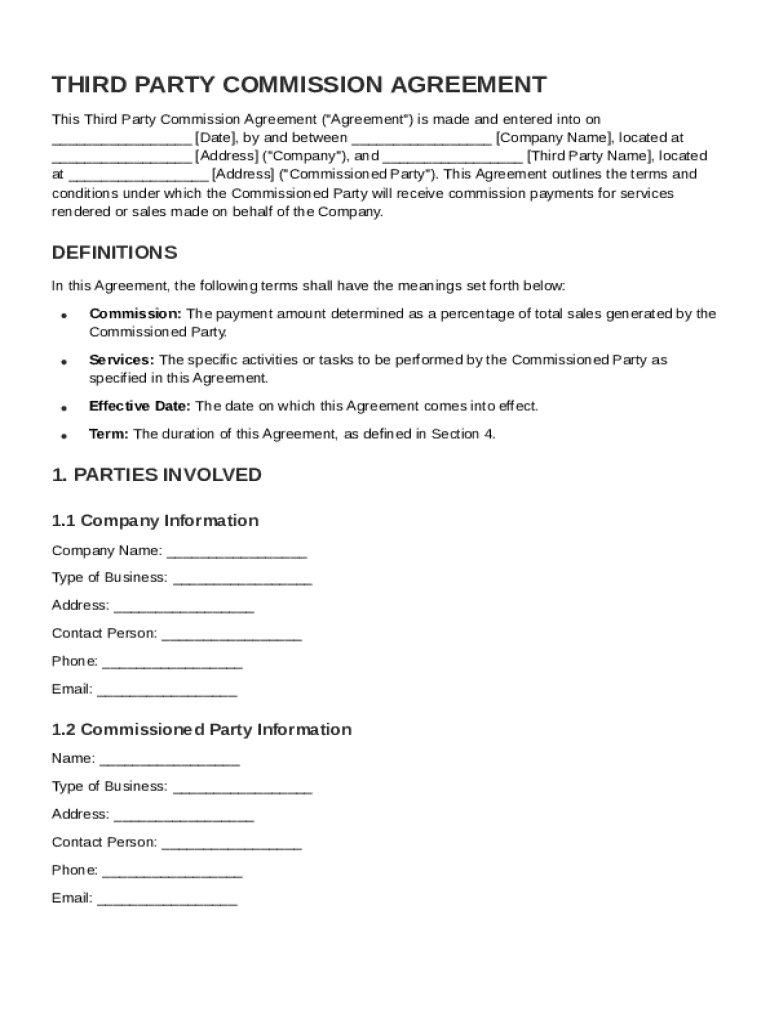
A Third Party Commission Agreement Template serves as a foundational legal document that outlines the terms under which a third-party individual or entity (referred to as the "Commissioned Party") earns commission for facilitating sales or completing services on behalf of another company. This agreement formalizes the relationship between the company and the Commissioned Party, establishing them as independent contractors rather than employees. It details crucial aspects such as the scope of work, commission structure, payment schedules, and obligations regarding confidentiality, providing a clear and mutual understanding of each party's responsibilities and limitations.
Key Components of the Agreement
-
Commission Structure: Clearly defines how the commission is calculated — whether it is a flat rate, percentage of sales, or a tiered system based on sales volume.
-
Payment Schedule: Specifies when the commissions will be paid, including any milestones or conditions that must be met before payment.
-
Scope of Work: Details the specific services or sales activities that the Commissioned Party is expected to perform.
-
Confidentiality Clauses: Outlines obligations concerning sensitive information handling to protect the company's business interests.
-
Indemnification: Addresses responsibilities related to legal claims that may arise from the Commissioned Party's activities, providing liability protection for both parties.
How to Use the Third Party Commission Agreement Template
To effectively utilize the Third Party Commission Agreement Template, it is essential to personalize the document according to the specific needs and conditions of both involved parties. This customization involves editing standard sections to reflect the particular commission terms, payment schedules, and unique company policies.
Steps to Customize the Agreement
-
Review Pre-Existing Content: Start by familiarizing yourself with the template's standard clauses, understanding their purpose and legal implications.
-
Tailor the Terms: Modify the commission structures, payment terms, and work scope to align with your business operations and objectives.
-
Include Specific Provisions: Add any additional clauses relevant to the business relationship, such as non-disclosure agreements or non-compete clauses.
-
Consult Legal Advisors: For complex modifications or to ensure compliance with state laws, consider consulting with a legal professional.
-
Final Review and Signatures: Before execution, review the agreement with all parties involved to ensure understanding and agreement on the terms. Secure signatures from authorized representatives to formalize the document.
Steps to Complete the Third Party Commission Agreement Template
Completing the Third Party Commission Agreement Template involves a structured approach to ensure accuracy and legal compliance. This process typically includes a series of well-defined steps that guide the preparation, execution, and validation of the agreement.
Step-by-Step Process
-
Fill Out Basic Information:
- Input the names and contact details of both the company and the Commissioned Party.
- Specify the effective date of the agreement.
-
Detail the Commission Terms:
- Clearly outline how the commission will be calculated and the conditions under which it is payable.
- Establish the payment schedule, including any advance payments or performance-triggered bonuses.
-
Define the Scope and Expectations:
- Describe in detail the services or sales efforts expected from the Commissioned Party.
- Set performance benchmarks or targets, if applicable.
-
Include Regulatory Requirements:
- Add clauses addressing tax responsibilities and reporting obligations, ensuring compliance with IRS guidelines.
-
Finalize and Sign:
- Ensure the document reflects all negotiated terms.
- Both parties must sign and keep a copy for their records.
Key Elements of the Third Party Commission Agreement Template
Certain elements are indispensable for making the Third Party Commission Agreement Template comprehensive and enforceable. These key elements ensure that the agreement meets legal standards and covers essential business considerations, creating a well-rounded contract.
Essential Elements to Include
-
Definitions and Interpretations: Clarifies terminology used within the agreement to prevent misunderstandings.
-
Termination Clauses: Outlines conditions under which the agreement can be terminated, including notice periods and termination for cause.
-
Dispute Resolution: Specifies processes for handling disputes, such as mediation or arbitration, and jurisdiction for legal proceedings.
-
Amendment Provisions: Details how changes to the agreement can be made, ensuring that modifications require mutual consent.
-
Notice Requirements: Specifies how and when communications regarding the contract, such as termination or amendment notices, should be delivered to each party.
Legal Use of the Third Party Commission Agreement Template
The legal framework supporting the Third Party Commission Agreement Template is crucial to protecting the interests of both parties and ensuring the agreement is enforceable. Legal use involves adhering to jurisdictional laws and incorporating necessary legal clauses that reflect current regulations.
Compliance Considerations
-
Governing Law: Clearly state which state’s laws will govern the agreement to manage potential legal disputes efficiently.
-
Acknowledgment of Independent Contractor Status: Establish that the relationship does not constitute a partnership, franchise, joint venture, agency, or employment.
-
IRS Compliance:
- Ensure alignment with IRS guidelines, particularly regarding the classification and tax reporting of payments to independent contractors.
-
Electronic Signature Legitimacy: Confirm that digital signatures are legally binding and equivalent to physical signatures under the ESIGN Act.
Who Typically Uses the Third Party Commission Agreement Template
This type of agreement is most frequently utilized by businesses that engage third-party service providers or sales agents to enhance their operational capabilities or expand their reach into new markets. The users of this template vary across industries but share common objectives of fostering growth while mitigating risks.


Typical Users
-
Small to Medium Enterprises (SMEs): Often use commission agreements to engage external agents who sell on their behalf without hiring full-time employees.
-
Real Estate Brokers: Implement these agreements to manage compensations among agents operating under the brokerage.
-
E-commerce Platforms: Use to formalize relationships with affiliates who drive sales and traffic to their online stores.
-
Manufacturers: Engage with distributors or sales agents to increase product penetration in various geographic regions.
Important Terms Related to Third Party Commission Agreement Template
Familiarity with certain critical terms within the Third Party Commission Agreement Template is essential for understanding and negotiating its content effectively. These terms cover a range of legal, financial, and operational areas within the agreement.
Relevant Terms and Definitions
-
Commission Rate: The percentage or fixed amount paid on sales generated or deals closed.
-
Net Sales: The revenue generated from sales after deducting returns, allowances, and discounts.
-
Force Majeure: A clause that frees both parties from obligations in unforeseen events like natural disasters or emergencies.
-
Non-Solicitation Clause: Prevents the Commissioned Party from soliciting the company’s clients or employees for a specified period after termination.
-
Exclusivity Clause: Determines whether the Commissioned Party is permitted to engage with competitor businesses during the agreement term.
State-Specific Rules for the Third Party Commission Agreement Template
Law variations across states can significantly impact the enforceability and formulation of the Third Party Commission Agreement Template. Recognizing these differences is crucial for ensuring that the contract is legally valid within the intended jurisdiction.
Variations and Considerations
-
Unique State Laws: Certain states may have specific requirements regarding commission payment timelines or definitions, such as when a commission is "earned."
-
Non-Compete/Non-Solicitation Enforceability: The enforceability of non-compete or non-solicitation clauses can vary significantly, with some states imposing more stringent limitations than others.
-
State Tax Obligations: Different states may impose varying tax treatments on commission payments, affecting the agreement's financial implications.
-
Contract Filing Requirements: Some jurisdictions may necessitate the filing or registration of commission agreements, especially for certain industries or transaction values.
Ensuring awareness and adherence to these state-specific considerations can prevent potential legal challenges and enforceability issues, reinforcing the integrity of the agreement.