
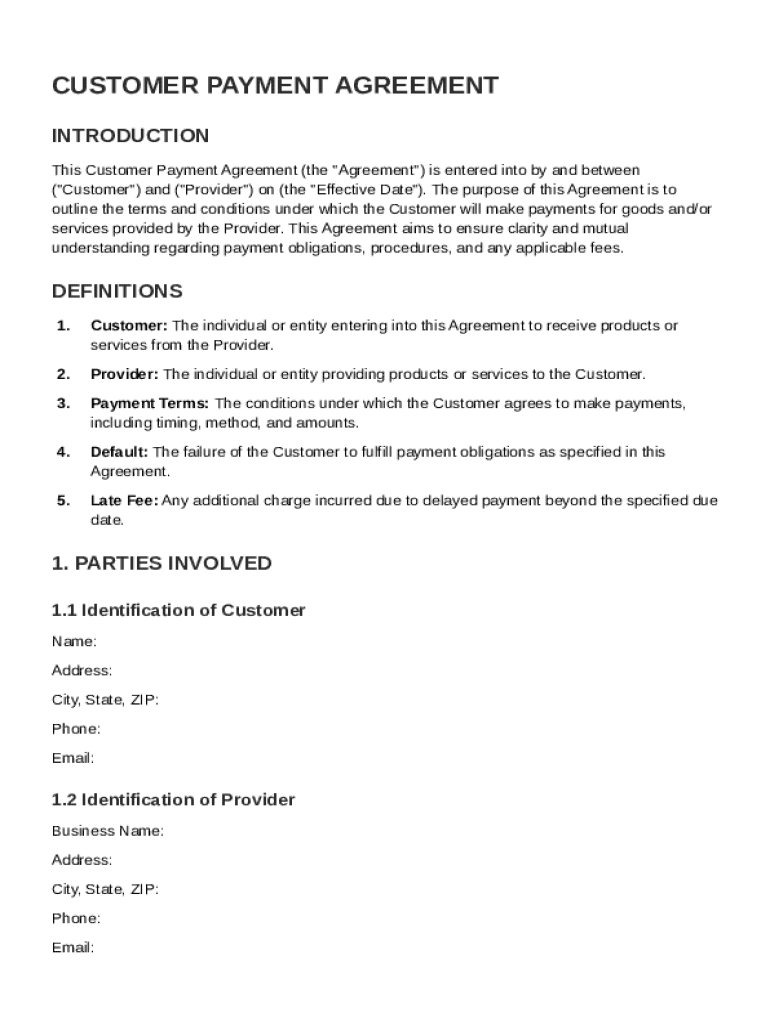







Definition & Purpose of a Customer Payment Agreement Template
A Customer Payment Agreement Template is a structured document used to clearly define the payment obligations between a provider and a customer for goods or services. This agreement outlines important aspects such as payment terms, late payment policies, dispute resolution processes, and modification procedures. By providing these details, the contract aims to facilitate smooth financial transactions, ensuring that both parties have a mutual understanding of payment responsibilities and the consequences of default. The template serves as a standardized framework that can be customized to suit the specific needs of the parties involved.
Key Elements of the Template
The Customer Payment Agreement Template typically includes the following core components:
- Identification of Parties: Names and contact details of the customer and provider.
- Payment Terms: Detailed terms, including amounts, due dates, and payment methods.
- Late Payment Policies: Consequences of late payments, such as interest or penalties.
- Dispute Resolution: Steps to address disagreements, possibly involving mediation or arbitration.
- Modification Procedures: How changes to the agreement will be handled and approved by both parties.
- Termination Conditions: Criteria under which the agreement can be terminated by either party.
- Miscellaneous Provisions: Additional clauses covering various contingencies.
Having these elements ensures that the agreement is comprehensive and all-encompassing, minimizing misunderstandings and enhancing contractual clarity.
Steps to Complete the Customer Payment Agreement Template
Completing a Customer Payment Agreement Template involves several sequential steps to ensure both parties agree on the terms. Here’s a step-by-step guide:
- Collect Information: Assemble basic details of both parties, including legal names and addresses.
- Define Payment Terms: Agree on specifics such as payment schedule, amount, method, and currency.
- Outline Late Fees: Specify any interest rates or penalties applicable to overdue payments.
- Include Dispute Procedures: Document acceptable methods for resolving potential disputes.
- Set Modification and Termination Conditions: Establish protocols for amendments and termination.
- Finalize and Review: With all terms included, both parties should review the document meticulously.
Practical Example
For instance, a small business providing subscription-based services may use this template to ensure subscribers are aware of monthly billing amounts and late fees, fostering mutual understanding and reducing payment-related conflicts.
Importance of Using a Customer Payment Agreement Template
Using a Customer Payment Agreement Template brings several significant benefits to both providers and customers:
- Clarification of Expectations: Clearly outlines what is expected of both parties concerning finances.
- Legal Protection: Acts as evidence in legal disputes by documenting agreed terms.
- Efficiency in Transactions: Streamlines the transaction process, reducing administrative overhead.
- Professionalism: Enhances the professional relationship by establishing formal payment protocols.
Example Scenario
Consider a freelance graphic designer securing a contract with a large corporation; using this template ensures that both parties have a professional, written record of the agreed upon payment milestones.
Legal Use and Compliance with the Customer Payment Agreement Template
In the United States, contractual agreements like this template are governed by contract law. They must meet essential legal requirements to be enforceable:
- Mutual Consent: Both parties must willingly agree to the terms.
- Consideration: There must be something of value exchanged, commonly the service or product in return for payment.
- Legal Purpose: The agreement must not involve illegal activities.
U.S. Legal Context
Providers in industries with specific regulatory requirements, such as real estate or finance, should consult legal counsel to ensure compliance. This might involve tailoring template clauses to reflect state-specific laws or sector-specific regulations.
Who Typically Uses the Customer Payment Agreement Template
The Customer Payment Agreement Template is beneficial across various industries and business entities, including:
- Freelancers and Consultants: To solidify payment arrangements with clients.
- Small Businesses: Companies may use it regularly for transactions with new or existing clients.
- Large Corporations: For maintaining formal relationships with smaller suppliers or contractors.
- Service Providers: Such as subscription-based services, to ensure clear terms.


Business Types Benefiting the Most
Industries like digital services, creative agencies, and subscription models particularly benefit from using this template due to their frequent transactional nature with clients.
Examples of Using the Customer Payment Agreement Template
There are numerous real-world applications for a Customer Payment Agreement Template, such as:
- Independent Contractors: An independent IT specialist setting payment terms for a project with a firm.
- Subscription Services: A gym owner laying out monthly membership fees and penalties for late payments.
- Goods Supply: A catering service providing event-specific contracts, including payment deadlines for customers.
Specific Use Cases
An event planner may use this agreement to set terms for deposit payments and balance settlements immediately following event dates, thereby providing financial security and predictability.
State-Specific Rules for the Customer Payment Agreement Template
When using a Customer Payment Agreement Template within the United States, it is essential to consider any state-specific legal requirements:
- Usury Laws: States have different maximum limits on late payment interest rates.
- Contracting Regulations: Some states have unique contractor laws, especially concerning consumer rights.
- Sectoral Adjustments: Specific adjustments may apply depending on the industry, as some sectors are heavily regulated (e.g., real estate).
Example Variations
For instance, California has stringent consumer protection laws affecting how contracts are formulated, necessitating additional clauses on cooling-off periods or increased consumer rights information in agreements.
Software Compatibility and Integration for Digital Management
Leveraging technology, many businesses use software like DocHub to manage Customer Payment Agreements digitally. The benefits include:
- Seamless Editing: Modify or customize templates using intuitive tools.
- Collaboration Features: Allow multiple stakeholders to participate in the document's review and finalization.
- Integration with Cloud Services: Sync with platforms like Google Drive for instant access and updates.
Application and Software Use
For businesses using QuickBooks or similar accounting software, exporting agreement data helps automate entries, enhancing overall workflow efficiency and financial accuracy in records.




