






Definition and Meaning
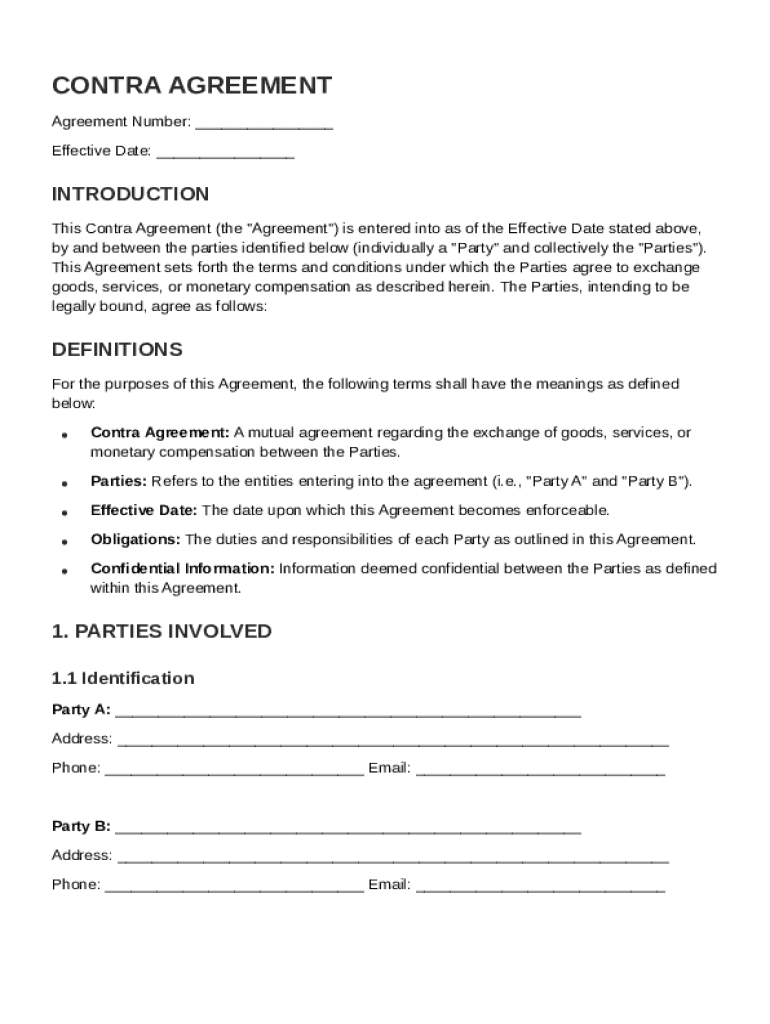
The Contra Agreement Template is a formal document outlining the terms and conditions for a mutual exchange of goods, services, or monetary compensation between two parties. This agreement serves as a legal contract that binds parties to honor their commitments within stipulated parameters. In the context of legal documentation, "contra" refers to a reciprocal arrangement where each party offers something of value in exchange for something else. The contra agreement is meant to ensure clarity in understanding the responsibilities and expectations of each party involved, thus reducing potential disputes and fostering transparent operations.
Key Elements of the Contra Agreement Template
A well-drafted Contra Agreement Template encompasses several critical components:
- Definitions: Clarifies specific terms used within the agreement to prevent ambiguity.
- Identification of Parties: Names and identifies the entities or individuals entering the agreement.
- Scope of Agreement: Outlines the nature and limits of the goods, services, or compensation being exchanged.
- Payment Terms: Details the financial aspects, including amounts, methods, and timelines for payment.
- Obligations and Responsibilities: Specifies the duties and responsibilities of each party to uphold the contract.
- Confidentiality Provisions: Ensures that any sensitive information exchanged remains confidential.
- Liability and Indemnification: Covers instances of liability and outlines indemnification clauses to protect parties.
- Governing Law: Indicates which jurisdiction’s laws will govern the agreement.
- Dispute Resolution: Provides procedures for resolving any disputes that arise under the agreement.
How to Use the Contra Agreement Template
Utilizing the Contra Agreement Template effectively requires understanding several steps:
- Preparation: Gather all the necessary information specific to the terms of exchange.
- Customization: Tailor the template to fit the unique requirements of your agreement, ensuring all relevant sections are filled out accurately.
- Review: Conduct a thorough review and verification of all details with legal counsel to ensure compliance with applicable laws.
- Execution: Both parties must sign the agreement to enforce its legality.
- Storage: Properly store the signed document for future reference.
Steps to Complete the Contra Agreement Template
Completing the Contra Agreement Template typically involves a series of methodical steps:
- Input Basic Information: Fill in the basic details like names, addresses, and contact information of both parties.
- Detail Exchange Terms: Explicitly state what each party is offering and expecting in return.
- Specify Timelines: Include clear timelines for exchanges or performances to prevent misunderstandings.
- Add Legal Protections: Ensure that clauses on confidentiality, liability, and dispute resolution are appropriately detailed to protect interests.
- Review and Amend: Check for consistencies, and if necessary, adjust terms or correct any discrepancies.
- Execution and Notarization (if required): Have all parties sign, and consider notarization for added legal weight.
- Secure Storage: Digitally archive or safely file the final document to preserve its integrity and accessibility.
Who Typically Uses the Contra Agreement Template
The Contra Agreement Template is primarily used by:
- Businesses: Companies often engage in contract agreements to facilitate barter deals or coordinate services.
- Freelancers and Contractors: Used to formalize agreements with clients or partners regarding deliverables in exchange for payment or services.
- Service Providers: Entities offering services in lieu of monetary compensation or other services.
- Trading Partners: Organizations that exchange goods or commodities rather than involve direct financial transactions.
- Legal Counselors: Attorneys utilize and adapt these templates to fit specific legal needs of their clients.


State-Specific Rules for the Contra Agreement Template
While the Contra Agreement Template is generally standardized, state-specific rules can influence its content:
- Jurisdictional Differences: Some states have unique requirements for contracts that might necessitate additional clauses or modifications to the template.
- Filing and Execution Requirements: Local laws may dictate how agreements are filed or need to be witnessed.
- Enforcement Regulations: Variances in how contracts are legally enforced across states mean the governing law clause is critical.
Understanding these variations is crucial for ensuring that a contra agreement is both enforceable and compliant within the applicable state jurisdiction.
Legal Use of the Contra Agreement Template
Ensuring the legal enforceability of the Contra Agreement Template involves:
- Consent and Competency: Both parties must have the legal capacity to contract and provide informed consent for the agreement.
- Legitimate Purpose: The agreement must serve a lawful purpose and not contravene public policy.
- Form and Execution: The structure of the contra agreement must comply with legal standards, and signatures must be obtained following correct formalities, potentially including witnesses or notarization for certain jurisdictions.
Examples of Using the Contra Agreement Template
Practical applications of a contra agreement can be found in various scenarios:
- Small Business Transactions: A bakery contracts with a coffee shop to supply baked goods in exchange for coffee supplies.
- Professional Services Exchange: A graphic designer provides services to a photographer in exchange for professional headshots.
- Corporate Partnerships: Two tech companies engage in sharing software licenses for mutual benefit without monetary compensation.
- Trade and Barter: An agricultural co-op exchanges produce with local restaurants for menu inclusion and promotion.
These examples illuminate how contra agreements facilitate non-cash transactions, enabling efficient resource utilization and strategic partnerships.