
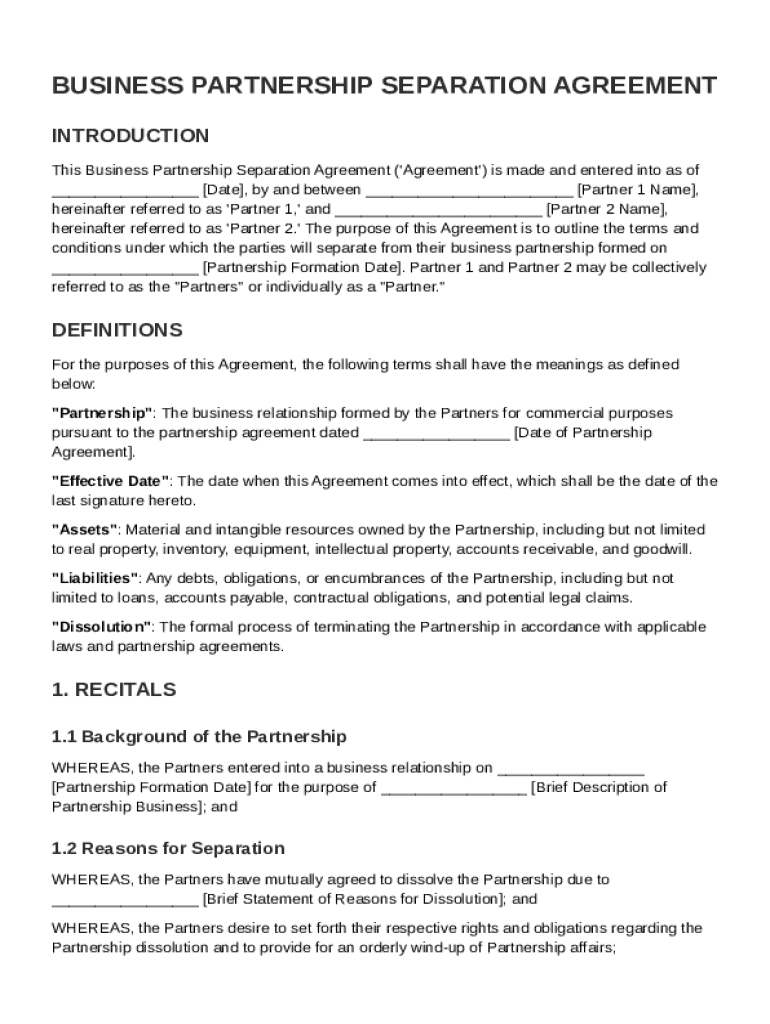







Definition & Purpose of a Business Partnership Separation Agreement
A Business Partnership Separation Agreement is a formal document that outlines the terms and conditions for dissolving a business partnership. It details critical aspects like the reasons for dissolution, the effective date of the separation, and the process for asset distribution. The document is designed to ensure an orderly wind-down of partnership affairs, protect the interests of both partners, and provide a clear framework for resolving disputes. This agreement may also cover confidentiality obligations, non-compete clauses, and the governing law applicable to the partnership termination.
Examples and Scenarios
-
Mutual Agreement: Two partners in a tech startup decide to amicably dissolve their partnership due to differing visions for the company's future. The agreement specifies how intellectual property and other assets will be divided.
-
Dispute Resolution: In a partnership where one partner accuses the other of breach of contract, the agreement outlines mediation steps and arbitration procedures to prevent lengthy legal battles.
Key Elements of the Agreement
The Business Partnership Separation Agreement comprises several essential components to comprehensively govern the separation process:
-
Asset Distribution: Defines how business assets such as equipment, real estate, and inventory will be divided.
-
Liability Allocation: Outlines responsibility for settling outstanding debts and obligations.
-
Confidentiality Obligations: Ensures that both parties agree to maintain the confidentiality of sensitive business information.
-
Non-Compete Clauses: Sets boundaries on starting or joining competitive businesses post-separation.
-
Dispute Resolution Mechanisms: Provides guidelines for resolving disagreements without resorting to litigation.
Real-World Application
Consider a scenario where two entrepreneurs co-own a restaurant but wish to part ways. The agreement might state that one partner retains the branding while the other takes ownership of the physical property, ensuring a smooth transition.
Steps to Complete the Agreement Template
Follow these detailed steps to accurately complete the Business Partnership Separation Agreement Template:
-
Identify All Parties Involved: Clearly list the names of the partners involved and their respective roles in the business.
-
Outline Reasons for Separation: Provide a comprehensive explanation of why the partnership is being dissolved.
-
Set Effective Date of Dissolution: Establish a clear and mutually agreed-upon date for when the dissolution will officially take place.
-
Detail Asset and Liability Distribution: Carefully document how assets and liabilities will be allocated between the partners.
-
Define Confidentiality and Non-Compete Clauses: Draft clauses to protect business information and outline any restrictions on future business activities.
-
Include Dispute Resolution Process: CHOOSE methods such as arbitration or mediation to handle potential disputes.
Practical Example
In a digital marketing agency partnership, the agreement might include a clause that assigns all current client contracts to one partner while stipulating that both partners must not solicit each other's clients for a defined period.
Legal Use and Compliance
The Business Partnership Separation Agreement must comply with applicable laws to ensure its enforceability:
-
Governing Law: Clearly specify which state's legal framework governs the agreement to avoid jurisdictional disputes.
-
Ensure Legality of Clauses: Verify that all clauses, including non-compete and confidentiality agreements, meet state-specific legal standards.
-
Seek Legal Counsel: Before finalizing, consult a legal professional to review the document and provide advice on any complex legal issues.
Case Study
A partnership in New York City may need to adjust the non-compete duration in the agreement to comply with New York state laws, which vary from those in California.
State-Specific Regulations
State laws can significantly impact the terms and validity of a Business Partnership Separation Agreement:
-
California: May have specific restrictions on non-compete clauses, focusing on promoting free enterprise.
-
Texas: Less stringent on non-compete clauses but emphasizes clarity and fairness in asset distribution.
-
Florida: May require detailed confidentiality agreements to protect business secrets.
Comparative Example
In a scenario where a Florida-based partnership dissolves, strict confidentiality requirements may be emphasized more heavily compared to other states, due to the state’s business environment.
Digital vs. Paper Version
Utilizing a digital format for the Business Partnership Separation Agreement can offer several advantages:
-
Ease of Access: Partners can collaborate in real-time and make instant changes to the document.
-
Electronic Signatures: Digital documents support electronic signatures, making the signing process faster and more secure.
-
Secure Storage: Digital agreements can be easily stored and accessed through cloud services, ensuring they remain secure and undamaged.
User Experience
A partnership can conveniently use software like DocHub to electronically draft, modify, sign, and store their separation agreement without the hassle of physical paperwork.
Examples of Using the Template
Examples of successful use cases for the Business Partnership Separation Agreement Template include:
-
Startup Termination: Allows tech startup co-founders to clearly divide intellectual property and customer databases.
-
Retail Business Breakup: Provides a framework for retail partners to equitably distribute physical stock and real estate holdings.
-
Professional Service Dissolution: Guides partners in a law firm through the separation of client accounts and office responsibilities.
Benefits
By using the template, businesses avoid ambiguities about responsibilities and retain cordial relationships post-separation, which is crucial for long-term professional reputation.
Software Compatibility
The Business Partnership Separation Agreement Template is compatible with several document management systems and editing software:
-
DocHub: Facilitates editing and signing through a seamless online platform.
-
Google Docs & Microsoft Word: Allows offline editing with easy conversion into PDF for final distribution.
-
Cloud Services Integration: Works well with services like Google Drive, Dropbox, and OneDrive for storage and sharing.
Integration Benefits
Through platforms like DocHub, partners gain access to functionalities such as automated reminders for signing deadlines, ensuring timely completion and compliance.




