
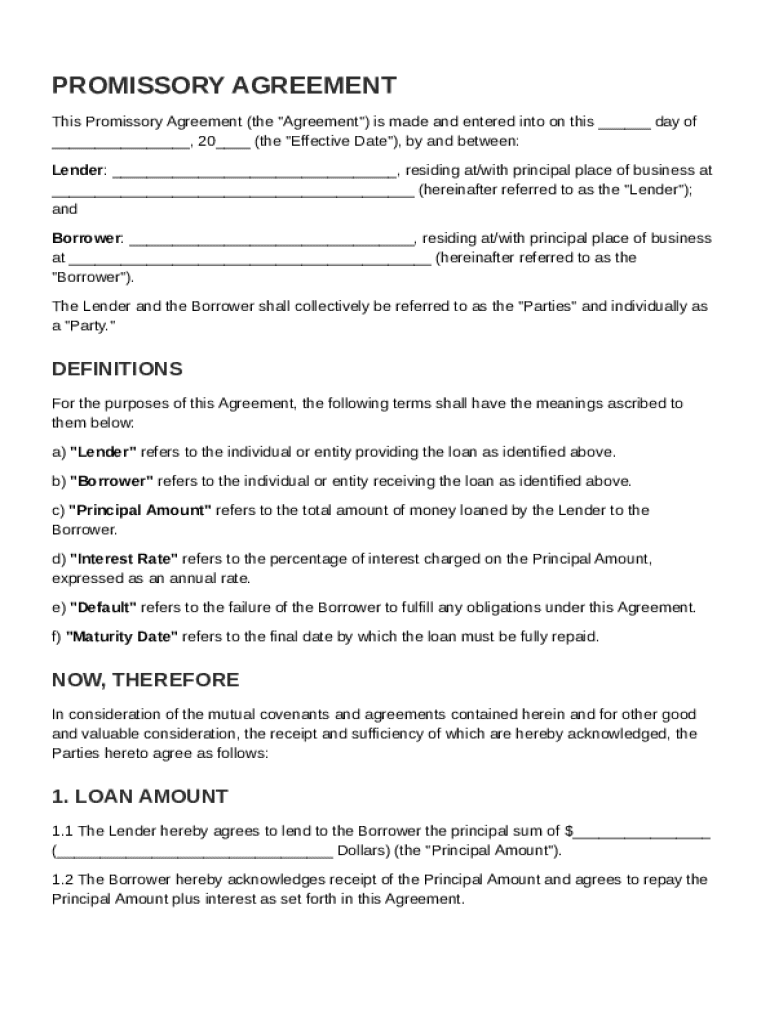







Definition and Meaning
A promissory agreement is a legal document that outlines the terms of a loan between a lender and a borrower. At its core, it serves as a formal commitment by the borrower to repay a specified amount of money, with outlined terms. The document typically includes essential details such as the principal loan amount, interest rate, repayment schedule, and conditions under which a default occurs. Consider it a straightforward contract establishing the borrower’s promise to pay, and the lender's right to receive those payments. Various scenarios necessitate such agreements, including personal loans, business financing, and real estate transactions.
Key Elements of the Promissory Agreement Template
The template for a promissory agreement is designed to ensure that all necessary information is captured coherently to protect the interests of both parties. Key elements include:
- Principal Loan Amount: Clearly states the exact amount borrowed.
- Interest Rate: Specifies the rate of interest applicable and its calculation method.
- Repayment Schedule: Details the frequency and amount of each payment, whether weekly, monthly, or in a lump sum.
- Terms for Default: Defines what constitutes a default and the penalties involved.
- Governing Law and Jurisdiction: States the laws of which state will govern the agreement.
- Signatures: Both parties must sign, acknowledging agreement to the terms.
Each component serves to outline responsibilities and protect both lender and borrower from potential disputes.
Legal Use of the Promissory Agreement Template
Legal use of a promissory agreement is pivotal as it serves as a binding contract in the eyes of the law, especially if a dispute arises. In the United States, adherence to the Uniform Commercial Code (UCC) ensures enforceability. It's critical to include clear, concise language that all parties can understand, mitigating misunderstandings. Adding a notarization or witness signature can strengthen its validity. Specific clauses like those addressing dispute resolution or amendments provide further legal clarity, ensuring the document adapts to unforeseen circumstances.
How to Use the Promissory Agreement Template
Utilizing a promissory agreement template involves several steps to customize and complete the agreement:
- Download the Template: Access the template from a trusted source like DocHub to ensure it includes all standard sections.
- Fill in the Details: Enter the specific details related to the loan, replacing placeholders with actual data including names, amounts, and dates.
- Review the Terms: Both lender and borrower should meticulously review the document, ensuring mutual understanding and agreement.
- Add Additional Clauses: Insert any additional clauses or terms specific to your agreement that are not covered in the standard template.
- Sign the Document: Both parties sign the document, preferably in the presence of a notary or witness.
- Distribute Copies: Ensure both parties keep copies for future reference.
Utilizing software such as DocHub can facilitate easier collaboration between parties when using the template, simplifying edits and signatures.
Steps to Complete the Promissory Agreement Template
Completion of a promissory agreement template involves a systematic approach:
- Collect Necessary Information: Gather all required personal and financial information for both parties.
- Populate Template Fields: Input data into the designated template sections, ensuring accuracy.
- Draft Additional Clauses if Required: Tailor the default terms by adding necessary custom clauses reflecting specific needs.
- Proofread the Document: Double-check for any errors or omissions that could cause potential problems.
- Finalize and Print: Upon review, finalize the draft and print it out for signing.
- Execute Signatures: Secure the necessary signatures from all parties involved, possibly in front of a notary.
Every section must be diligently filled to preserve the agreement's integrity and enforceability.
Who Typically Uses the Promissory Agreement Template
Promissory agreements are employed by various entities, including:
- Individuals: Friends or family members lending money may use a promissory agreement to define the loan terms.
- Small Business Owners: When seeking financial assistance from investors or banks.
- Corporations: Engaging in inter-company loans or when receiving loans from shareholders.
- Real Estate Investors: For financing arrangements outside traditional mortgage paths.
By establishing clear terms, these entities can mitigate conflict and maintain positive relations with borrowers.


Important Terms Related to Promissory Agreement Template
Understanding specific terms within a promissory agreement is vital to comprehend fully:
- Amortization: Refers to the process of spreading out a loan into a series of fixed payments over time.
- Acceleration Clause: Grants the lender the right to demand the entire loan amount if conditions are met such as a breach of contract.
- Collateral: An asset pledged by the borrower to secure the loan.
- Grace Period: A set timeframe in which the borrower can make late payments without facing penalties.
Familiarity with these terms ensures clarity in communication and agreement execution.
State-Specific Rules for the Promissory Agreement Template
In the United States, state-specific regulations could affect the drafting and enforcement of promissory agreements. While the UCC governs these agreements broadly, states might impose additional requirements or offer unique interpretations. For instance, maximum interest rates often vary by state to protect against usury. Similarly, some states may require specific language to be included for enforceability, or offer unique avenues for dispute resolution. Users should familiarize themselves with relevant state laws to ensure compliance and validity of the agreement.
Penalties for Non-Compliance
Failure to adhere to the terms outlined in a promissory agreement can lead to severe consequences, including legal action. If a borrower defaults, the lender may pursue remedies like:
- Repossession of Collateral: If tangible assets secure the loan, the lender has the right to reclaim them.
- Legal Action: The lender may decide to take the borrower to court to enforce the terms.
- Credit Impact: Failure to comply or default on the agreement can negatively impact the borrower’s credit rating, hindering future borrowing ability.
Repercussions serve as a deterrent, encouraging compliance with the agreed-upon terms and conditions.




