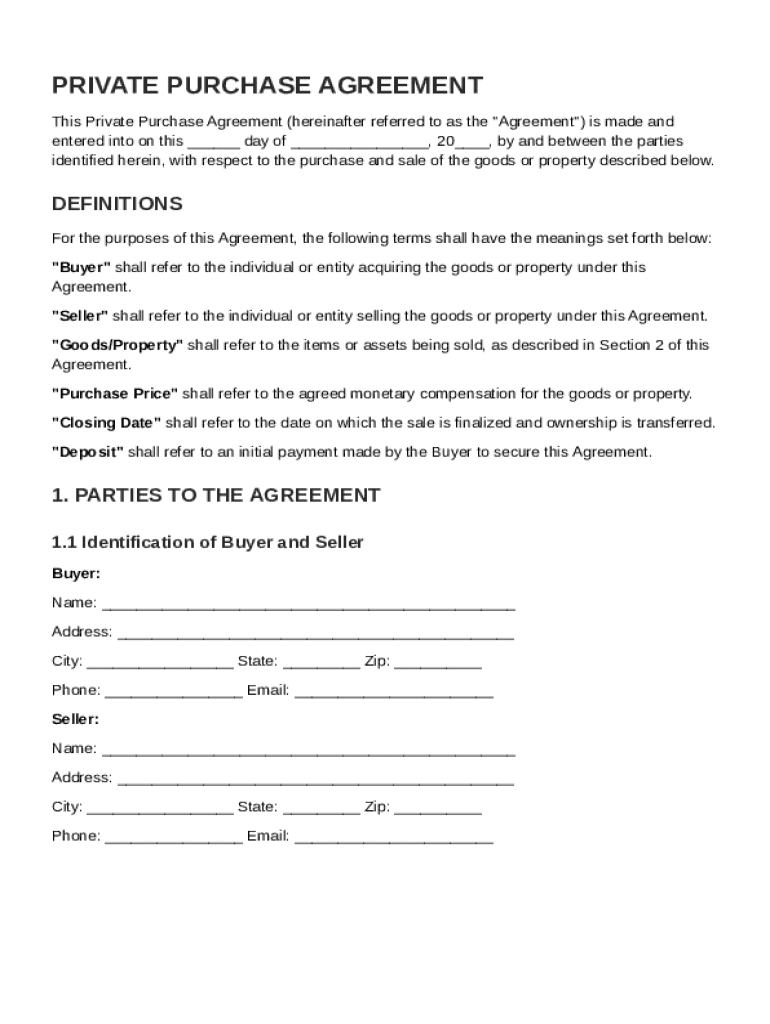







Key Elements of the Private Purchase Agreement Template
The Private Purchase Agreement Template is a vital document that outlines the terms and conditions for the sale of goods or property between two parties: a Buyer and a Seller. It acts as a formal written record of the transaction, ensuring clarity and legal compliance. The agreement typically includes:
-
Identification of Parties: Clearly identifies the Buyer and Seller involved in the transaction, including their legal names and contact information.
-
Description of Goods/Property: Detailed information regarding the item(s) being sold, including descriptions, specifications, and, if applicable, serial numbers.
-
Purchase Price and Payment Terms: Specifies the agreed amount to be paid for the goods or property, along with detailed payment terms such as deadlines and methods of payment.
-
Representations and Warranties: Outlines any assurances provided by the Seller, such as the condition of the goods or property and any legal encumbrances.
-
Delivery and Acceptance Procedures: Details the process for delivering the goods or property to the Buyer and the criteria for acceptance.
-
Risk of Loss and Deposit Arrangements: Specifies who bears the risk if the goods are damaged during transit, as well as any deposit requirements.
-
Governing Law: Indicates which state's laws will govern the agreement, ensuring legal clarity.
How to Use the Private Purchase Agreement Template
Utilizing a Private Purchase Agreement Template involves several steps to ensure that both parties are protected and that the transaction proceeds smoothly. Here are some key steps:
-
Tailor the Template: Adjust the template to suit the specifics of your transaction, including names, descriptions, and values.
-
Review All Terms: Ensure that all terms and conditions are fully understood and agreed upon by both parties.
-
Seek Legal Advice: Consider consulting a legal professional to review the document and confirm that it complies with relevant state laws.
-
Both Parties Sign: Both the Buyer and Seller should sign the agreement, indicating their consent to its terms.
-
Distribute Copies: Provide each party with a signed copy of the agreement for their records.
Steps to Complete the Private Purchase Agreement Template
Completing a Private Purchase Agreement Template requires attention to detail to ensure that all aspects of the transaction are covered. Follow these steps for successful completion:
-
Gather Information: Collect all necessary details about the parties and the goods or property involved.
-
Fill Out the Template: Enter the gathered information into the relevant fields of the template, ensuring accuracy.
-
Specify Key Terms: Clearly define the purchase price, payment terms, and any warranties or conditions related to the transaction.
-
Revise Sections: Modify sections that may require specific conditions pertinent to the sale, such as special delivery arrangements.
-
Check for Completeness: Review the document to ensure that all fields have been completed and nothing important has been omitted.
-
Finalize and Sign: Obtain signatures from all parties and distribute copies for everyone's records.
Legal Use of the Private Purchase Agreement Template
This agreement must be used in accordance with state laws and regulations to be legally binding. Some important considerations include:
-
Compliance with State Laws: Each state may have specific requirements for what must be included in a purchase agreement.
-
Inclusion of Necessary Elements: Ensure that all essential elements like consideration (payment) and agreement are present.
-
Use for Legitimate Transactions: The agreement should only be used for bona fide transactions between willing parties.
Important Terms Related to the Private Purchase Agreement Template
Understanding key terms within a Private Purchase Agreement is essential for all parties involved:
-
Consideration: The payment or compensation exchanged for the goods or property.
-
Indemnity: A provision where one party agrees to compensate the other for certain damages or losses.
-
Contingency: Specific conditions that must be met for the transaction to proceed.
-
Escrow: An arrangement where a third party holds funds until specified conditions are fulfilled.
State-Specific Rules for the Private Purchase Agreement Template
State-specific rules may influence various aspects of the agreement such as its enforceability and content requirements. For example:
-
Disclosure Requirements: Some states require additional disclosures, particularly for real estate transactions.
-
Buyer’s Right to Rescind: Certain states provide buyers with a specific time frame in which they can rescind or cancel an agreement.
-
Notary Requirements: Some transactions, especially those involving real estate, may require notarization.
Examples of Using the Private Purchase Agreement Template
Real-world scenarios demonstrate the practicality of the Private Purchase Agreement Template:
-
Vehicle Sale: John uses the template to sell his car to Alice, ensuring both agree on the condition and price, while also transferring ownership legally.
-
Property Transaction: A property owner sells a piece of land, detailing its boundaries, the agreed price, and any contingencies for zoning approval.
-
Business Asset Sale: A business sells off certain assets listing each item, its condition, and the agreed sale amount, ensuring full compliance with state trade regulations.
Digital vs. Paper Version of the Private Purchase Agreement Template
The choice between a digital versus a paper version can affect the document’s usability and management:
-
Digital Version:
- Allows for easy edits and sharing.
- Facilitates electronic signatures, which are legally binding under the ESIGN Act.
- Suitable for remote transactions.
-
Paper Version:
- Preferred by parties who want physical documents.
- May require in-person signing or notarization for certain transactions.
Using the template’s digital capabilities through platforms like DocHub offers significant flexibility and ease of use, ensuring efficient processing of all necessary agreements.