
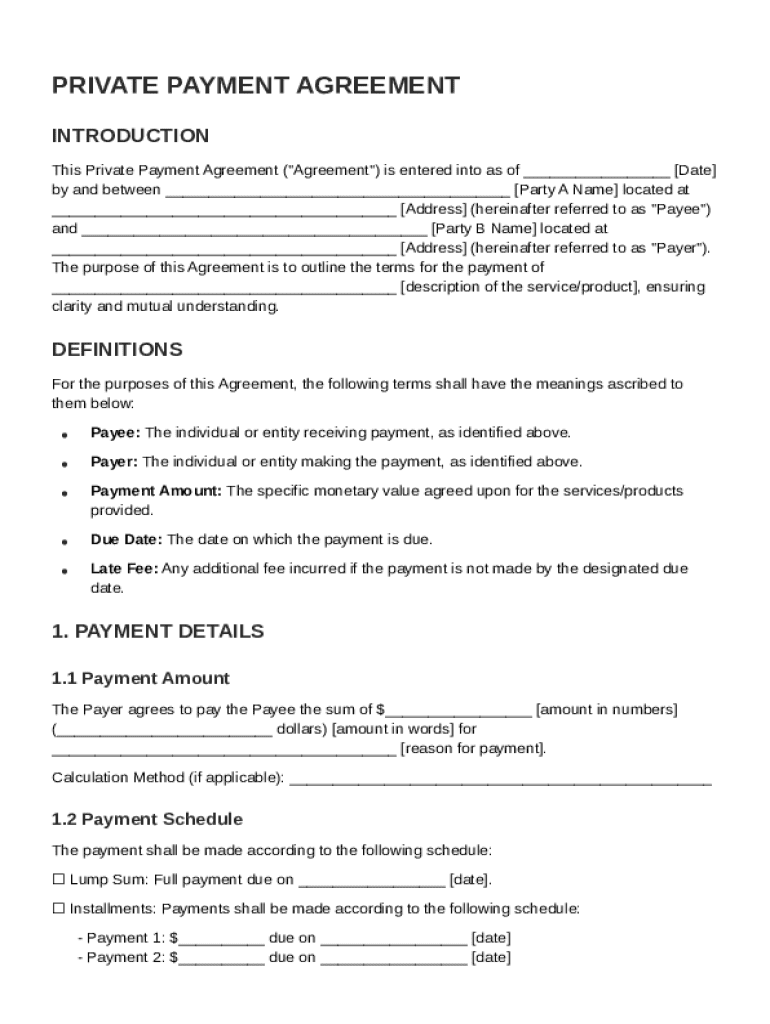







Definition and Purpose of a Private Payment Agreement Template
A Private Payment Agreement Template is a document designed to clearly outline the agreed terms between a Payee and a Payer concerning the payment for specific services or products. Its primary purpose is to ensure that both parties involved in the transaction have a mutual understanding of the payment conditions and obligations. This template typically includes details such as the amount to be paid, payment schedule, payment method, and the responsibilities of each party. It also incorporates clauses for late payments, dispute resolutions, governing law, and severability, offering a comprehensive framework for managing financial agreements.
How to Use the Private Payment Agreement Template
Utilizing a Private Payment Agreement Template involves several steps to ensure it meets the needs of both parties involved. Initially, both the Payee and Payer must collaboratively fill in the various sections of the template. These sections cover key aspects like the full names of both parties, the payment amount, the date by which payments are due, and the agreed upon payment method. Once filled, both parties should review the document in detail to confirm that each agrees with the terms. This step helps to prevent misunderstandings in the future. After the review, both parties can sign the document, making it a binding agreement. It is recommended that both the Payee and Payer keep copies of the signed agreement for their records.
Key Elements of the Private Payment Agreement Template
A properly constructed Private Payment Agreement Template will encompass several important elements to ensure its effectiveness. Key elements include:
- Party Information: Details of both the Payer and Payee, including their full names and contact information.
- Payment Terms: Definition of the payment amount, frequency, and method.
- Responsibilities and Obligations: Specification of each party's duties in the context of the agreement.
- Late Payment Clause: Terms describing the consequences of a late payment, including potential fees or interest rates.
- Dispute Resolution Process: Steps to resolve any disputes that may arise from the agreement.
- Governing Law: The jurisdiction under which the agreement falls, which is particularly important for legal enforceability.
- Severability Clause: Assurance that if part of the agreement is found invalid, the rest remains in effect.
These elements come together to create a comprehensive agreement that protects both parties' interests.
Steps to Complete the Private Payment Agreement Template
Completing a Private Payment Agreement Template involves a systematic approach to ensure all necessary details are accurately captured:
- Preparation: Gather all relevant information about the transaction, such as service descriptions, payment amounts, and deadlines.
- Fill Out Party Information: Input full names and contact details for both the Payee and Payer.
- Specify Payment Terms: Clearly detail the agreed payment amount, method, and schedule.
- Outline Responsibilities: Define the specific duties each party will fulfill under the agreement.
- Add Legal Protections: Include clauses regarding late payments, dispute resolutions, and governing law.
- Review and Finalize: Both parties should review the completed document to confirm that all information is correct and agreed upon.
- Signatures: Both the Payee and Payer must sign the agreement, making it a legally binding document.
Legal Use of the Private Payment Agreement Template
In the United States, a Private Payment Agreement Template serves as a legally enforceable document, provided it meets specific criteria. It is crucial for the template to contain clear terms that both parties both understand and agree to. Moreover, the parties must demonstrate a willingness to enter into a contractual agreement, and there must be a lawful purpose for the agreement. Having legally sound language and clauses within the template, such as those related to governing law and dispute resolution, further solidifies its enforceability. Finally, both parties must sign the agreement willingly, with no coercion involved, to uphold its legal validity.
Examples of Using the Private Payment Agreement Template
Several scenarios illustrate the utility of a Private Payment Agreement Template:
- Freelance Services: A freelance graphic designer and their client might use the template to agree upon the terms for a project, including charges for design work and submission deadlines.
- Rental Agreements: Landlords and tenants can utilize the template to outline rent payments, including due dates and penalties for late payments.
- Loan Agreements: A family loan where one member lends money to another with specified repayment terms can be formalized using this agreement, protecting the interests of both parties involved.
These examples demonstrate the versatility and importance of having a formal agreement documented.
Who Typically Uses the Private Payment Agreement Template
Various individuals and entities make use of the Private Payment Agreement Template, including:
- Freelancers and Contractors: To formally agree on terms for services rendered and payments received.
- Small Business Owners: To establish clear payment expectations with clients or partners.
- Landlords and Tenants: In rental situations to document rent payments and obligations.
- Private Lenders and Borrowers: To outline loan terms between family members or friends.
These users find the template beneficial for ensuring clarity and security in financial transactions.


State-Specific Rules for the Private Payment Agreement Template
When implementing a Private Payment Agreement Template, attention must be paid to state-specific rules and regulations, as legal requirements can vary considerably across different states. For instance, some states may require additional clauses for interest on late payments beyond a certain limit, or they may enforce specific disclosure requirements for agreements involving consumer credit. It is advisable for parties to consult with legal counsel to ensure their agreement adheres to local laws, thereby maintaining its enforceability.
Versions or Alternatives to the Private Payment Agreement Template
While the Private Payment Agreement Template is versatile, certain variations or alternatives might better suit specific needs:
- Installment Payment Agreements: Useful for arranging periodical payments over time, often seen in loan arrangements.
- Service Contracts: These agreements cover a broader scope beyond payment, including service deliverables and performance metrics.
- Promissory Notes: Serve as simpler alternatives, focusing solely on loan repayment terms between private parties.
Each variation offers specific advantages, allowing individuals to choose the template type that best fits their particular situation.




