
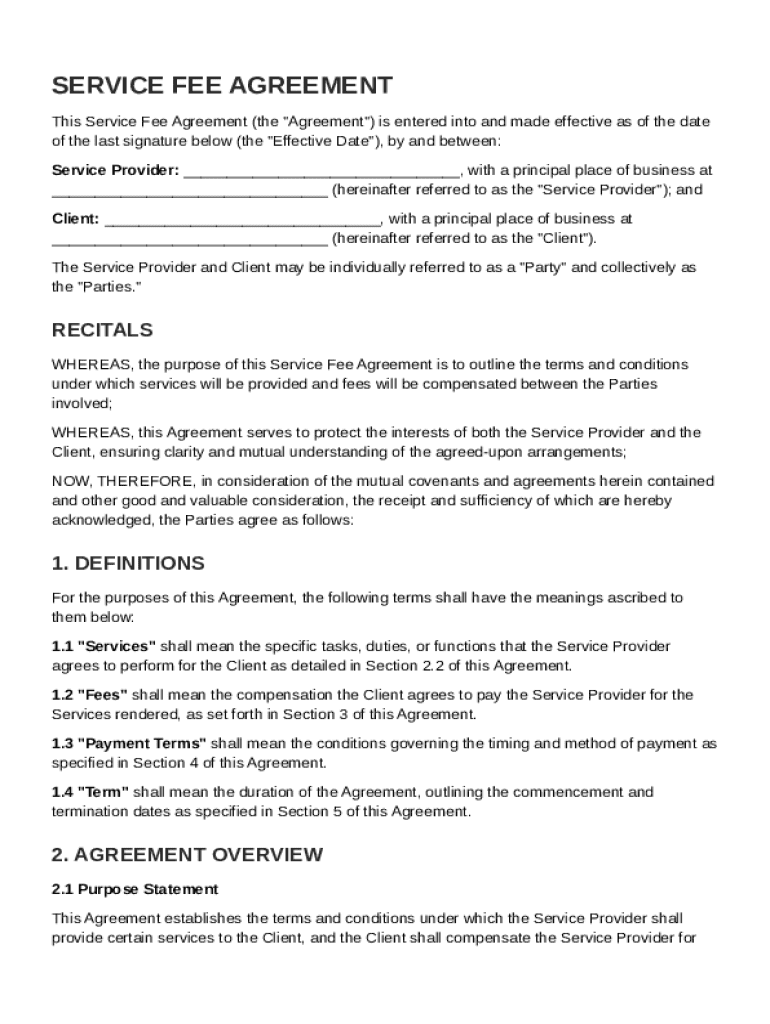







Definition & Meaning
A Service Fee Agreement Template outlines the terms and conditions of service provision between a Service Provider and a Client. It serves as a formalized understanding of the rights and obligations of both parties involved in a business relationship. Elements typically covered in this template include the definition of key terms, the scope of services, the fee structure, and any confidentiality obligations each party has. Incorporating these components ensures clarity and aids in mitigating disputes by having a clear contractual framework of what is expected and provided.
Key Components
- Scope of Services: This section details the specific services that the Service Provider will deliver. This ensures that both parties have a mutual understanding of what is included in the service agreement and what might incur additional fees.
- Compensation and Payment Terms: Clearly outlines how much the Client will pay, when payments are due, and any applicable penalties for late payments. It often specifies the method of payment and may include conditions under which the service provider can increase fees.
- Confidentiality Obligations: Establishes how sensitive information exchanged during service provision will be handled. It often includes clauses on nondisclosure and limitations on the use of confidential data.
Key Elements of the Service Fee Agreement Template
The Service Fee Agreement Template comprises various critical elements that safeguard both the Client’s and the Service Provider’s interests. Detailed attention to these elements helps ensure a robust contractual framework that covers all necessary angles.
Essential Clauses
- Liability Limitations: Helps protect the service provider from potential legal claims by limiting the extent of liability in the case of disputes or service lapses.
- Governing Law: Specifies which state’s legal system will interpret and enforce the contract, offering clarity in the event of litigation.
- Termination Conditions: Outlines the circumstances under which the agreement may be terminated prematurely, either by mutual consent or for reasons like breach of contract or non-payment.
Steps to Complete the Service Fee Agreement Template
Completing a Service Fee Agreement Template involves a step-by-step approach to ensure accuracy and compliance with legal standards.
- Gather Required Information: Compile all necessary details about both parties, including names, addresses, and contact information.
- Define Scope and Services: Clearly articulate the services to be provided, including detailed descriptions and any exclusions to preempt misunderstandings.
- Establish Compensation Terms: Specify all payment-related information such as amount, frequency, method, and penalties for late payment.
- Draft Confidentiality and Liability Clauses: Include clauses that protect intellectual property, confidential information, and outline liability limitations.
- Choose a Governing Law: Select an appropriate jurisdiction as the legal reference in case of disputes that may require legal interpretation.
- Finalize and Review: Carefully review the document for accuracy and completeness before all parties sign to make it legally binding.
Legal Use of the Service Fee Agreement Template
The Service Fee Agreement Template is a legally binding document once both parties have signed it. It complies with U.S. contract law, providing a basis for enforcement in the courts if necessary.
Jurisdictional Considerations
The template’s enforceability hinges on the jurisdiction specified in the contract. This section confirms that the template adheres to state-specific legal requirements, which is vital to ensure that the agreement is honored by local legal systems.
State-Specific Rules for the Service Fee Agreement Template
Understanding the nuances of state-specific regulations is crucial when drafting a Service Fee Agreement Template. Different states have varying guidelines concerning contract law, affecting the creation and execution of these agreements.
Important State Variations
- Variations in Governing Law: While most agreements include a governing law clause, the peculiarities of each state's contract law can lead to significant differences, such as consumer protection regulations or business transaction laws.
- Local Business Licensing Requirements: Some states might have specific licensure requirements for service providers that should be explicitly acknowledged in the agreement to ensure compliance.
Examples of Using the Service Fee Agreement Template
Real-world scenarios illustrate the versatility and importance of a Service Fee Agreement Template in various industries and contexts.
Business Scenarios
- Freelance Designers: Freelancers utilize this template to define expected deliverables, project timelines, and payment milestones with clients, safeguarding both payment and production expectations.
- Consulting Firms: Consulting agreements often involve complex engagements with various stakeholders, for which this template provides clarity on roles and responsibilities, ensuring smooth collaboration and project execution.
Required Documents
Completing a Service Fee Agreement Template requires specific documentation to validate details and terms.
Necessary Paperwork
- Identification Documents: These confirm the identity of both parties entering into the contract, ensuring that they have the legal capacity to agree to the terms.
- Business Registration Proofs: Service Providers often need to supply proof of their business registration or licensing as part of the contractual document package.
Digital vs. Paper Version
The Service Fee Agreement Template is adaptable to both digital and paper formats, allowing flexibility in how it’s created, executed, and stored.
Benefits of Digital Versions
- Ease of Access: Digital templates can be effortlessly shared via email or cloud storage services, making them accessible to all involved parties instantly.
- Security and Trackability: Electronic agreements often come with audit trails and can be secured with electronic signatures, providing a reliable record of who signed when, which minimizes ambiguities in contract management.




