Self Billing Agreement Template 2026

Get Form
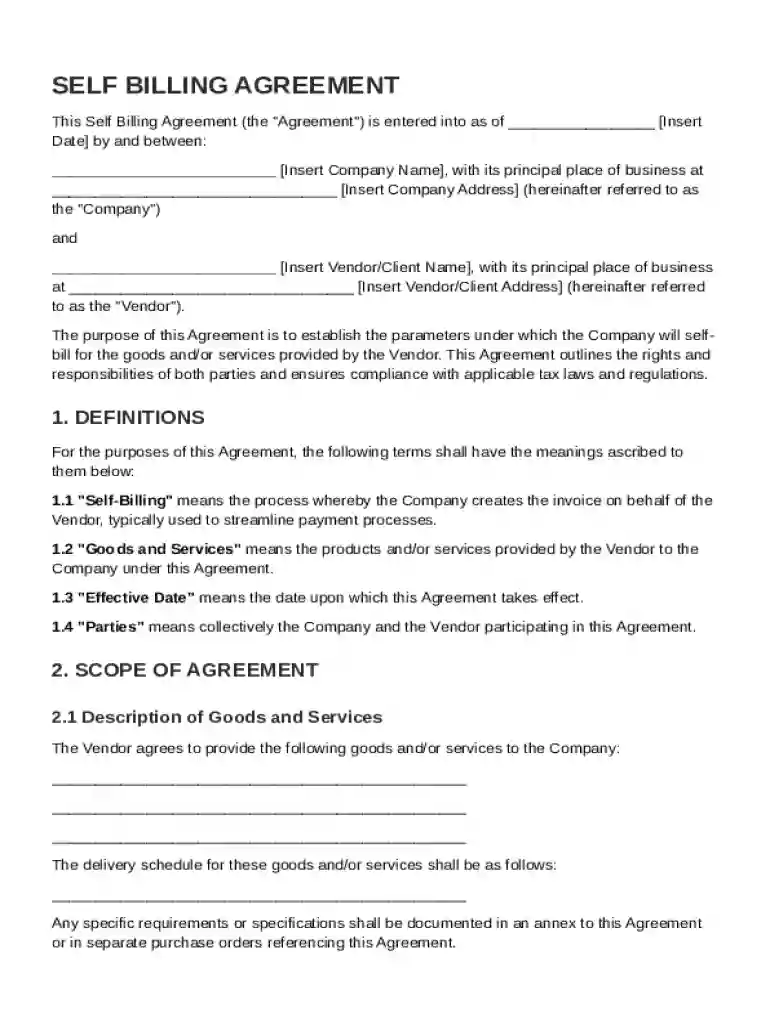
Self Billing Agreement Template Preview on Page 1

Here's how it works

01. Edit your form online
Type text, add images, blackout confidential details, add comments, highlights and more.

02. Sign it in a few clicks
Draw your signature, type it, upload its image, or use your mobile device as a signature pad.

03. Share your form with others
Send it via email, link, or fax. You can also download it, export it or print it out.

Definition and Meaning

A Self Billing Agreement Template is a formal document that defines the terms and conditions under which a company (referred to as the Company) will handle billing on behalf of a vendor (referred to as the Vendor). Primarily, this agreement outlines the process involved when the Company generates invoices on the Vendor’s behalf for goods and services provided. This setup can simplify the invoicing process, streamline financial operations, and ensure both parties adhere to respective tax regulations and confidentiality obligations. By adopting a self-billing arrangement, both parties aim to minimize errors and delays in the billing process, thereby fostering a more efficient transaction workflow.

How to Use the Self Billing Agreement Template

To successfully implement a self-billing agreement, both parties must thoroughly review and fill out their respective sections accurately. The template typically requires the Company to define its responsibilities, such as documenting the delivery of goods or services and generating corresponding invoices. Meanwhile, the Vendor must verify the accuracy of the invoices generated. Here’s a basic step-by-step approach:

  1. Review the Template: Begin by carefully reading through the entire template to understand every aspect of the agreement.
  2. Enter Company Details: The Company should enter its contact information and tax identification number accurately.
  3. Vendor Details: The Vendor must also provide similar contact and tax information.
  4. Invoicing Terms: Define how often invoices will be generated and what specific details each invoice must include.
  5. Signatures: Both the Company and Vendor should review the completed document, agree to the terms, and sign the agreement to activate it.

Steps to Complete the Self Billing Agreement Template

Completing a Self Billing Agreement Template involves several precise steps to ensure the document is comprehensive and enforceable:

  1. Gather Information: Both parties need to collect essential business details, such as business names, addresses, and tax identification numbers.
  2. Draft the Agreement: Use the self-billing template to draft the agreement’s specific terms, focusing on invoicing schedule, methods of dispute resolution, and confidentiality clauses.
  3. Review Legal Compliance: Ensure the drafted terms comply with local tax and business laws to avoid any legal disputes or penalties.
  4. Check for Accuracy and Clarity: Carefully review the filled-out template to verify all information is accurate and clearly stated to avoid misunderstandings.
  5. Finalize with Signatures: Obtain signatures from authorized representatives from both companies to legitimize the agreement.

Legal Use of the Self Billing Agreement Template

The Self Billing Agreement Template serves as a legal document that upholds the mutual agreements between the Company and Vendor. Adhering to respective local, state, and federal regulations is essential. The document should facilitate compliance with the Internal Revenue Service (IRS) guidelines, especially concerning reporting and taxation of sales. Furthermore, ensuring confidentiality clauses are included and followed will protect both parties’ sensitive information, thus maintaining trust and lawful adherence.

Key Elements of the Self Billing Agreement Template

Several critical elements form the backbone of a Self Billing Agreement Template:

  • Roles and Responsibilities: Clear definitions of both parties’ obligations regarding the self-billing process.
  • Invoice Details: Specifications on how invoices will be created, detailing the necessary information required within each invoice.
  • Payment Terms: Agreed-upon terms regarding payment timelines and methods.
  • Tax Compliance: Instructions on how to handle sales tax and other relevant taxation requirements.
  • Confidentiality: Provisions that restrict the disclosure of sensitive business or personal information to unauthorized parties.
  • Termination Clause: Conditions under which either party can terminate the agreement.

Importance of the Self Billing Agreement Template

Using a Self Billing Agreement Template provides several benefits, particularly in terms of efficiency and legal compliance. It standardizes the billing process, reducing errors and administrative workload. This type of agreement also eliminates the need for redundant invoicing procedures and facilitates quicker payment cycles. By clearly defining roles and responsibilities, it minimizes disputes, ensuring smoother business operations. Additionally, having a formal agreement helps in maintaining transparency and trust between parties involved in repeated transactions.

Who Typically Uses the Self Billing Agreement Template

A Self Billing Agreement Template is commonly utilized by businesses that regularly engage in transactions for goods and services. It is particularly beneficial in scenarios where the buying Company wishes to streamline the vendor payment process. Typical users include:


  • Large Corporations: Seeking to manage vendor payments efficiently across multiple departments or locations.
  • Retail Chains: Managing stock or product orders with various suppliers.
  • Service Providers: With multiple contractors or service vendors.
  • Companies Utilizing Supply Chains: To manage and streamline voluminous invoices across various vendor partners.
decoration image ratings of Dochub

State-Specific Rules for the Self Billing Agreement Template

In the United States, self-billing agreements must adhere to both federal and state-specific regulations. Each state may have distinct requirements concerning tax reporting and agreement wording. Companies should be aware of:

  • Sales Tax Regulations: Variations in state tax rates and reporting methods must be incorporated into the agreement.
  • State Business Laws: Understanding the legal precedents concerning contract formation and enforcement.
  • Documentation Requirements: Ensuring copies of self-billing agreements meet state standards for documentation retention and presentation.

When drafting a self-billing agreement, consulting with a legal expert knowledgeable about the pertinent state laws is advised to ensure compliance and validity of the agreement.

be ready to get more

Complete this form in 5 minutes or less

Get form

Got questions?

We have answers to the most popular questions from our customers. If you can't find an answer to your question, please contact us.
Contact us
Yes, any business can use self-billing if both the customer and supplier agree to the arrangement and sign a legally binding agreement.
Advantages for the customer The purchase invoices are produced to a standard format, making life easier for its accounts department. It may make invoicing easier if the customer (rather than the supplier) determines the value of purchases after the goods have been delivered or the services supplied.
In a list bill, the supplier creates their own invoice and sends it to the customer to receive payment. With self-billing, on the other hand, the customer creates the invoice and sends it to the supplier with payment. Special agreements and conditions are required to set up a self-billing arrangement.
Self-billing is a convenient arrangement between a supplier and their customer where the customer bills on the suppliers behalf. Whilst there are benefits to this, we have seen first-hand several times when this can fall apart.
Although there are numerous pros to self-billing, there are a few potential drawbacks to consider. In some cases, self-billing could introduce the potential for errors. Documents could go missing, or the wrong VAT rate could be applied to the invoice. It is, therefore, vital to use a well configured accounting system.

Security and compliance

At DocHub, your data security is our priority. We follow HIPAA, SOC2, GDPR, and other standards, so you can work on your documents with confidence.

Learn more
ccpa2
pci-dss
gdpr-compliance
hipaa
soc-compliance

People also ask

Self-billing is a financial agreement between a customer and a supplier. In most cases, it involves the customer preparing the invoice and sending it, along with the payment, to the supplier.

Related links