






Definition and Meaning
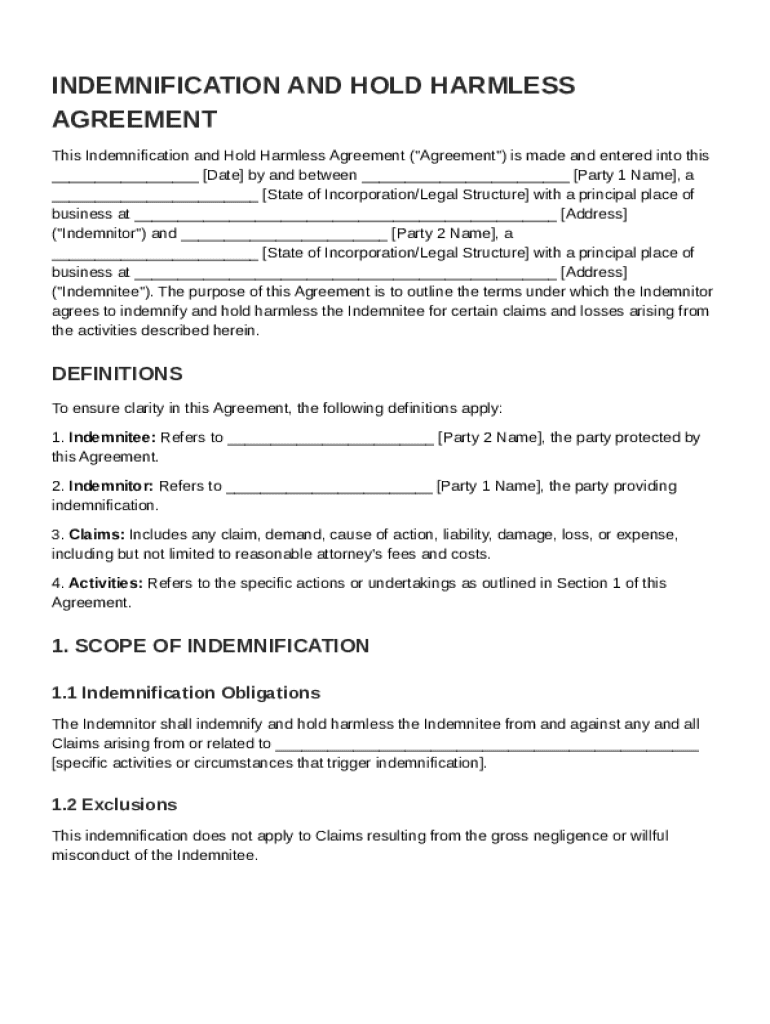
The Indemnification and Hold Harmless Agreement Template is a legal document used to outline the terms and conditions under which one party (known as the Indemnitor) agrees to indemnify and protect another party (the Indemnitee) from specific claims, liabilities, or damages. This agreement emphasizes coverage for losses arising from defined activities and excludes claims that result from the Indemnitee's gross negligence or willful misconduct. It is crafted to ensure clarity about the scope and limits of the indemnity obligation, safeguarding the Indemnitee from certain financial risks associated with contractual activities or services.
Key Elements of the Indemnification and Hold Harmless Agreement Template
The template is structured to include several critical components that form the foundation of the agreement:
-
Definitions: Clear definitions of key terms such as "Indemnitor," "Indemnitee," and "claims" are essential for ensuring both parties have a shared understanding of the agreement's terms.
-
Scope of Indemnification: This section delineates what actions or circumstances trigger the indemnification obligation. It outlines the types of claims covered, such as legal fees, settlement costs, or damages from third-party claims.
-
Exclusions: Specifies situations where indemnification will not apply, particularly in cases of the Indemnitee's own negligence or intentional misconduct.
-
Notification of Claims: Describes the process by which the Indemnitee must notify the Indemnitor of any claims that may lead to indemnification. Timely notification is often crucial for the Indemnitor's defense or settlement of claims.
-
Limitation of Liability: This clause may place restrictions on the amount or type of liability that the Indemnitor is required to cover, often shaped by the level of risk involved in the contract.
-
Governing Law: Specifies which jurisdiction’s laws will govern the terms of the agreement. It's particularly important if the parties are in different states or countries.
Steps to Complete the Indemnification and Hold Harmless Agreement Template
-
Fill in Party Details: Begin by accurately entering the names and contact details of the Indemnitor and Indemnitee. This ensures each party is clearly identified.
-
Define the Scope and Indemnification Terms: Clearly outline which activities or scenarios are covered under the agreement. Be specific to avoid potential disputes.
-
Detail Exclusions and Limitations: Specify any exclusions explicitly to avoid misunderstandings. Clearly outline any cap on the indemnity obligation.
-
Provide for Notification Requirements: Include a section on the procedure for notifying about claims. Define timelines and the method of communication.
-
Choose Governing Law: Decide and document the state or jurisdiction laws that will apply to interpret and enforce the agreement.
-
Check for Completeness: Ensure all sections are thoroughly completed and nothing critical is omitted. Consult with a legal advisor if unsure about any clause.
-
Execute the Agreement: Once both parties are satisfied, proceed to sign the document. Ensure signatures are legally valid if the agreement will be used for official purposes.
Important Terms Related to the Indemnification and Hold Harmless Agreement Template
-
Indemnitor: The entity providing indemnification, responsible for covering claims and losses defined in the agreement.
-
Indemnitee: The entity receiving protection under the indemnity, shielded from specified liabilities or claims.
-
Third-Party Claim: Claims made by entities who are not directly a party to the agreement, often resulting from the agreement's activities.
-
Gross Negligence: A severe lack of care escalating beyond simple negligence; a key term that often limits indemnification.
-
Willful Misconduct: Intentional wrongdoing or unlawful conduct by the Indemnitee, often leading to the exclusion of indemnity.
Legal Use of the Indemnification and Hold Harmless Agreement Template
This agreement is widely used across various industries to manage risk in contractual relationships, ensuring both parties are aware of their exposure to potential liabilities. It is especially prevalent in sectors like construction, real estate, and services where activities entail significant risks. The precise application of the template—and compliance with state and federal regulations—ensures its enforceability and effectiveness in protecting involved parties.
Examples of Using the Indemnification and Hold Harmless Agreement Template
-
Construction Contracts: A contractor is indemnified by subcontractors for third-party injury claims arising from construction site activities.
-
Service Agreements: An IT service provider includes an indemnity clause that protects a client from intellectual property claims due to software use.
-
Event Planning: An event organizer requires vendors to indemnify against any damage incidents occurring during an event run by the vendors.
State-Specific Rules for the Indemnification and Hold Harmless Agreement Template
Certain states have distinct regulations regarding indemnity clauses. For example, some restrict indemnity in construction contracts, not allowing one party to be indemnified for its own negligence. Understanding these nuances is critical:
-
California: Limits the enforceability of specific indemnity clauses in construction contracts.
-
New York: Imposes restrictions on indemnification for public works to enhance accountability.
Understanding the specific requirements and limitations in different jurisdictions is vital for drafting a legally sound and enforceable agreement.
Practical Scenarios and Considerations
When integrating an Indemnification and Hold Harmless Agreement:
-
Assess the Risk Environment: Consider the inherent risks of the activity or contract to determine the necessity and scope of indemnification.
-
Tailor to Specific Business Needs: Customize the agreement terms to match the context of your industry and the specific role of each party.
-
Consult with Legal Professionals: Ensure compliance with legal standards and address any complex scenarios or potential legal overlaps.
By incorporating these considerations, parties can effectively use the agreement to manage both anticipated and unforeseen liabilities efficiently.