
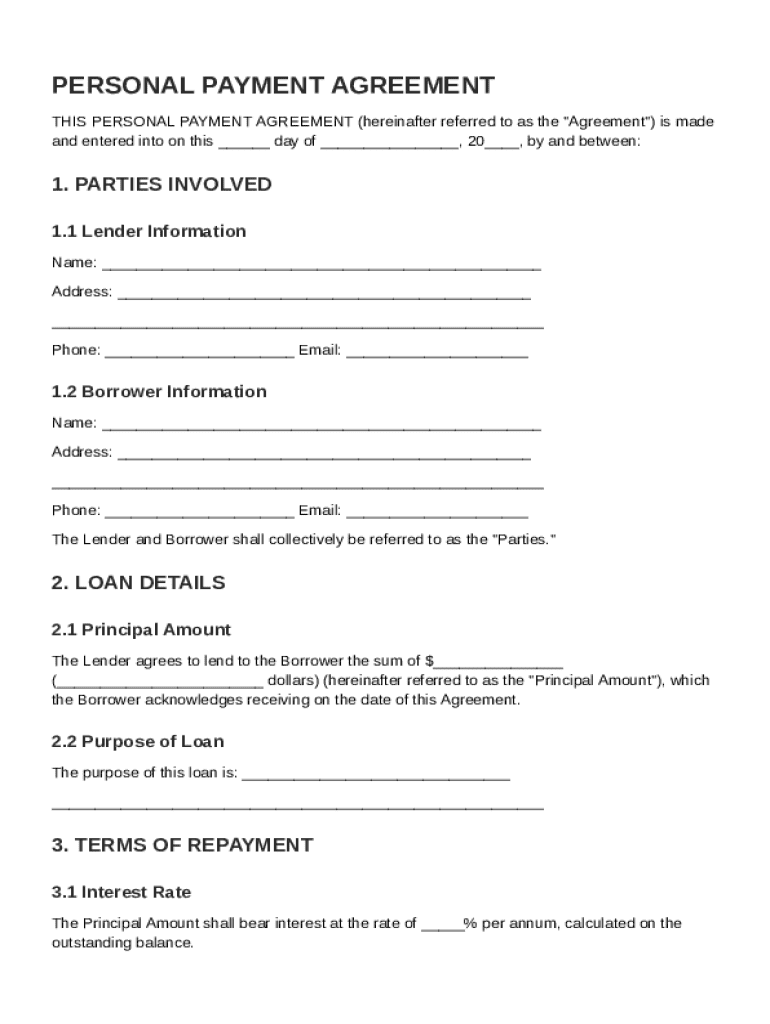







Definition and Meaning of Personal Payment Agreement Template
A Personal Payment Agreement Template is a formal contract between a lender and a borrower detailing the terms and conditions of a loan. This template outlines essential components such as the principal amount, interest rate, repayment schedule, default terms, governing law, and provisions for amendments. It ensures both parties understand their obligations, offering a structured way to document financial arrangements.
- Principal Amount: The loan's initial sum provided by the lender to the borrower.
- Interest Rate: The percentage charged on the principal amount, calculated annually.
- Repayment Schedule: Agreed-upon timeline for returning the borrowed funds.
- Default Terms: Conditions and consequences if the borrower fails to meet repayment obligations.
- Governing Law: Jurisdiction under which the agreement is interpreted.
By using this template, both parties have a clear understanding and record of financial responsibilities, reducing the risk of misunderstandings or disputes.
Key Elements of the Personal Payment Agreement Template
The Personal Payment Agreement Template consists of several key components that ensure a comprehensive record of the loan transaction. These elements are crucial for legal and operational clarity:
- Borrower and Lender Information: Full names, addresses, and contact information.
- Loan Amount and Purpose: Total funds provided and intended use.
- Payment Terms: Details about installment amounts, due dates, and interest calculation.
- Amendment Provisions: Guidelines for making changes to the agreement terms, if necessary.
These elements form the foundation of a well-structured agreement, helping both parties know exactly what is expected throughout the loan's duration.
Important Terms Related to Personal Payment Agreement Template
Understanding the terminology within the Personal Payment Agreement Template is critical for both lender and borrower. Here are some key terms that might appear:
- Collateral: An asset pledged by the borrower as security for the loan.
- Amortization: The process of spreading loan payments over time.
- Acceleration Clause: A provision allowing the lender to demand full repayment under specific conditions.
- Promissory Note: A written promise to pay a specified sum of money.
Having clarity on these terms ensures all parties are informed of their rights and obligations.
Legal Use of the Personal Payment Agreement Template
The Personal Payment Agreement Template is designed to be a legally binding document, provided it is filled out correctly and signed by both parties. To ensure its enforceability:
- Completeness: Ensure all sections of the template are filled with accurate information.
- Signature Verification: Both parties must sign the document, ideally with witness or notary.
- Date and Jurisdiction: Precise dating and acknowledgment of jurisdiction underpin the legal strength.
This document serves as a protection for both lender and borrower, offering a legal framework for resolving disputes.
Steps to Complete the Personal Payment Agreement Template
Filling out the Personal Payment Agreement Template requires attention to detail and accuracy. Follow these steps for a thorough completion:
- Gather Necessary Information: Personal details for both lender and borrower.
- Define Loan Terms: Clear statement of principal, interest rate, and repayment plan.
- Review for Accuracy: Double-check all entered data for correctness.
- Sign and Obtain Signatures: Both parties must sign, ensuring all conditions are agreed upon.
This careful approach to completion minimizes errors and ensures clarity.
Who Typically Uses the Personal Payment Agreement Template
The Personal Payment Agreement Template is versatile and can be used by various individuals or entities:
- Individuals: Personal loans between family or friends.
- Small Businesses: When securing a loan for operational expenses.
- Partnerships: Formalizing loans among partners or stakeholders.
- Private Lenders: Establishing terms with borrowers outside traditional banking systems.
The template's adaptability means it can accommodate a wide range of financial situations, aiding in transparent communication.


Examples of Using the Personal Payment Agreement Template
Practical scenarios demonstrate the utility of the Personal Payment Agreement Template:
- Family Loan: To avoid misunderstandings, parents may use the template to document a loan to their child for tuition.
- Business Loan: A small business owner uses the template to borrow from a private investor.
- Vehicle Purchase: A person borrows funds to buy a vehicle and uses the template to formally record the obligation.
These examples highlight the template's role in providing clarity and security in financial dealings.
State-Specific Rules for Personal Payment Agreement Template
In the United States, state-specific rules may influence how a Personal Payment Agreement Template is structured or enforced:
- Interest Rate Caps: Some states have maximum allowable interest rates.
- Usury Laws: Regulations prohibiting exorbitant interest rates.
- Required Disclosures: Mandatory information disclosures to the borrower.
Understanding these nuances ensures the template is compliant with local laws, maintaining its legal validity across jurisdictions.




