
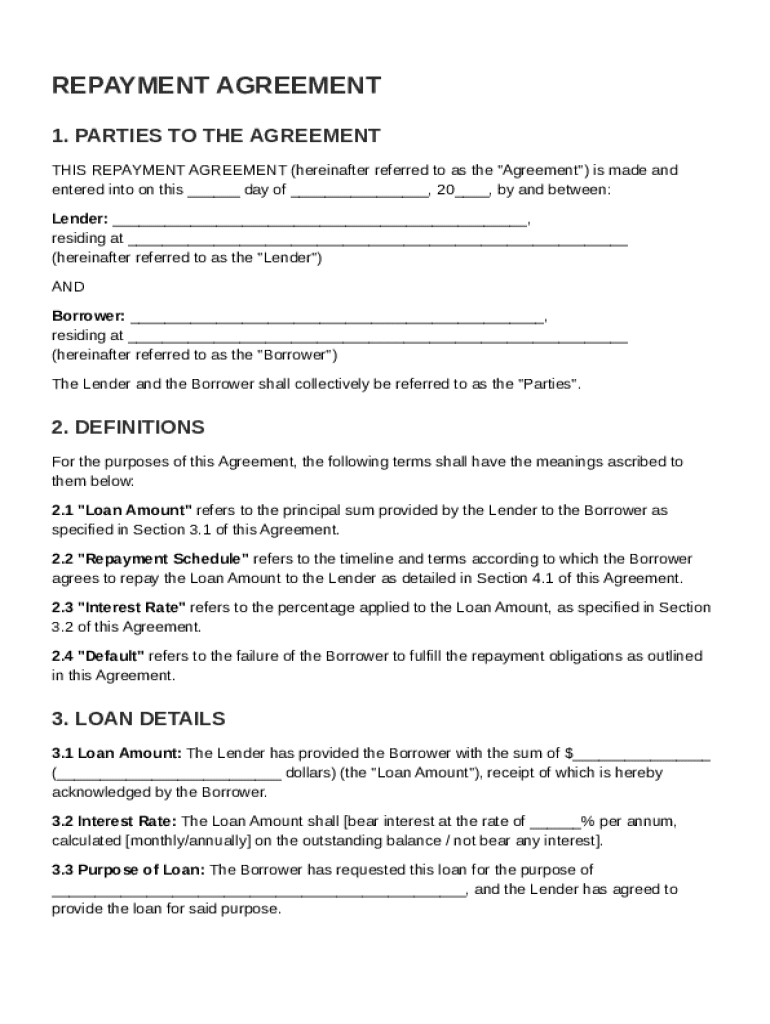







Definition and Purpose of a Repayment Agreement Template
A Repayment Agreement Template is a legally binding document designed to outline the terms and conditions under which a borrower repays a lender. This includes not only the principal loan amount but also the interest rate, repayment schedule, payment methods, and the consequences of defaulting on payments. A well-structured template serves as a comprehensive guide to ensure all parties understand their obligations. Using such a template can simplify the drafting process, ensuring that important details are not overlooked. This type of agreement is crucial for maintaining transparency and legal clarity between a lender and a borrower.
How to Use the Repayment Agreement Template
Using a Repayment Agreement Template involves customizing the document to fit the specifics of the loan arrangement. Both parties should review the template to ensure all sections accurately reflect their agreed-upon terms. Here's a step-by-step guide:
-
Download the Template: Obtain a professional template from a reputable online platform that can be edited digitally.
-
Input Loan Details: Fill in the specific loan amount, interest rate, and repayment terms. Make sure that these numbers are agreed upon and realistic.
-
Set the Repayment Schedule: Clearly outline how and when payments will be made. Specify whether payments are monthly, quarterly, or in another interval.
-
Define Payment Methods: Indicate the acceptable forms of payment (e.g., bank transfer, check).
-
Include Clauses for Default: Clearly state what constitutes a default and the actions that will be taken if default occurs.
-
Review and Sign: Both parties should thoroughly review the document before signing. It's advisable to have a legal expert ensure that the template meets all local legal requirements.
Key Elements of a Repayment Agreement Template
An effective Repayment Agreement Template must be comprehensive, covering several key elements:
- Loan Amount: The total amount borrowed by the borrower.
- Interest Rate: The rate at which interest will be applied to the outstanding principal.
- Repayment Schedule: Specific dates or intervals at which payments must be made.
- Payment Methods: The mode through which payments can be made.
- Default Terms: Clear penalties or actions if the borrower fails to meet payment obligations.
- Amendment Conditions: The process required to make changes to the agreement.
- Termination Clauses: Conditions under which the agreement may be terminated by either party.
Steps to Complete the Repayment Agreement Template
Successfully completing a Repayment Agreement Template involves careful attention to detail:
-
Gather Necessary Information: Before completing the template, ensure that you have all the needed information such as personal details of both parties, loan specifics, and repaying capacity.
-
Fill in Loan Details: Start by accurately entering the loan amount and interest rate.
-
Detail the Repayment Schedule: Specify deadlines for each payment and the total duration of the loan period.
-
Include Payment Method Details: Make sure to note acceptable payment methods for record-keeping.
-
Outline Default Actions: Clearly define what actions will be enforceable in case of a default.
-
Agree on Additional Terms: Include any other specific terms agreed upon by both parties.
-
Review and Execute: Make sure to conduct a final review before having each party sign the document.
Legal Use of the Repayment Agreement Template
A Repayment Agreement Template must comply with relevant laws and regulations. Consider these legal aspects:
- State Laws: Ensure the template includes terms that align with the state laws where the agreement is executed.
- ESIGN Act Compliance: If executed electronically, the agreement must adhere to electronic signing laws.
- Loan Regulations: Comply with any particular lending regulations, such as those governing interest rates or repayment practices.
Why Use a Repayment Agreement Template
Using a template offers significant advantages:
- Clarity and Structure: Provides an organized format to ensure all critical aspects are covered efficiently.
- Time-Saving: Reduces the time needed to draft an agreement from scratch.
- Customizability: Facilitates adjustments to specific terms to suit personal requirements.
- Legal Protection: Reduces the risk of legal disputes by clearly documenting all terms and conditions.
Examples of Using the Repayment Agreement Template
Various scenarios demonstrate the utility of a repayment agreement:
- Personal Loans: Friends or family lending money can use the template to maintain transparency.
- Business Financing: Companies borrowing from investors can document terms and clarify partnership expectations.
- Real Estate Transactions: Loans from private investors for property purchases can be documented using the template to protect both parties.
Important Terms Related to the Repayment Agreement Template
Understanding the terminology associated with a repayment agreement is crucial:
- Principal: The original sum of money borrowed.
- Accrued Interest: Interest calculated on both the initial principal and accumulated interest from previous periods.
- Collateral: An asset pledged as security for loan repayment.
- Deferment: An agreement to delay payments temporarily without penalty.
- Acceleration Clause: A provision allowing the lender to demand full repayment if certain conditions are not met.




