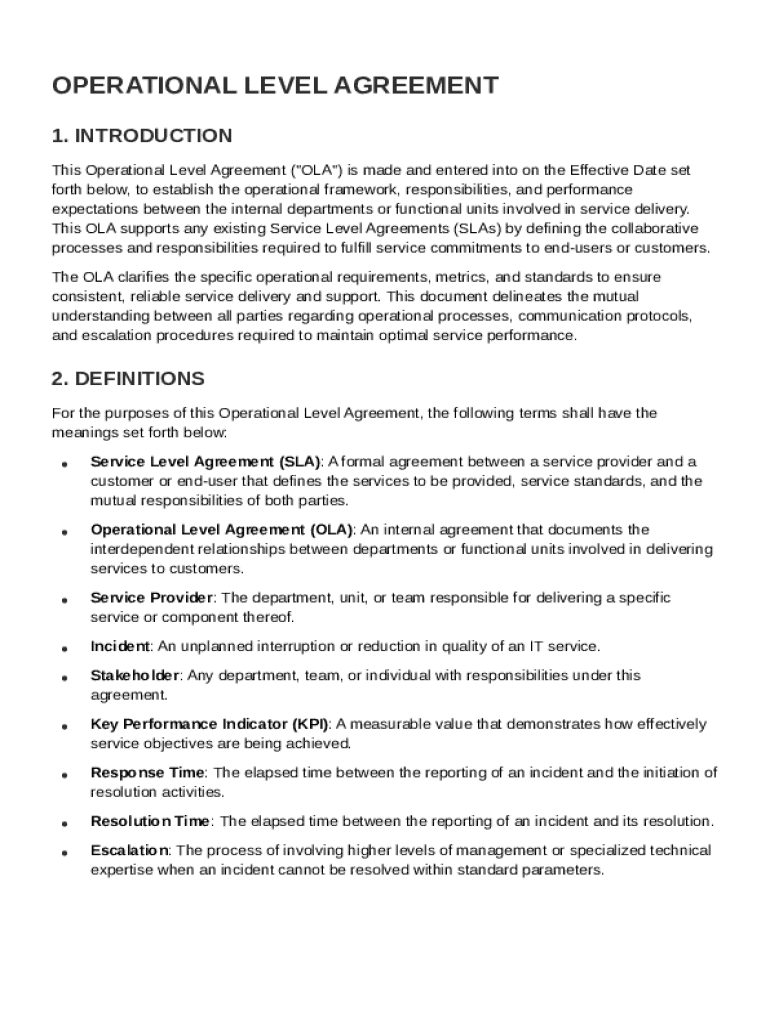







Definition & Purpose of the Operational Level Agreement Template
The Operational Level Agreement (OLA) Template is a crucial document that establishes a framework for collaboration among internal departments involved in service delivery. It supports existing Service Level Agreements (SLAs) by defining operational requirements, performance metrics, and standards necessary to ensure reliable service. Its purpose is to outline responsibilities, set expectations, and facilitate communication among different teams within an organization.
The OLA Template includes core sections such as service descriptions, performance metrics, and roles and responsibilities. It also addresses incident management procedures and compliance requirements. This structured format helps in maintaining coherence and clarity, ensuring that all involved parties have a mutual understanding of the service delivery objectives.
Importance of Communication Protocols
An essential aspect of the OLA is the establishment of clear communication protocols. This includes specifying methods of communication, frequency, and the designated points of contact. Effective communication ensures that information is accurately exchanged, queries are promptly addressed, and any potential misunderstandings are minimized. Well-defined protocols support the escalation processes needed to maintain optimal service performance.
How to Use the Operational Level Agreement Template
Using the OLA template is imperative for organizations seeking to streamline their internal operations. Here are the steps to effectively utilize this template:
-
Identify Departments Involved: Recognize the departments or teams that will be part of the agreement. This might include IT services, customer support, and service management teams.
-
Define Services and Expectations: Clearly articulate the services provided by each department and set performance expectations. Include service descriptions, objectives, and deliverables.
-
Assign Roles and Responsibilities: Each department must have specific roles and responsibilities detailed in the agreement. This aids in accountability and clarifies who handles what tasks.
-
Set Performance Metrics: Establish key performance indicators (KPIs) to measure the success of the service delivery. Examples include response times, issue resolution times, and user satisfaction rates.
-
Outline Incident Management Procedures: Document how incidents will be managed, including steps for incident detection, reporting, resolution, and closure.
Steps to Complete the Operational Level Agreement Template
Completing the OLA template requires a systematic approach to ensure all necessary elements are thoroughly addressed:
-
Gather Initial Information: Begin by collecting all relevant data about the current service processes and any existing performance data.
-
Draft Initial Document: Use the template to draft the initial document, incorporating all service details, metrics, and roles defined earlier.
-
Involve Stakeholders: Communicate with all stakeholders to review the draft. Their feedback is vital to ensure accuracy and operability.
-
Adjust and Finalize: Edit the document based on stakeholder input. It must be comprehensive and accommodate practical considerations.
-
Approve and Distribute: Once finalized, the OLA must be approved by all relevant parties and shared with all involved departments.
-
Review Regularly: Regular reviews are necessary to ensure it continues to meet operational needs effectively.
Key Elements of the Operational Level Agreement Template
The template consists of several critical elements that are essential for operational success:
-
Service Description: What service is provided and its significance.
-
Roles and Responsibilities: Clearly defined roles for each department and member.
-
Performance Metrics: KPIs and success criteria specific to the services offered.
-
Incident Management Procedures: Steps and protocols for managing incidents.
-
Compliance Requirements: Legal and corporate standards the agreement must meet.
Who Typically Uses the Operational Level Agreement Template
The OLA template is commonly used by various departments within an organization, particularly those involved in service provision and support:
-
IT Departments: To manage software, hardware, and network services.
-
Customer Support Teams: For maintaining customer satisfaction through effective service delivery.
-
Service Management Teams: To oversee and ensure the seamless operation of services across different departments.
These departments use the OLA to ensure they meet internal service commitments and manage resources efficiently.


Legal Use of the Operational Level Agreement Template
The OLA is not just an operational tool but also has legal significance. It must comply with relevant regulations and standards to be legally enforceable. This includes adhering to any industry-specific regulations that may apply. The agreement acts as a reference in case of disputes, and clear documentation facilitates resolution.
Compliance Requirements
- Ensure the OLA adheres to corporate governance standards.
- Meet any industry-specific regulatory requirements, such as data protection laws.
Examples of Using the Operational Level Agreement Template
Consider the following scenarios to understand the application of OLAs:
-
IT Support Services: An IT department uses an OLA to outline expectations and procedures for responding to technical issues within 30 minutes and resolving them in four hours.
-
Customer Service Teams: A customer service team employs an OLA to detail how customer queries should be addressed within 24 hours to enhance customer satisfaction.
In both examples, OLAs ensure that service delivery is consistent and aligned with the organization's overall goals.
Variations and Alternatives to the Operational Level Agreement Template
While the OLA is a comprehensive tool, variations may exist depending on organizational needs:
-
Standard Operating Procedures (SOPs): Used for detailing specific procedures not fully covered in the OLA.
-
Internal Service Agreements: Similar to OLAs but may focus more on micro-goals within smaller units.
Ultimately, the choice between these alternatives depends on the specific requirements of the department or service in question.
Software Compatibility & Integration
The OLA template should be compatible with all standard document editing and management software for ease of use and integration across various platforms. Many organizations leverage collaborative tools like Google Workspace to edit and share these documents seamlessly.
Considerations
- Ensure the document can be accessed and edited by all stakeholders involved in the agreement.
- Incorporate any specific software requirements necessary to facilitate operational processes.
By structuring the OLA document effectively, organizations can enhance operational efficiency and service quality.